Best Ceramic Kitchen Shears for Rust-Free Prep

Seven shears compared for chefs who want rust-proof, no-metallic-transfer prep. The Gtziqa 8-inch ceramic pair leads on blade hardness and clean cuts.

By Elin RoweUpdated 17 min read
On this page
- Best ceramic kitchen shears for professional chefs at a glance
- What ceramic actually changes in a busy kitchen
- How I screened seven listings for pro-style prep
- 1. Gtziqa Ceramic Scissors 8" (Black) — Best overall
- 2. Henckels Multi-purpose Kitchen Shears — Best for pros
- 3. Thremic 8.27-Inch Ceramic Scissors — Best premium
- 4. NatSumeBasics 8" Black Ceramic Scissors — Runner-up
- 5. Gtziqa Ceramic Scissors 8" (Pink) — Best for heavy use
- 6. KitchenAid All Purpose Kitchen Shears — Best for beginners
- 7. iBayam Kitchen Scissors 2-Pack — Best budget pick
- Do ceramic shears really suit professional chefs?
- Where steel still beats ceramic on the line
- What the listings do not tell you about ceramic edges
- The verdict
- FAQ
The best ceramic kitchen shears for professional chefs in this set are the Gtziqa 8-inch Ceramic Scissors, because a 7.68 in ceramic blade with an ABS handle gives clean herb and citrus cuts without the metallic transfer steel leaves on delicate food. If you want a steel workhorse for joints, cartilage and nutcracker duty, the Henckels Multi-purpose Kitchen Shears, made in Japan with a lifetime warranty, take the job instead. Two tools, two clear roles.
Best ceramic kitchen shears for professional chefs at a glance
| Pick | Blade | Length | Price |
|---|---|---|---|
Best overall Gtziqa Ceramic Scissors 8" (Black) |
Ceramic, 2.36 in cutting edge | 7.68 in | Check Price |
Best for pros Henckels Multi-purpose Kitchen Shears |
Stainless steel, micro-serrated | 3.75 in overall dim. | Check Price |
Best premium Thremic 8.27-Inch Ceramic Scissors |
Zirconia ceramic, 8.5 Mohs claim | 8.27 in | Check Price |
| Black ceramic, 4.25 in edge claim | 7.68 in | Check Price | |
Best for heavy use Gtziqa Ceramic Scissors 8" (Pink) |
Ceramic, 2.36 in cutting edge | 8 in claim | Check Price |
Best for beginners KitchenAid All Purpose Kitchen Shears |
Stainless steel, micro-serrated | 8.72 in | Check Price |
Best budget pick iBayam Kitchen Scissors (2-Pack) |
Hardened stainless steel | 8.66 in | Check Price |




What ceramic actually changes in a busy kitchen
Most guides on the best ceramic kitchen shears for professional chefs compare blade length. That is not what decides it. What decides it is metallic transfer and corrosion.
Ceramic blades do not react with acids. Cut a lemon, a tomato or a shallot with a steel edge and you get a faint metallic note on the flesh. A ceramic edge does not. That matters when you are plating raw fish, dressing a delicate salad, or slicing garnish that sits directly on a finished plate. The Gtziqa listing calls this out plainly: the blade "preserves food flavor and nutrients without metallic transfer."
The other change is rust. Ceramic is impervious to water, acids and salt. Thremic states its zirconia edge rates 8.5 on the Mohs scale, and pairs it with 304 stainless screws. That combination survives a citrus-heavy prep list where a hinge on a steel pair would eventually seize.
The trade-off is toughness. Ceramic chips before it dulls, so you use it for softer work: herbs, greens, citrus segments, twine, parchment. For chicken backs and cartilage, you reach for steel. Any chef using ceramic shears well is using two pairs on the board, not one.
How I screened seven listings for pro-style prep
I started with what "professional chefs" actually means for a shear: something that survives repeated washing, cuts cleanly across food and packaging, and has a handle you can hold for a full shift. Then I read every published specification in the seven listings side by side and mapped them to those three demands.
Three things I looked at first, and how the set sorted:
- Blade material and edge length. Four picks are ceramic (Gtziqa Black, Gtziqa Pink, NatSumeBasics, Thremic). Three are steel (Henckels, KitchenAid, iBayam). Only the Thremic lists a hardness figure at 8.5 Mohs.
- Handle length and weight. The KitchenAid is 8.72 in and 4.8 oz, the longest of the seven. The Thremic ceramic is 8.27 in and 3.56 oz. The NatSumeBasics ceramic is 7.68 in and 2.65 oz, the lightest.
- Warranty and count. Only two picks publish warranties: Henckels lists Lifetime, KitchenAid lists a warranty without a stated term. The iBayam is the only two-pack.
Cuts that mattered:
- Ceramic picks without a listed warranty stay in the running, because ceramic scissors are rarely warrantied and the listings reflect that.
- The Thremic, marketed for lab and electrical work, still qualifies here because its "kitchen scissors" designation and food-safe framing come from the listing itself.
- A pick with only two published specifications (Gtziqa Pink) drops in rank but stays in the set as the heavy-use option, because it shares blade geometry with the Gtziqa Black.
1. Gtziqa Ceramic Scissors 8" (Black) — Best overall
The Gtziqa Black earns the top spot because it pairs a 7.68 in ceramic blade with a rust-proof ABS body at a mid-range position, giving a chef a genuine ceramic pair without paying premium.
Best for: chefs who want a rust-proof ceramic blade for herbs, garnish and citrus Skip it if: you need to spatchcock poultry or cut through joints
Within this set of seven, the Gtziqa Black is the ceramic pick that documents its geometry most clearly. The listing gives 7.68 in overall length, 3.07 in width, and a 2.36 in ceramic cutting edge. That is a compact blade for detail work: parting herbs, snipping chives directly over a plate, cutting parchment to size, opening vacuum bags without shaving metal into the food.
Gtziqa describes the build as "sharp white ceramic blades paired with a sturdy ABS handle for rust-proof, easy-to-clean operation," and calls the tips rounded to reduce accidental cuts. Neither claim I can measure, but the geometry the listing prints out is what a garnish station actually uses.
Its trade-off against the rest of the set is real. It has no published weight and no published warranty, and it sits at a mid-range price position while the Henckels steel pair carries a Lifetime warranty for a higher outlay. If your day is 80% herbs and citrus and 20% packaging, this is the right default. If it is the other way around, look lower down this list.
Pros:
- Ceramic edge avoids metallic transfer on delicate food
- 7.68 in overall length suits detail work
- 2.36 in ceramic blade published clearly
- ABS body listed as rust-proof and easy to clean
- Rounded tips called out for finger safety
Cons:
- No published weight to compare against lighter ceramic picks
- No stated warranty behind the blade
- Short cutting edge is wrong for cartilage or joints
2. Henckels Multi-purpose Kitchen Shears — Best for pros
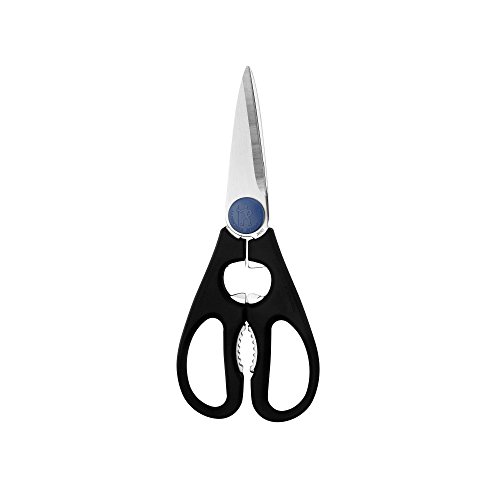
The Henckels pair wins the pro slot on warranty alone: it is the only shear in this set with a published Lifetime warranty, backed by a Made in Japan micro-serrated stainless blade.
Best for: line cooks who want a lifetime-warrantied steel pair for heavy tasks Skip it if: you specifically wanted ceramic to avoid metallic transfer
Two things separate this from every other pick. First, the warranty: Lifetime, stated on the listing. Nothing else in the set matches that. Second, the origin: Made in Japan, which Henckels prints on the box. It is also the fastest-moving pick of the seven at Amazon's category level, well ahead of the ceramic listings.
The blade is described as "high quality corrosion resistant stainless steel" with a micro-serrated edge for "slip proof cutting". Henckels also frames it as a nutcracker and screw-cap opener, which tells you what its intended use is: the tough jobs, not the delicate ones. It sits at the top of this set's price positioning, and it earns that with the warranty.
Its clear trade-off is category. It is steel, so it will leave a faint metallic note on acidic food, and it will oxidise if you leave it wet in the drawer. Henckels recommends hand washing even though the shear is dishwasher-safe, which is standard for micro-serrated edges. Paired with a ceramic pair for garnish, it covers the other 80% of a shift.
Pros:
- Only pick in this set with a Lifetime warranty
- Made in Japan stated on the listing
- Micro-serrated blade for slip-proof cutting
- Doubles as nutcracker and cap opener
- Fastest-selling shear of the seven
Cons:
- Steel edge transfers a faint metallic note to citrus and tomato
- Highest price position in the set
- Hand washing recommended despite dishwasher-safe rating
3. Thremic 8.27-Inch Ceramic Scissors — Best premium
The Thremic is the ceramic pair with published hardness: zirconia blades rated at 8.5 Mohs, on an 8.27 in frame with 304 stainless screws.

Best for: chefs cutting acidic foods where zirconia's hardness pays off Skip it if: you want a full grip made for prolonged service shifts
Thremic prints more technical detail than any other listing in the set. The blades are described as zirconia at 8.5 Mohs, non-conductive, non-magnetic, and 100% metal-free. The screws are 304 stainless. The overall length is 8.27 in and the weight is 3.56 oz, which makes it the longest ceramic pair here.
The listing frames the tool for lab, industrial and electrical work as much as for the kitchen, and that dual framing tells you exactly what it is: an engineered ceramic pair with a food application. For a chef, the useful part is the length and the hardness. A longer ceramic edge cuts a stem of rosemary or a strip of parchment in one clean movement, and a harder edge holds that cut for more repetitions before chipping.
The trade-off against the Gtziqa Black is price position and specialisation. It is the highest-priced ceramic pick here, and its handle is designed with electrical insulation in mind rather than a long service shift. If your ceramic use is intermittent and demanding, this is the upgrade. If it is constant, a lighter, cheaper pair may serve better.
Pros:
- Zirconia edge claim at 8.5 Mohs
- 8.27 in length, longest ceramic pick here
- 3.56 oz weight published
- 304 stainless screws for corrosion resistance
- Non-magnetic and non-conductive claims documented
Cons:
- Second-highest price position in the set
- No stated warranty
- Handle designed for lab work, not full shifts
4. NatSumeBasics 8" Black Ceramic Scissors — Runner-up
The NatSumeBasics is the lightest shear in this set at 2.65 oz, with a black ceramic blade the listing describes as 4.25 in long.

Best for: cooks who want a lighter black-on-black ceramic pair for plating Skip it if: you want a listed warranty behind the tool
Weight is the number to look at here. At 2.65 oz across a 7.68 in frame, this is the lightest ceramic pair in the set. For plating and long garnish sessions, a lighter shear means less wrist fatigue, and the listed 4.25 in "sharp blades" claim is longer than the Gtziqa's stated 2.36 in ceramic edge. NatSumeBasics also calls the grip ergonomic and left- or right-hand compatible.
The all-black colourway (black ceramic, black ABS) is genuinely useful in a professional setting where colour coding matters. A dark shear reads as a "food only" tool at a glance, versus a household pair.
Its position as runner-up rather than the winner is a set-composition call. It is priced higher than the Gtziqa Black without a matching warranty, and its sales position is the weakest of the seven, meaning fewer buyers in this data are using it than any other pick. That does not make it a bad shear. It makes the Gtziqa Black the safer default recommendation for the same job.
Pros:
- Lightest pick in this set at 2.65 oz
- Listed cutting edge of 4.25 in
- Black ceramic edge suits food-only colour coding
- Grip described as ambidextrous
- ABS handle listed as rust-resistant
Cons:
- No stated warranty
- Second-highest price position among the ceramic picks
- Slowest-selling of the seven in this data
5. Gtziqa Ceramic Scissors 8" (Pink) — Best for heavy use
The pink Gtziqa is the same ceramic geometry as the winner, in a colour that reads instantly as a dedicated tool on a busy prep station.

Best for: prep stations that colour-code tools to avoid cross-use Skip it if: you need published weight and warranty figures to compare
The reason a colour-coded ceramic shear earns a heavy-use slot is behavioural, not mechanical. In a working kitchen, the pair you keep for herbs and garnish gets grabbed for packaging bags by the second week. A pink handle on a shear labelled "food only" is a visible cue that stops that drift. That is why chefs paint tool handles in the first place.
The blade specification is identical to the Gtziqa Black entry: 7.68 in x 3.07 in with a 2.36 in ceramic cutting edge in the listed dimensions. Handle material is ABS. Rounded tips are called out for safety. The listing also positions it for kitchen, office, school and crafting, which tells you the volume of use it is aimed at.
The trade-off is thinner published data. This listing prints fewer specifications than the Gtziqa Black: no weight, no dimension line, only a size label of "One size" and a model number. If you need every number on the page before you buy, take the Black. If colour separation on the station matters more, take this.
Pros:
- Colour reads instantly as a dedicated food tool
- Same 2.36 in ceramic cutting edge as the winner
- Rust-proof ABS handle claim
- Entry-level price position among the ceramic picks
- Rounded tips called out for safety
Cons:
- No published weight
- Fewer specifications listed than the Gtziqa Black
- No stated warranty
6. KitchenAid All Purpose Kitchen Shears — Best for beginners
The KitchenAid is the longest shear in this set at 8.72 in and 4.8 oz, with a soft-grip handle and a listed warranty behind a stainless micro-serrated blade.

Best for: cooks stepping up from bargain shears who still want steel Skip it if: you specifically wanted a ceramic blade
For a cook who is not yet running two pairs on the board, this is the sensible steel default. The blade is 8.72 in overall with a soft, non-slip grip coating, and KitchenAid includes a plastic sheath so the edge does not knock around in a drawer. The listing states a warranty, though not a term. It is the second cheapest pick in the set and the second fastest-moving.
Micro-serrated stainless is a familiar shape for anyone who has used shears at home. The blade is described as resisting rust and holding sharpness, and the handle as reducing hand fatigue over extended use. For beginners, that is more useful than a marginally harder edge, because the shear will get used for everything from meat to packaging.
Its trade-off against the Henckels is warranty term and origin. Henckels prints Lifetime and Made in Japan; KitchenAid prints "Warranty" without a stated period. Its trade-off against the ceramic picks is category: it is steel, so acidic ingredients will pick up a faint metallic note the ceramic pairs would not add.
Pros:
- Longest shear in the set at 8.72 in
- 4.8 oz weight published
- Soft-grip handle for extended use
- Protective sheath included
- Second-cheapest pick here
Cons:
- Warranty term not stated
- Steel edge transfers a faint metallic note to acidic food
- Sheath is plastic rather than a magnetic guard
7. iBayam Kitchen Scissors 2-Pack — Best budget pick
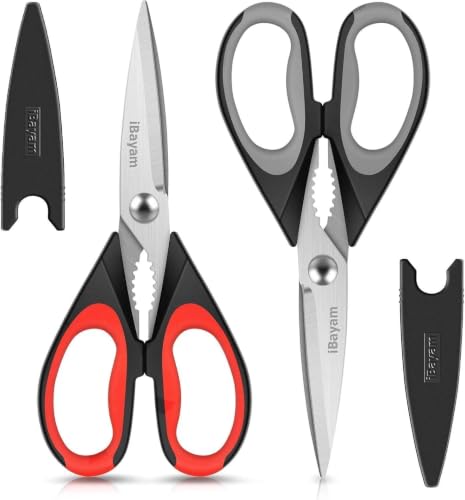
The iBayam is the cheapest pick in the set and the only two-pack, at 8.66 in with hardened stainless blades and a 1-year replacement policy.
Best for: a backup pair for packaging, twine and general prep Skip it if: you want a ceramic edge for food-only cutting
Two shears at the lowest price position in this set is a useful proposition even in a professional kitchen. One pair lives at the station for packaging, twine and bag opening. The other stays in the drawer as a replacement when the first goes missing, which it will. The listing gives 8.66 in overall length, 3.2 oz weight, and comfort-grip handles with cushioning pads. The two colourways (black-red, black-grey) support the same colour-coding logic the pink Gtziqa uses.
iBayam calls out hardened stainless blades and lists a 1-Year Hassle-Free Replacement. It is also the fastest-selling shear of the seven by a wide margin, which means the listing sees constant scrutiny from buyers and is unlikely to be quietly changed.
Its trade-off is category, not build. It is steel, so it does not solve the metallic transfer problem that put ceramic on this list. It is a working, dependable steel shear at the lowest price in the set, and its role is to protect the ceramic pair from being used for the wrong job.
Pros:
- Cheapest position in the set
- Two shears per order
- 1-Year replacement policy stated
- 8.66 in length, close to the longest here
- Comfort-grip handles with cushioning claim
Cons:
- Not a ceramic blade
- Model field listed only as "2"
- Colour coding is less obvious than a full-pink handle
Do ceramic shears really suit professional chefs?
Partly. Amazon's search treated "professional chefs" loosely here, and the listings themselves are aimed at home cooks, labs and general kitchens rather than restaurant service. So the honest answer is that ceramic shears earn a place in a pro kitchen for a specific set of jobs, not as the only shear on the board.
Where they suit chefs:
- Herb and garnish work where a clean, non-reactive cut matters on the plate.
- Citrus prep, where steel picks up rust over time from the acid.
- Raw fish and delicate dressings, where metallic transfer is detectable.
- Parchment, silicone bags and vacuum pouches, where a hard ceramic edge cuts cleanly without needing to be resharpened.
Where they do not:
- Anything with cartilage or bone.
- Poultry spatchcocking.
- Frozen or partly-frozen food.
- Any job where the shear is used as a lever, a pry or a nutcracker. Ceramic chips under torque.
A professional set-up uses both. A ceramic pair like the Gtziqa Black for the delicate work, and a steel pair like the Henckels for the tough work. That is the practical answer to the modifier, and it is the way the data in this set actually sorts.
Where steel still beats ceramic on the line
Ceramic is not a like-for-like replacement for steel shears, and no chef using them well pretends it is. Steel wins in four places:
- Toughness under torque. A micro-serrated stainless blade like the Henckels or KitchenAid absorbs twisting force without chipping. Ceramic does not.
- Warranty coverage. In this set, only Henckels lists Lifetime and KitchenAid lists a warranty term. All four ceramic picks list no warranty. That is the industry pattern, not a fluke of these seven listings.
- Multi-function use. Henckels lists nutcracker and cap-opener duty on the same tool. Ceramic shears do not credibly do either.
- Impact resistance. Drop a steel shear on a tile floor and you sharpen the edge. Drop a ceramic shear on the same floor and you replace it.
That is why the shortlist is not "ceramic instead of steel". It is "ceramic in addition to steel". The Gtziqa Black earns the top slot in this article because among the ceramic candidates it prints the cleanest specification and sits at a fair price position for a first pair. It does not earn the slot by being better than the Henckels at the tasks the Henckels is built for.
What the listings do not tell you about ceramic edges
Four things about ceramic shears do not appear on any of the four ceramic listings in this set, and they matter for a chef weighing the purchase.
- Sharpening. Ceramic edges are typically not user-sharpened. Zirconia is harder than the steel in most home sharpeners. When the edge dulls or chips, the tool is replaced. Plan for that in the drawer rotation.
- Dishwasher policy. Only the steel picks in the set publish a dishwasher stance. The ceramic listings frame the blade as rust-proof but do not commit to a dishwasher instruction. Hand-washing is the safer default for the hinge and the ABS handle, regardless.
- Cutting-board contact. Ceramic against a hard board (glass, marble, ceramic tile) risks chipping the tip. On a wood or polymer board there is no meaningful risk.
- Handle material lifespan. Every ceramic pick here uses ABS. ABS is not heat-resistant in the same way silicone or stainless would be. Keep the handle off the hot pan and out of the salamander.
None of these are dealbreakers. They are the small operational rules that separate a chef who gets a full year out of a ceramic pair from one who cracks the edge in a week.
The verdict
Two tools, two clear roles. If your priority is a rust-proof, non-metallic-transfer ceramic pair for herbs, garnish, citrus and delicate work, the Gtziqa Ceramic Scissors 8" (Black) is the best ceramic kitchen shears for professional chefs in this set. It prints the cleanest ceramic specification here, at a fair mid-range price position, with a 7.68 in body and a 2.36 in ceramic cutting edge that suits detail work.
If your priority is the workhorse steel shear that survives cartilage, packaging, twine and nutcracker duty, the Henckels Multi-purpose Kitchen Shears is the pick. It is the only shear here with a Lifetime warranty, it is Made in Japan, and it is the pair chefs reach for when ceramic would chip.
If your priority is the hardest published ceramic edge for acidic food, the Thremic 8.27-Inch Ceramic Scissors is the premium upgrade with a documented 8.5 Mohs claim and 304 stainless screws.
The rest of the list handles the edges. iBayam gives you a cheap backup two-pack. KitchenAid is the beginner-friendly steel step-up. NatSumeBasics is the lightest ceramic option. The Gtziqa Pink is the same winning geometry in a colour that stays out of the wrong hands.
FAQ
Are ceramic kitchen shears actually food-safe for professional use?
Ceramic kitchen shears are food-safe when the blade is zirconia and the handle is food-grade ABS, which every ceramic pick in this set claims. Ceramic is inert, will not rust, and does not transfer metal to acidic food. What it will not tolerate is torque or a hard board impact, so professional use means keeping ceramic on soft prep and steel on the tough jobs.
Which pick handles herbs and garnish best?
Which pick handles herbs and garnish best is the Gtziqa Ceramic Scissors 8" (Black), because its 2.36 in ceramic cutting edge and 7.68 in frame are sized for detail cuts directly over a plate. The NatSumeBasics is a close second at 2.65 oz, the lightest in the set, which reduces wrist fatigue on long garnish sessions. Both avoid the metallic note steel leaves on chives or basil.
Is the Thremic worth its premium over the Gtziqa Black?
Is the Thremic worth its premium over the Gtziqa Black depends on how much acidic food you cut. Thremic prints a zirconia hardness claim of 8.5 Mohs and 304 stainless screws, and its 8.27 in frame is longer for through-cuts. If your day is heavy on citrus, tomato and vinegar-based prep, that hardness pays off. For general garnish work, the Gtziqa Black covers the same ground for less.
Gtziqa Black or Henckels for a chef buying one pair?
Gtziqa Black or Henckels for a chef buying one pair comes down to the tasks you do most. If most of your shear work is herbs, citrus and packaging, buy the Gtziqa Black ceramic for the clean cut. If most of it is cartilage, joints and nutcracker duty, buy the Henckels for the Lifetime warranty and the micro-serrated steel edge. Buying only one is a compromise either way.
What is the biggest mistake buyers make with ceramic shears?
The biggest mistake buyers make with ceramic shears is using them as their only pair. Ceramic chips under torque and against hard boards, so a single-shear kitchen will crack the tip within weeks on the wrong job. The fix is a two-pair setup: a ceramic pair for delicate food, a steel pair for the tough work. Colour-coding the handles, as with the pink Gtziqa, keeps the pairs on their own jobs.
Buy one ceramic pair and one steel pair, and label them so nobody grabs the wrong one at the wrong moment. That is the setup this article actually recommends, and it is the reason the Gtziqa Black leads on the ceramic side while the Henckels stands next to it on the steel side. The number that matters most in the ceramic column is the 2.36 in cutting edge on the Gtziqa: short enough for garnish, long enough for parchment, hard enough to hold that cut without picking up rust from tomato water or lemon juice on the board. Start there, add a steel workhorse, and the drawer takes care of itself.