Best Compact Manual Coffee Grinder for Travel

Six pocket-sized hand grinders, judged on burr material, click count and chamber size. One winner, three runners-up, and the trade-offs each one makes.

By Elin RoweUpdated 16 min read
On this page
- Best compact manual coffee grinder at a glance
- How I narrowed the field to six
- 1. CEVING MCG-01 — Best overall
- 2. ALPACA VENTURES AV 1 — Best premium
- 3. JavaPresse Manual Coffee Grinder — Best warranty
- 4. HZBSGZR KFXMJ-001 — Best for families
- 5. Rsoilch HS-011 — Most versatile
- 6. Matrjestice 013-XPZ — Best budget pick
- Ceramic or steel burr: which suits you?
- How many clicks do you actually need?
- What the listings do not tell you
- Compact does not always mean travel-ready
- The verdict
- FAQ
The best compact manual coffee grinder is the CEVING MCG-01, a 0.84 lb ceramic-burr mill with 40 external click settings and a 30g bean chamber that fits a 6.7 x 7.4 x 2.3 in footprint. If you brew espresso and want a steel burr with 45 clicks, the ALPACA VENTURES AV 1 is the better spend. Most shoppers overweight capacity here. What actually decides a compact manual grinder is burr material, click count and how repeatable those clicks feel under load.
Best compact manual coffee grinder at a glance
| Pick | Burr & clicks | Capacity & weight | Price |
|---|---|---|---|
Best overall CEVING MCG-01 |
Ceramic conical 40 external clicks |
30g 0.84 lb |
Check Price |
Best premium ALPACA VENTURES AV 1 |
420 stainless conical 45 clicks |
1 oz claim 1 lb |
Check Price |
Best warranty JavaPresse Manual |
Ceramic conical 18 settings |
Not listed 0.59 lb |
Check Price |
Best for families HZBSGZR KFXMJ-001 |
Ceramic conical 40 clicks |
30g 0.72 lb |
Check Price |
Most versatile Rsoilch HS-011 |
Ceramic conical 40 clicks |
25g Not listed |
Check Price |
Best budget pick Matrjestice 013-XPZ |
Ceramic conical 35 settings |
40g 0.6 lb |
Check Price |


How I narrowed the field to six
I lined up the published specifications for every compact manual grinder in the set and screened on four things: burr type, click count, dose capacity, and the physical footprint. Anything without a stated burr material was cut before I started. What survived is a set of six hand mills that all share a conical burr, all fit inside a jacket pocket, and all sit in the entry-to-premium range for the category.
The cuts were harder than the picks. Grinders that listed only "adjustable settings" without a number of clicks were dropped, because a stepless-sounding dial with no repeatable stops is the single biggest failure mode in a travel mill. Anything over 1 lb was cut too, since the point of a compact manual coffee grinder is that it goes with you.
What was left divided cleanly. Five ceramic-burr mills sit in a tight cluster around 30g of capacity and 40 clicks. One steel-burr outlier, the ALPACA VENTURES AV 1, pushes the click count to 45 and the price position to the top of this set. That single split defines the whole roundup.
1. CEVING MCG-01 — Best overall
A ceramic-burr, 40-click hand mill that hits the sweet spot for capacity, footprint and click resolution in this set.
Best for: a daily driver at home that still slips into a weekender bag Skip it if: you want a steel burr or a stated warranty
The MCG-01 wins the best compact manual coffee grinder slot because it does not force a trade-off the way the others do. At 0.84 lb and 6.7 x 7.4 x 2.3 in, it is not the smallest here, but it carries a 30g bean chamber and a 40-click external dial in one body. CEVING says the adjustment is external rather than internal, which matters: you can shift from espresso to French press without disassembly. The listing pairs that with a conical ceramic burr, which CEVING says runs cooler than steel or blade grinders and holds a more uniform grind.
Two things hold it back. There is no published warranty, unlike the JavaPresse, and the offer count sits at two rather than the single seller most of the set carries, which suggests the listing is newer. Against the ALPACA VENTURES premium pick, it gives up the steel burr and five clicks of dial resolution. Against every ceramic-burr rival here, it keeps more capacity, more clicks, or both. That is why it leads.
Pros:
- 40 external clicks without disassembly
- 30g bean chamber matches the top of the ceramic set
- Ceramic conical burr, cooler than blade grinders per the listing
- Three-part detachable body for cleaning
- Sells faster than the rest of this set
Cons:
- No stated warranty
- Steel-burr rivals hold their edge longer
- Heavier than the JavaPresse and Matrjestice
- Only two sellers list it
2. ALPACA VENTURES AV 1 — Best premium
The only steel-burr grinder in this set, with 45 audible clicks and a documented dial map from cezve to cold brew.

Best for: espresso obsessives who want repeatable clicks and a steel burr Skip it if: you begrudge paying the top of this set for 1 oz per fill
The AV 1 is the most expensive pick here, and it is also the only one that names its burr steel: 420 stainless, hardened to 57 HRC, running in a 430 stainless bearing housing per ALPACA VENTURES. Steel burrs hold their edge longer than ceramic, and the dial gives 45 clicks with a published map: 5 to 10 for cezve, 11 to 15 for espresso, 16 to 20 for siphon, 21 to 30 for French press, 31 to 45 for cold brew. That is the sort of documentation the rest of the set does not attempt.
The catch is capacity. ALPACA VENTURES says one fill is 1 oz, roughly two single espressos, and at 1 lb the body is the heaviest of the six. If you brew four cups of French press each morning, you will grind twice. The dial only clicks audibly when you hold the crank still, which the listing notes. There is no stated warranty, and the sales position is the slowest of the six. This is a niche pick with real strengths, not the default.
Pros:
- 420 stainless burr hardened to 57 HRC per the listing
- 45 clicks with a documented grind map
- Aluminium alloy body, 1.9 in across
- Dual bearing mechanism keeps the shaft centred
- Audible clicks for repeatable settings
Cons:
- The most expensive pick here
- Only 1 oz per fill by ALPACA VENTURES's own count
- Heaviest in the set at 1 lb
- No published warranty
- The slowest seller of the six
3. JavaPresse Manual Coffee Grinder — Best warranty
The only pick in the set with a written warranty and return policy on the listing.

Best for: cautious buyers who want a written return window in writing Skip it if: you brew filter and want more than 18 click positions
The JavaPresse is the only grinder here whose listing publishes both a warranty and a return policy: JavaPresse states a 6-month warranty on manufacturer defects and a 30-day return window from date of purchase. Every other pick in this set leaves that field blank. If a paper safety net matters to you, that alone earns it the third slot.
At 0.59 lb and 1.8 x 1.8 x 7.5 in, it is also the narrowest and second-lightest in the set. The body is a slim cylinder that fits into a mug or a side pocket rather than lying flat, which changes how it packs. JavaPresse says the ceramic conical burr gives consistent grinds and that the hand crank eliminates 90% of electric grinder noise. That last figure is the brand's, not mine.
The trade-off is coarse dial resolution. JavaPresse lists 18 grind settings, less than half the count on the CEVING, the HZBSGZR or the Rsoilch. For espresso that gap is real, because espresso lives on the narrow fine end where every extra click matters. For French press or drip you have plenty of latitude.
Pros:
- 6-month warranty and 30-day return per JavaPresse
- Slim 1.8 x 1.8 in cylinder, easy to pack
- 0.59 lb, the second-lightest in the set
- Ceramic conical burr
- Long-standing listing in the category
Cons:
- Only 18 click settings, half the ceramic rivals here
- Chamber capacity not listed
- Tall 7.5 in body may not fit shorter drawers
- Fewer espresso adjustment points than the AV 1
4. HZBSGZR KFXMJ-001 — Best for families
A ceramic-burr grinder with a glass jar so a second person can see the dose land.

Best for: a shared kitchen where two people need to see the grounds Skip it if: you want the lightest option or a metal build
The KFXMJ-001 covers the same 40 clicks and 30g chamber as the CEVING but swaps the closed grounds cup for a glass jar. HZBSGZR says the transparent container lets you monitor the grinding process and prevents powder leakage. In a household where one person doses by eye and another by scale, being able to watch the coffee land is genuinely useful, and it also gives an early warning when the burr is losing consistency.
At 0.72 lb it is lighter than the CEVING, in a nearly square 6.7 x 6.7 x 2.3 in footprint. HZBSGZR describes the body as ABS plastic and the burr as ceramic, with an ergonomic hand crank the listing calls smooth under load. A cleaning brush is included per the listing.
The best compact manual coffee grinder in a shared house is one that everyone can operate confidently, and the glass jar carries most of that weight. Against the CEVING it gives up the second seller and the sharper sales position; against the JavaPresse it gives up the warranty. Glass also breaks. If your grinder lives in a rucksack, the closed CEVING body is the safer choice.
Pros:
- Glass grounds jar for visible dosing
- 40 clicks matching the top of the ceramic set
- 30g bean chamber
- 0.72 lb, lighter than the CEVING
- Cleaning brush included per the listing
Cons:
- Glass jar is more fragile than a metal cup
- ABS plastic body, less rugged than the AV 1
- No stated warranty
- Only one seller lists it
5. Rsoilch HS-011 — Most versatile
Forty clicks with a published brewing map spanning espresso, pour-over and French press.

Best for: a rotation of espresso, pour-over and French press on one dial Skip it if: you need more than a 25g dose in a single crank
The HS-011 is the second-cheapest pick here and one of only two entry-priced options. Rsoilch says the 40 clicks match all brewing styles, calling out espresso, pour-over and French press by name, and the burr is a conical ceramic that the listing describes as crushing beans rather than chopping them. Dimensions are 6.69 x 5.98 x 2.17 in, and a glass grounds jar sits under the burr chamber.
Where it earns the versatile label is the combination of a wide click range and an explicit brew list. That is not unique in the set, but paired with an entry price it is the widest reach for the least outlay. Rsoilch also emphasises the quiet operation, saying no battery, cord or power draw is involved and the mechanism runs on a low-noise structure.
Two things hold it back. The chamber lists at 25g rather than the 30g the CEVING and HZBSGZR advertise, which means one more crank cycle if you are dosing a double batch. Total weight is not published on the listing, so if grams in your pack matter you cannot check it against the JavaPresse or the Matrjestice. It ranks well down the sales positions here.
Pros:
- Entry price with 40 clicks
- Published brew map covering espresso to French press
- Glass grounds jar for visible dosing
- Quiet hand-crank operation per the listing
- Compact 6.69 x 5.98 in footprint
Cons:
- 25g dose, smaller than the 30g ceramic rivals
- Total weight not listed
- No stated warranty
- Only one seller lists it
6. Matrjestice 013-XPZ — Best budget pick
The cheapest of the six, with the largest listed chamber in the set.
Best for: a first hand grinder to see whether manual grinding suits you Skip it if: you want the widest click range or the newest listing
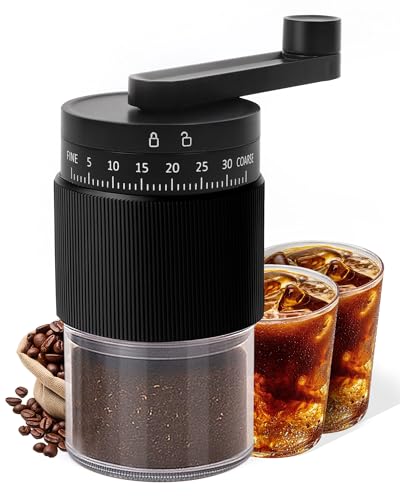
The 013-XPZ is the cheapest of the six and, oddly for an entry pick, carries the biggest published bean chamber in the set: 40g against the 30g on the CEVING and HZBSGZR. Matrjestice says the dial offers 35 external settings, five fewer than the ceramic pack at the top but well ahead of the JavaPresse's 18. The body is 5.9 x 2.7 x 2.7 in, a taller cylinder than the flat CEVING, and weight comes in at 0.6 lb.
That combination makes it the natural starter mill. If you have never ground coffee by hand and you are not certain you will keep at it, the entry price and larger chamber lower the risk of both wallet and elbow. Matrjestice pitches the detachable parts as easy to clean and the grip as comfortable for travel, though the listing does not give a weight class comparison against the JavaPresse's slim cylinder.
Trade-offs are honest. The listing is the slowest seller of the six by a wide margin, which usually reflects a newer or less-marketed product rather than a quality read. There is no warranty. If you want the sharpest espresso dial in the set, look at the AV 1 or the CEVING instead.
Pros:
- Cheapest pick in the set
- 40g chamber, largest here
- 35 click settings
- 0.6 lb, the lightest in the ceramic group
- Detachable parts per the listing
Cons:
- Slowest seller of the six by a large gap
- Five fewer clicks than the top of the set
- No stated warranty
- Only one seller lists it
Ceramic or steel burr: which suits you?
Five of the six picks here use a ceramic conical burr. One, the ALPACA VENTURES AV 1, uses a 420 stainless steel burr hardened to 57 HRC per the listing. That is the single biggest material split in the set and it matters more than any other spec sheet detail.
Ceramic burrs generate less heat than steel and are harder in absolute terms, which the CEVING, HZBSGZR and Rsoilch listings all lean on. Less heat means less loss of aromatic oil during the grind. Ceramic is also brittle: a stone or a piece of gravel in a bag of beans can chip an edge that will not sharpen back.
Steel keeps its edge sharper for longer under normal use and shrugs off the odd hard object. It costs more, both to make and to buy, which is why the AV 1 sits at the top of the price positions here. Steel also runs slightly warmer, though at hand-crank speeds the difference is measured in single degrees.
The rule I would use:
- If you drink two to three cups a day and value low heat and low cost, buy ceramic.
- If you grind daily, brew espresso, and expect to keep the mill for years, buy steel.
- If you travel with the grinder over rough ground, buy steel.
How many clicks do you actually need?
Click count is the spec most listings shout about and most buyers misread. The set here ranges from 18 clicks on the JavaPresse to 45 on the ALPACA VENTURES AV 1. Four picks sit at 40 clicks. The Matrjestice lists 35.
More clicks give you finer control at the espresso end of the dial, where a single position can change extraction from sour to sweet. Filter and French press live much further out where two or three clicks either way barely register in the cup. If you only ever brew French press, an 18-click dial is fine. If you dial in espresso by taste, you want at least 30, and 40 to 45 is better.
Three questions to run past your own routine:
- Do you brew espresso or only immersion and drip? Espresso raises the click count you need.
- Do you switch methods often? A wider range covers more.
- Do you weigh and taste, or eyeball it? Weighers benefit more from resolution.
The AV 1 is the only pick that publishes a click-by-click brew map. The CEVING, HZBSGZR and Rsoilch each claim 40 clicks but leave the mapping to you.
What the listings do not tell you
The specifications you get on a compact hand grinder are only half the story. Three things routinely go unstated across the set:
- Grind time per dose. None of these listings publishes a minutes-to-grind figure. A ceramic burr at 30g typically takes 90 seconds to two minutes for a medium grind. Espresso is longer.
- Wrist load. A crank handle that is 3 in long feels different from one that is 6 in long. ALPACA VENTURES states 6.3 in on the AV 1. The others do not publish handle length.
- Static and clump behaviour. Grinding fine into a plastic cup can leave a coating of grounds behind. Glass jars, as on the HZBSGZR and Rsoilch, tend to hold less static but you can see the mess.
Two habits reduce all three: pre-warm the burr with two seconds of empty cranking on cool mornings, and tap the collector cup gently before you unscrew it to knock grounds off the walls. Neither habit is mentioned on any listing here.
Compact does not always mean travel-ready
Compact is not the same as travel-ready. A mill can be small on a countertop and still be a pain in a rucksack.
The set splits three ways. The JavaPresse is a slim 1.8 x 1.8 in cylinder that slides into any side pocket. The AV 1 is 1.9 in across but 1 lb, so it is compact in one direction but heavy in another. The CEVING and HZBSGZR are flatter and wider at 2.3 in through the body, which packs well in a jacket pocket but occupies more space in a small toilet bag.
If you fly with hand luggage only, weight decides. In this set the Matrjestice at 0.6 lb, the JavaPresse at 0.59 lb and the HZBSGZR at 0.72 lb are the lightest. The AV 1 is the heaviest by a clear margin. If you drive to a rental cabin, weight does not matter and the AV 1's steel burr and dial map earn their place.
Amazon's search on this keyword returned some grinders that lean more toward home countertop use than pocket travel. The picks above are the ones whose footprint or weight makes them credible as a compact manual coffee grinder in practice.
The verdict
The CEVING MCG-01 is the best compact manual coffee grinder for most people because it stacks a 30g chamber, a 40-click external dial and a 0.84 lb ceramic-burr body without giving up ground on any of them. It carries the strongest sales position in the set, and the external adjustment means you switch brew methods without disassembly. That combination is the reason it leads.
Two conditions flip the recommendation. If you brew espresso daily and want a steel burr with 45 audible clicks and a published grind map, buy the ALPACA VENTURES AV 1 and accept that you pay the top of this set and grind 1 oz at a time. If a written warranty and return policy matter more than click resolution, the JavaPresse Manual Coffee Grinder is the only pick here with both stated on the listing, and the slim 1.8 x 1.8 in cylinder is easier to pack than any wide-body rival.
The HZBSGZR, Rsoilch and Matrjestice are all solid ceramic-burr grinders that do one thing better than the winner: visible dosing, an entry price with 40 clicks, and the cheapest entry point in the set respectively. Choose one of those if that particular strength maps to your kitchen. Otherwise, the MCG-01 is the safe default.
FAQ
Is a compact manual coffee grinder worth it?
A compact manual coffee grinder is worth it if you value fresh grinding without an electric burr on the counter. The five ceramic-burr picks here all sit between 0.59 lb and 0.84 lb and grind 25g to 40g per fill, enough for one or two brews. If you make more than four cups at once every morning, an electric mill is faster. For one or two drinkers, the trade in a minute of cranking for fresher coffee is real.
Which is the best compact manual coffee grinder for espresso?
The best compact manual coffee grinder for espresso in this set is the ALPACA VENTURES AV 1. It uses a 420 stainless steel burr hardened to 57 HRC, offers 45 clicks with a published espresso range of 11 to 15, and its dial clicks audibly when the crank is held still. The CEVING MCG-01 is a strong runner-up with 40 clicks and an external dial, but the AV 1's steel burr and grind map suit espresso better.
How does the CEVING MCG-01 compare with the ALPACA VENTURES AV 1?
The CEVING MCG-01 compares with the ALPACA VENTURES AV 1 on burr and price. The CEVING uses a ceramic burr, 40 clicks, a 30g chamber, weighs 0.84 lb and sits mid-priced. The AV 1 uses a steel burr, 45 clicks, holds 1 oz per fill per the listing, weighs 1 lb and sits at the top of the price positions. Pick the CEVING for value and daily brewing; pick the AV 1 for espresso and durability.
Can ceramic burrs grind fine enough for espresso?
Ceramic burrs can grind fine enough for espresso, yes, and four of the picks here list espresso in their brewing range: the CEVING MCG-01, HZBSGZR KFXMJ-001, Rsoilch HS-011 and JavaPresse Manual. Ceramic is harder than steel in absolute terms and stays cool during the grind. The trade is edge chipping if a stone slips in with the beans. For daily espresso over years, a steel burr like the AV 1's holds its edge longer.
What is the biggest mistake buyers make with a compact manual coffee grinder?
The biggest mistake buyers make is treating the click count as the only spec that matters. Burr material, chamber capacity and handle length all shape the actual experience of grinding. A 40-click dial on a 25g chamber means you crank twice for a double dose. A slim cylindrical body packs into a pocket where a wider flat body will not. Read all four numbers together before you pick.
Once you have picked a grinder, the routine is what makes it worth owning. Grind fresh for each brew, store beans away from the mill, and clean the burr every couple of weeks with the brush most listings include. The CEVING MCG-01 is the pick I would put in a new coffee drinker's hand because it does not ask them to trade capacity for clicks or clicks for pocketability. It gives them room to try espresso, pour-over and French press on one dial without buying a second mill. When the routine sticks, the AV 1 waits for the day steel burrs and a documented grind map start to matter.