Best Energy Efficient Electric Kettle: Cosori Wins
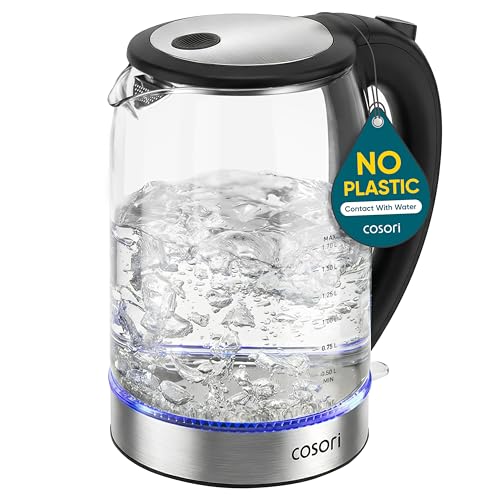
Six electric kettles compared on capacity, wattage, materials and boil times, with a plastic-free Cosori taking the top spot and five alternates for tighter budgets, smaller counters and glass-body fans.

By Elin RoweUpdated 16 min read
On this page
- Best energy efficient electric kettle at a glance
- How I narrowed six kettles from a longer shortlist
- Why wattage is a poor proxy for efficiency
- 1. Cosori Electric Kettle — Best overall
- 2. Chefman Electric Kettle — Most versatile
- 3. Hamilton Beach 1 Liter Electric Tea Kettle — Best upgrade
- 4. COMFEE' Stainless Steel Electric Kettle — Best minimal setup
- 5. OVENTE 1.7L Electric Tea Kettle — Best budget pick
- 6. MUELLER HOME Rapid Boil Electric Tea Kettle 1.8L — Best for pros
- How much water do you actually boil per day?
- Head-to-head: Cosori versus Chefman
- What the listings do not tell you about kettle efficiency
- The verdict
- FAQ
The best energy efficient electric kettle for most kitchens is the Cosori Electric Kettle, a 1.7L model that heats 0.5L in under 3 minutes with no plastic touching the water. If you boil larger batches and want to see the water level while it heats, the 1.8L Chefman Electric Kettle with its 1500W element and borosilicate glass body is the smarter pick. Both beat a stovetop on the same volume, which is where the real energy saving sits.
Best energy efficient electric kettle at a glance
| Pick | Capacity | Wattage / claim | Price |
|---|---|---|---|
Best overall Cosori Electric Kettle |
1.8 qt (1.7L) | Heats 0.5L in under 3 min (claim) | Check Price |
Most versatile Chefman Electric Kettle |
1.9 qt (1.8L) | 1500W, 3 min claim | Check Price |
Best upgrade Hamilton Beach 1L Kettle |
1.1 qt (1L) | Rapid-boil, wattage not listed | Check Price |
Best minimal setup COMFEE' Stainless Kettle |
1.8 qt (1.7L) | 1500W, 5 to 7 min for full 1.7L | Check Price |
Best budget pick OVENTE 1.7L Kettle |
1.8 qt (1.7L) | 1100W | Check Price |
Best for pros MUELLER HOME Glass Kettle |
1.9 qt (1.8L) | 1500W rapid-boil | Check Price |



How I narrowed six kettles from a longer shortlist
I compared listings for six kettles in the same Amazon subcategory: Kettles & Tea Machines > Electric Kettles. Three sit in the entry or mid price band, three run higher. Two use borosilicate glass, three use stainless steel, and the Cosori uses a stainless interior with no plastic on the water path.
The screening rules were simple:
- Capacity had to be listed and usable for a household, not a travel mug volume.
- Wattage or an explicit boil-time claim had to appear in the listing, because a kettle that hides both is a kettle you cannot compare.
- Auto shut-off and boil-dry protection had to be present. Every one of the six passes.
- Materials had to be named. Vague "food-grade plastic" descriptions were cut before this shortlist.
That left the six here. Note that Amazon's search treats "energy efficient" softly, so no product in this set is certified against a specific efficiency standard. The comparison below is about which kettle wastes the least water and the least electricity in normal use, not about a badge.
Why wattage is a poor proxy for efficiency
Most best energy efficient electric kettle guides lead with wattage. That is not what decides it. A 1500W kettle draws more current per second than a 1100W kettle, but it also finishes the job sooner, so the total energy for a given volume of water is very close. Physics sets the floor: heating 1 litre from tap-cold to boiling takes roughly the same joules regardless of the element.
What actually decides efficiency in real use is different. It is the volume you boil versus the volume you needed. If you fill a 1.7L kettle to boil one mug, you have wasted more than 80% of the energy on water you will pour down the drain. A visible water level, a marked minimum line, and a shape that pours a small amount without tipping the whole reservoir all matter more than a 400W spec gap.
That is why the Cosori's under-3-minute claim for 0.5L is more useful than a raw wattage figure, and why the Hamilton Beach 1L model earns a place despite its smaller capacity. A kettle you can fill honestly for one cup is a kettle that saves power every day.
1. Cosori Electric Kettle — Best overall
A stainless interior with no plastic on the water path, at a capacity that suits a household and a fast small-batch boil.
Best for: daily tea drinkers who care about taste and want no plastic touching the water Skip it if: you want to watch the water and prefer a glass body
The Cosori's headline claim is that water never touches plastic, which matters if you notice a plastic aftertaste on the first pour of the morning. It holds 1.8 quarts (1.7L), weighs 2.7 lb empty and measures 9.5 x 7.9 x 6.1 in, which is compact for its capacity. Cosori says the kettle heats 0.5L in under 3 minutes, so a two-cup pour finishes faster than a stovetop on gas and comfortably faster than a microwave doing the same job.
The dual-angle lid opens to a splash-reducing position with one touch, then all the way for cleaning. That matters for descaling, because a kettle you rinse without effort is a kettle you actually descale. It is the most expensive pick here and it is the one buyers choose most often in this set. Against the others it trades a see-through body for a materials story, and I think that is the right trade for a daily kettle.
Pros:
- No plastic contact with water on the boil path
- 0.5L in under 3 minutes (manufacturer claim)
- Dual-angle lid opens for easy cleaning
- Compact 9.5 x 7.9 x 6.1 in footprint
- Auto shut-off and boil-dry protection
Cons:
- The highest price position in this set
- Opaque body hides the water level and scale build-up
- Only one seller lists it
2. Chefman Electric Kettle — Most versatile
A 1.8L borosilicate glass body with a 1500W element and a claimed 3-minute boil, at entry pricing.

Best for: households that boil small and large batches and like a visible water level Skip it if: you want stainless walls that hide scale and fingerprints
The Chefman is the second-cheapest here and one of only two glass-body kettles in this set. That transparency is not decoration. It shows you when you have over-filled, and it turns descaling from a chore you forget into a chore you notice. Capacity is 1.9 quarts (1.8L), empty weight is 2.3 lb, and Chefman says the 1500W element gets water hot in about 3 minutes.
The stainless steel filter catches scale flakes before they land in a cup, which matters more in hard-water areas than the marketing usually admits. The cordless base is a small thing that pays off daily: lift, pour, replace. LED indicators show heating state without a separate switch to read.
Its trade-off against the Cosori is the material story. Glass gets fingerprints, glass shows lime scale, and a glass kettle on a tile floor is a kettle you drop once. If you can accept those risks, this is a lot of kettle for the price position.
Pros:
- 1500W element with a 3-minute claim
- Borosilicate glass body shows the water level
- Stainless steel filter at the spout
- Cordless base for easy pouring
- Second-cheapest of the six here
Cons:
- Glass body needs regular cleaning to stay clear
- No published warranty in the listing
- Fingerprints show on the stainless collar
3. Hamilton Beach 1 Liter Electric Tea Kettle — Best upgrade
The only 1L kettle in this set, which turns out to be the honest capacity for one or two mugs at a time.

Best for: singles and couples who rarely need more than four cups at once Skip it if: you routinely fill a French press and two mugs in one go
If the real efficiency question is "how much water are you boiling that you did not need," a 1L kettle is the answer for many households. The Hamilton Beach holds 1.1 quarts, weighs 2 lb empty and measures 7.8 x 5.5 x 8 in, which is the smallest footprint in this set on two of three axes. It carries a one-year warranty, one of only three published warranties in this shortlist.
The rapid-boil element is not given a wattage in the listing, which is a real gap. Hamilton Beach says it boils faster than a microwave, which is a claim rather than a spec. The concealed heating element keeps the interior cleanable and means scale does not coat a visible coil. A removable mesh filter sits behind the easy-pour spout to catch flakes.
Against the larger kettles here, it loses on batch size. If you make coffee for four every morning, this is the wrong pick. If your day is two mugs of tea and a cup for a hot water bottle, it is the right size to stop wasting energy on unused volume.
Pros:
- 1.1 qt (1L) capacity sized for small batches
- 7.8 x 5.5 x 8 in, the smallest here overall
- Concealed heating element resists scale
- One-year warranty stated in the listing
- Removable mesh filter at the spout
Cons:
- Wattage not listed
- Too small for a full French press plus mugs
- Sells slower than the rest of this set
4. COMFEE' Stainless Steel Electric Kettle — Best minimal setup
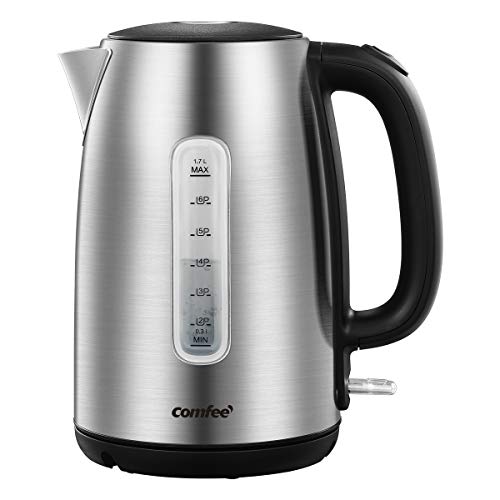
A full 1.7L stainless steel body at just 1.95 lb empty, with a clearly stated one-year warranty.
Best for: small kitchens that want stainless steel and a light footprint Skip it if: you want the fastest possible boil at 1.7L
The COMFEE' is the lightest kettle in this set at 1.95 lb empty, which sounds trivial until you pour a full 1.7L one-handed. The inner pot is 304 food-grade stainless steel and the housing is brushed stainless, so fingerprints are softer than on a mirror finish. The heating element is concealed. COMFEE' publishes a one-year manufacturer warranty on the product page, which is worth checking against your own use.
The boil time claim is where this pick loses ground: 5 to 7 minutes for a full 1.7L on a 1500W element, which is honest and slower than what the Chefman and MUELLER kettles claim on similar capacity. The cool-touch handle and pop-up lid are the small ergonomic touches that decide whether you use a kettle daily or push it to the back of the counter.
Its position in the set is subtle. It is not the cheapest, it is not the fastest, and it does not have a glass window. What it does have is a stainless build, a stated warranty, and dimensions of 9 x 8 x 7 in that slide under most upper cabinets.
Pros:
- 1.95 lb empty, lightest here
- 304 stainless interior with brushed housing
- One-year manufacturer warranty listed
- Cool-touch handle and pop-up lid
- 9 x 8 x 7 in fits under most cabinets
Cons:
- 5 to 7 minutes for a full 1.7L is slower than rivals
- Sits in the premium price band without the fastest boil
- Stainless body hides the water level
5. OVENTE 1.7L Electric Tea Kettle — Best budget pick
A 1100W 1.7L kettle with a two-year limited warranty, the longest published in this set.
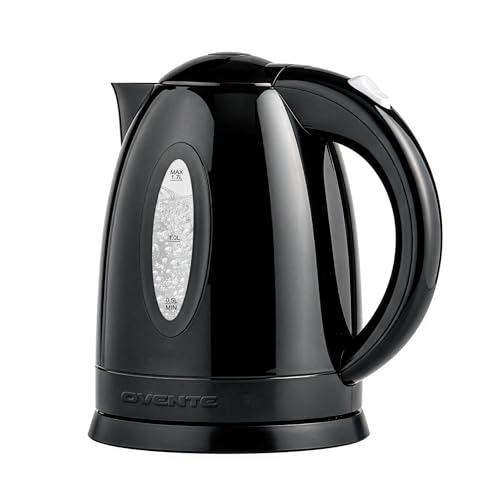
Best for: occasional users who boil one or two cups at a time Skip it if: you need a full 1.7L boil in under four minutes
The OVENTE is the cheapest of the six and the only kettle here with a stated 2-year limited warranty, which is a real point in its favour if you plan to keep the same kettle for years. Capacity is 1.8 quarts (1.7L), the body is BPA-free, and the shape is a straightforward jug with a fixed lid and a concealed base.
The 1100W element is the lowest wattage in this set. OVENTE says the kettle is 50% more efficient than a traditional stovetop kettle, which is an efficiency claim about the category rather than a comparative one against the others here. A lower wattage means a longer full-fill boil, so this is the pick you use when you boil one mug at a time and put the kettle away between uses.
Weight is not listed on the product page, which is a real gap for a jug of this size. Against the pricier picks, it trades boil speed and material transparency for a lower price and a longer warranty. That is a fair trade for a second kettle in a spare kitchen or a rental.
Pros:
- The cheapest of the six
- Two-year limited warranty, the longest here
- 1.7L capacity for household batches
- BPA-free construction
- Auto shut-off and boil-dry protection
Cons:
- 1100W is the lowest wattage in this set
- Empty weight not stated
- Opaque body hides scale build-up
6. MUELLER HOME Rapid Boil Electric Tea Kettle 1.8L — Best for pros
A borosilicate glass body with a fully removable lid and a 1500W element, sized for a full French press.

Best for: pour-over coffee makers who want a clear glass body and a controlled spout Skip it if: counter space is tight or you dislike glass on a hard tile floor
The MUELLER holds 1.9 quarts (1.8L), which the listing rounds to about 7 cups. The body is borosilicate glass with a food-grade stainless steel spout and built-in filter. What separates it from the Chefman is the fully removable lid: the whole top comes off, so filling and deep cleaning use the wide opening rather than a hinged flap. That matters if you descale monthly and want to reach the base with a bottle brush.
The 1500W rapid-boil element gets a full 1.8L to a rolling boil quickly, though the listing does not give a specific time figure for the full-fill case. Auto shut-off triggers at the boil, and boil-dry protection cuts power if the base is dry. Manufacturer's warranty is stated but the length is not specified, so budget on the assumption of a shorter term than the OVENTE.
At 2.88 lb empty and 10 x 8.5 x 6.25 in, it is the largest and heaviest kettle here. Its trade-off is bulk and fragility for visibility and cleaning access. If your morning starts with a pour-over, this is the kettle in this set that respects the ritual.
Pros:
- 1500W rapid-boil element
- Borosilicate glass with stainless spout
- Fully removable lid for cleaning
- 1.8L holds a full French press plus mugs
- Manufacturer's warranty stated
Cons:
- Heaviest here at 2.88 lb empty
- Slowest seller of the six
- Warranty length not specified
How much water do you actually boil per day?
The single most useful thing you can do before buying is measure. For one week, note how many mugs and pots you fill. Then compare that to the capacity of the kettle you are eyeing.
- Under 1L per day: the Hamilton Beach 1L is the honest match. A larger kettle will get filled past the minimum line out of habit.
- 1L to 2L per day: a 1.7L or 1.8L kettle used at half fill is the sweet spot. This is where the Cosori and Chefman earn their place.
- Over 2L per day: any 1.7L or 1.8L pick here works, but wattage starts to matter. A 1500W element cuts total on-time versus a 1100W element, which means less standby heat lost to the room.
The efficiency lever is the volume you actually boil, not the wattage on the label. A 1500W kettle boiling 250ml wastes more energy than a 1100W kettle boiling 250ml, because both heat the same 250ml but the faster kettle spends more of its short run near peak draw. That is why the deciding question is not "how powerful" but "how honestly can you fill it small."
Head-to-head: Cosori versus Chefman
These two are the picks I'd start with, and they answer different questions. The Cosori is the one to buy if the taste of the first pour matters and you drink daily. The Chefman is the one to buy if you want to see the water and to spend less up front.
On capacity they are almost identical: 1.7L for the Cosori, 1.8L for the Chefman. On weight, the Chefman is 0.4 lb lighter empty. On boil time, both claim a fast small-batch heat. Where they diverge is on materials and price position: the Cosori keeps water off plastic, sits at the top of the set's price band and is the one buyers choose most often here. The Chefman uses borosilicate glass, sits in the entry price band and shows the water level.
If your water comes through old copper or lead-solder plumbing, that plastic-free interior is worth paying for. If your water is soft and clean and you care about visibility for pour-over accuracy, the Chefman is the sharper choice.
What the listings do not tell you about kettle efficiency
Product pages are optimised for the sale, not for the second year of ownership. A few things the listings here quietly omit:
- Standby draw. None of the six lists idle wattage. In practice, unplugging the base between uses is the only guaranteed way to zero it.
- Descaling interval. Scale on the element is the biggest efficiency killer in a kettle's life. A scaled element can add 20 to 30% to boil time. None of the listings state a recommended descale interval.
- Minimum fill. Every kettle has a marked minimum line inside, usually around 0.5L. Below it, the sensor may not read correctly and the element sits near-exposed. Match your daily mug count to the minimum line, not to the maximum.
- Cord length. Not stated on any of the six pages. If the outlet is far from the counter zone, measure before you commit.
The trick is to treat the marketing claim as the ceiling and the maintenance reality as the floor. A 3-minute boil at 0.5L becomes a 5-minute boil at 1L with light scale, and that is the number that actually shapes your electricity bill.
The verdict
The Cosori Electric Kettle is the winner because it does the two things a daily kettle has to do well: it heats a small batch fast, and it keeps water off plastic while doing it. At 1.7L capacity, 2.7 lb empty and a manufacturer claim of under 3 minutes for 0.5L, it is the pick I'd hand to someone who drinks tea every morning and does not want to think about taste again. It is the most expensive kettle here, and it earns that position.
The Chefman Electric Kettle is the runner-up and it wins in a specific case: when you want to see the water level and pay entry pricing. Its 1500W element, 1.8L capacity and borosilicate glass body are a strong combination for households that boil variable volumes and care about descaling on schedule.
Two conditions flip the recommendation. If you routinely boil one mug at a time, the Hamilton Beach 1L is the more honest fit and its concealed element keeps scale off view. If your priority is a long stated warranty at the lowest price, the OVENTE's 2-year limited term is the pick to reach for.
FAQ
What size is the best energy efficient electric kettle for one person?
The best energy efficient electric kettle for one person is a 1L model with a low minimum-fill line, because the biggest waste is boiling water you never use. The Hamilton Beach at 1.1 quarts is sized for one or two mugs at a time without over-filling. A 1.7L kettle used at half fill works, but only if you actually stop pouring at the halfway mark.
Is a higher-wattage electric kettle worth it?
Higher-wattage electric kettle models finish the same volume faster, but the total energy used is close to the same. The 1500W Chefman and MUELLER kettles here reach a boil sooner than the 1100W OVENTE, which reduces standby heat lost while the kettle is on. If you value time and boil larger volumes daily, higher wattage is worth it. If you boil small volumes, wattage matters less than fill discipline.
Cosori versus Chefman: which is better for pour-over coffee?
For pour-over coffee, the Chefman is the better match because the borosilicate glass body lets you see the water level and time your pour. The Cosori is opaque, which is fine for tea but limits visibility for controlled coffee brewing. If pour-over is your daily ritual, the MUELLER HOME kettle in this set is worth a look too, since its stainless spout and removable lid suit the same use.
Do electric kettles use less energy than a stovetop kettle?
Electric kettles use less energy than a stovetop kettle for the same volume in most homes, because the heating element sits directly in the water rather than under a metal base. Gas stovetops lose heat around the base, and electric coils lose heat before the metal transfers it. Every kettle in this set uses a concealed or immersed element, which is the design that captures the efficiency gain.
How often should I descale an electric kettle?
Descale an electric kettle every month in hard-water areas and every three months in soft-water areas. Scale on the element or the base insulates it from the water, so the kettle runs longer for the same boil and uses more electricity. White vinegar and water at a 1:1 ratio, brought to a boil and left to sit for 20 minutes, clears light scale. The COMFEE' listing describes the same method.
The default pick here is the Cosori Electric Kettle: 1.7L, a claimed under-3-minute boil on 0.5L, and a water path that never touches plastic. That last point is the one most guides skip, and it is the one you notice on the first hot drink of the day. Measure your typical daily boil before you buy, match the capacity to that number rather than to the maximum on the box, and unplug the base between uses. Do those three things and the kettle you choose will earn back its price in a year of quieter mornings and steadier bills.