Best Japanese Chef Knife by Steel Core and Edge

Seven Japanese chef knives compared on edge angle, blade steel, weight and handle material, with a named winner and the conditions that flip the pick to something else.

By Elin RoweUpdated 17 min read
On this page
- Best japanese chef knife for electric stoves at a glance
- How I narrowed the field to seven knives
- Does the stove type actually matter for a knife?
- Edge angle, hardness, and which one you should read first
- 1. HOSHANHO Kitchen Knife in Japanese High Carbon Steel — Best overall
- 2. imarku Japanese Chef Knife-Sharp Kitchen Knife 8 Inch — Best lightweight
- 3. SHAN ZU Chef Knife 8 Inch Japanese Steel Damascus Kitchen — Best for families
- 4. Emojoy 8-Inch Damascus Chef Knife — Best budget pick
- 5. Atumuryou Japanese Chef Knife — Most versatile
- 6. HOSHANHO 9 Inch Kiritsuke Chef Knife — Best upgrade
- 7. imarku 3 Pieces Knife set — Best premium
- What separates the two HOSHANHO blades?
- What a Japanese blade asks of you in return
- The verdict
- FAQ
The best japanese chef knife for electric stoves is the HOSHANHO Kitchen Knife in Japanese High Carbon Steel, an 8" blade hand-sharpened to 13 degrees per side on a 10Cr15CoMoV core. If 0.77 lb feels heavy in your hand, the imarku Japanese Chef Knife-Sharp Kitchen Knife 8 Inch weighs 6.56 oz and does the same jobs with less wrist load. Edge angle is what splits this field, not the steel name printed on the box. Two of these seven publish a 13-degree grind. Three publish 15 degrees. That gap decides how the blade feels on your first cut.
Best japanese chef knife for electric stoves at a glance
| Pick | Blade | Edge angle | Price |
|---|---|---|---|
| 8", 0.77 lb | 13° per side claim | Check Price | |
Best lightweight imarku Japanese Chef Knife-Sharp Kitchen Knife 8 Inch |
8", 6.56 oz | not stated | Check Price |
Best for families SHAN ZU Chef Knife 8 Inch Japanese Steel Damascus Kitchen |
8", 0.57 lb | not stated | Check Price |
Best budget pick Emojoy 8-Inch Damascus Chef Knife |
8", 67 layers | 15° bevel claim | Check Price |
Most versatile Atumuryou Japanese Chef Knife |
8", 13.3 in long | hand-sharpened claim | Check Price |
Best upgrade HOSHANHO 9 Inch Kiritsuke Chef Knife |
9", 0.52 lb | 12-15° per side claim | Check Price |
Best premium imarku 3 Pieces Knife set |
8" chef, 3 pieces | 15° double bevel claim | Check Price |




How I narrowed the field to seven knives
I set three criteria before looking at a single listing, and weighted them in this order.
- Published edge angle, weighted heaviest. A stated grind in degrees is the one number that predicts how the knife feels on a tomato. Four of these seven publish one.
- Published blade weight, weighted second. Weight is the specification most shoppers ignore and most regret. It spans 6.56 oz to 0.77 lb here, which is a real difference in the hand.
- Steel core named on the listing, weighted third. 10Cr15CoMoV, VG-10 and 10Cr15Mov are all named on at least one of these listings. A knife that says only "Japanese stainless steel" tells you less.
Those weights are deliberate. Steel names get the marketing attention, and they matter for edge retention, but you cannot feel a steel name. You feel the angle behind the edge every time you push through an onion. So the knife with the thinnest published grind on a full-size blade takes the top spot.
I cut anything without an 8" or 9" blade length, since that's the size range that handles both a butternut squash and a shallot. I also kept the field to single chef's knives plus one set, so the comparison stays like-for-like. Of the seven, six are single blades and one is a three-piece.
Does the stove type actually matter for a knife?
Here's the honest answer: the best japanese chef knife for electric stoves is not a category the listings recognise. None of these seven mentions a cooktop, because a knife never touches one. Amazon's search returned chef's knives regardless of the stove qualifier, so I won't pretend any of these blades was engineered around a coil or an induction hob.
What the stove does change is your prep rhythm. Electric elements hold heat and lose it slowly, so you cannot dial a pan down the way you can on gas. That pushes competent cooks toward mise en place: everything cut, sorted and waiting in bowls before the pan gets warm. A knife that stays keen through a full board of prep matters more in that workflow than in one where you chop as you go.
So judge these on cutting performance, not on cooktop compatibility. The things worth checking:
- Published edge angle, in degrees per side
- Blade weight, if the listing states it
- Handle material and whether it stays grippy wet
- Whether the steel core is named or vague
One caution. Never rest a Japanese blade on a warm electric element or a still-hot ceramic top, and never leave one in a sink. Thin, hard steel is unforgiving about heat and moisture, and no listing here promises otherwise.
Edge angle, hardness, and which one you should read first
Edge angle is the number of degrees the bevel is ground to on each side of the blade. A German chef's knife typically sits near 20 degrees per side. Everything on this list that publishes a figure is thinner than that.
HOSHANHO states 13 degrees per side on the 8" blade and 12 to 15 degrees per side on the 9" Kiritsuke. Emojoy and imarku both state a 15-degree bevel. Thinner means less resistance entering food and a cleaner cut through soft skins. It also means less steel behind the edge, so the edge chips more easily against bone or a frozen edge.
Hardness is the second number, measured on the Rockwell C scale. Three listings publish it: SHAN ZU claims 62 HRC, Atumuryou claims 62 HRC for its VG-10 core, and imarku's three-piece set states 57 ± 1 HRC. Higher hardness holds an edge longer. It also makes the steel more brittle, which is the trade nobody prints on the box.
Read the angle first, hardness second. The angle is what you notice on day one. Hardness is what you notice in month six.
- 13 degrees per side: HOSHANHO 8", HOSHANHO 9" Kiritsuke (12-15° range)
- 15 degrees per side: Emojoy, imarku 3-piece
- Angle not published: imarku 8", SHAN ZU, Atumuryou
1. HOSHANHO Kitchen Knife in Japanese High Carbon Steel — Best overall
The thinnest published grind on a full-size 8" blade, on a named 10Cr15CoMoV core, makes this the default pick of the seven.
Best for: a cook who wants the thinnest published edge angle on a full-size 8" blade Skip it if: you want a light knife in the hand
Two things separate this one inside the set. It's the only 8" blade here that publishes both a named steel core and a specific per-side angle, and it sells faster than every other knife on this list. HOSHANHO says the blade is hand-sharpened to 13 degrees on each side, and that the core is 10Cr15CoMoV high carbon steel. The brand also claims twice the sharpness and durability of other premium knives, which is marketing language rather than a measurement, so weigh the angle figure instead.
At 0.77 lb this is the heaviest blade in the group where weight is published. That weight is not a flaw. A heavier knife carries itself through dense carrots and does more of the work for you on a downward chop. It's simply the opposite of what you want for two hours of fine dicing.
The handle is wood with what HOSHANHO calls a sloped bolster to encourage a pinch grip. That's a design choice you either like immediately or don't. The trade against the rest of the set: only one seller lists it, and it sits at a mid-range price position while asking you to accept more weight than either imarku or SHAN ZU.
Pros:
- Thinnest stated grind here at 13° per side
- Named 10Cr15CoMoV high carbon steel core
- The one buyers choose most often here
- Sloped bolster shaped for a pinch grip
- Full 13.5 in overall length
Cons:
- Heaviest published weight in the set at 0.77 lb
- Only one seller lists it
- No hardness figure published, unlike three rivals
- Mid-range price with no stated warranty
2. imarku Japanese Chef Knife-Sharp Kitchen Knife 8 Inch — Best lightweight
At 6.56 oz it's the lightest blade with a published weight, and the second-cheapest knife here.

Best for: small hands and long prep sessions Skip it if: you want a high-hardness steel core
Weight is the specification that separates this from the winner, and it's a bigger deal than it sounds. 6.56 oz against 0.77 lb is roughly a 4.7 oz difference, which your wrist registers clearly after the second onion. If your prep sessions run long because your cooktop forces everything to be ready in advance, this is the blade that finishes the board without complaint.
imarku classes it as a gyutou, the Japanese take on a Western chef's knife, and says it cuts, dices, slices, chops and takes meat off bones. The listing describes the steel only as high-carbon stainless, with no hardness rating and no stated grind angle. That's the honest weakness: three other knives here publish an HRC figure and this one doesn't. The handle is pakkawood, shaped to reduce finger fatigue on long holds.
One thing to know before you order. imarku states it's mid brand upgrade, so the logo on the knife you receive may differ from the listing photo, and units ship at random. Cosmetic, but worth knowing if it's a gift.
Pros:
- Lightest published weight here at 6.56 oz
- Second-cheapest of the seven
- Pakkawood handle shaped against finger fatigue
- Sells faster than five of the six others
Cons:
- No published hardness or edge angle
- Steel described only as high-carbon stainless
- Logo may differ from the listing photo
- Only one seller lists it
3. SHAN ZU Chef Knife 8 Inch Japanese Steel Damascus Kitchen — Best for families
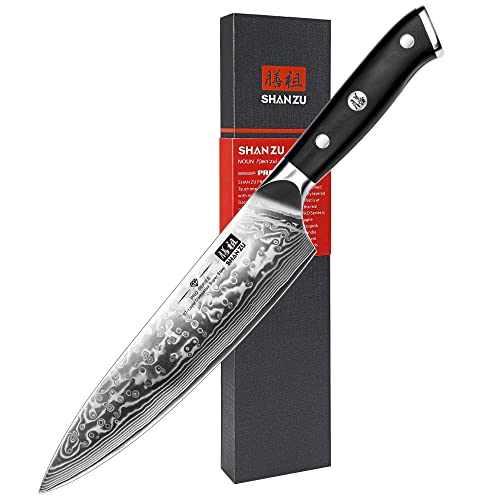
A claimed 62 HRC core and a G10 handle make this the one to hand to another cook without wincing.
Best for: a busy household kitchen with several cooks Skip it if: you prefer the warmth of a wood handle
Five of the seven knives here use a wood or wood-composite handle. This is one of only two that don't, and in a kitchen where teenagers rinse and drop things, that matters. SHAN ZU uses frosted glass-fibre G10, which the brand says is more solid than wood. G10 doesn't absorb water, doesn't swell and doesn't mind a soapy hand.
The blade specifications hold up too. SHAN ZU claims a 10Cr15Mov Damascus core at 62 HRC across 67 layers, and states that the pattern is forged rather than laser-etched. At 0.57 lb it sits between the imarku featherweight and the HOSHANHO winner, which is a sensible place to be for shared use. Overall length is 13.2 in with a 1.18 in profile.
What it doesn't give you is a published grind angle, so you're taking the sharpness claim on faith in a set where four rivals put a number on it. It's also the slowest-moving knife of the seven, and it's the second-cheapest to buy while the cheapest pick offers a lifetime warranty it doesn't match.
Pros:
- G10 handle unaffected by water and soap
- Claimed 62 HRC hardness, joint highest here
- Forged 67-layer pattern, not etched
- Entry price position with two sellers stocking it
Cons:
- No published edge angle in degrees
- Slowest seller of the seven
- No stated warranty, unlike the budget pick
- G10 lacks the look of wood if that matters
4. Emojoy 8-Inch Damascus Chef Knife — Best budget pick
The cheapest of the seven, and the only one whose listing promises a lifetime warranty.

Best for: a first Damascus knife or a gift Skip it if: you want a published blade weight before buying
Emojoy publishes more chemistry than anything else in this group. The listing states 0.98% carbon and 18% chromium in a 67-layer Damascus blade at 58 HRC, sharpened to a 15-degree bevel. That chromium figure is the one to note: 18% is generous, and chromium is what resists rust. On a thin, hard blade that spends its life near a sink, corrosion resistance is not a footnote.
The handle is Calabrian olive wood, which is the prettiest material named across these seven. It ships in a wooden box with what Emojoy describes as a lifetime warranty, making this the only pick here with any warranty language at all. For a gift, that combination is hard to argue with at the cheapest price position in the set.
Where it falls short is data. There's no published weight and no published dimensions, which means you cannot compare its balance against the winner before it arrives. And 58 HRC is real but modest next to the 62 HRC claimed by SHAN ZU and Atumuryou, so expect to touch up the edge sooner.
Pros:
- Cheapest pick of the seven
- Only listing here stating a lifetime warranty
- Publishes 0.98% carbon and 18% chromium
- Stated 15° bevel and 67-layer construction
- Olive wood handle in a wooden gift box
Cons:
- No published weight or dimensions
- 58 HRC is the lowest Damascus hardness here
- Only one seller lists it
- Laser-controlled sharpening, not fully hand-ground
5. Atumuryou Japanese Chef Knife — Most versatile
A VG-10 core at a claimed 62 HRC, aimed squarely at mixed prep across fish, meat and vegetables.

Best for: mixed prep across fish, meat and vegetables Skip it if: you need to know the weight in advance
VG-10 is the reason to look at this one. It's a specific, well-known Japanese cutlery steel, and naming it tells you more than "Japanese stainless" ever will. Atumuryou pairs it with a claimed 62 HRC and says the edge is hand-sharpened using traditional Japanese methods, then points the knife at fish, meat and vegetables in equal measure. That breadth is what earns the versatility label here.
The handle combines stabilised wood with resin, which sits between the pure olive wood of the Emojoy and the synthetic G10 of the SHAN ZU. Resin infusion stops wood from drinking water, so it's a reasonable middle path. Overall length is 13.3 in with a 1.77 in profile, the widest blade profile published in this set, which helps when you're scooping diced vegetables off a board.
Two gaps. No weight is published, so balance is a guess until it lands. And it carries the most expensive single-knife price position here without publishing a grind angle, while the cheaper HOSHANHO does. It also moves slowly compared with the winner.
Pros:
- Named VG-10 steel core, claimed 62 HRC
- Widest published blade profile at 1.77 in
- Stabilised wood and resin handle resists moisture
- Ships in a gift box, stocked by two sellers
Cons:
- No published weight
- No stated edge angle in degrees
- Premium price position without more published data
- Sells slower than four of the six others
6. HOSHANHO 9 Inch Kiritsuke Chef Knife — Best upgrade
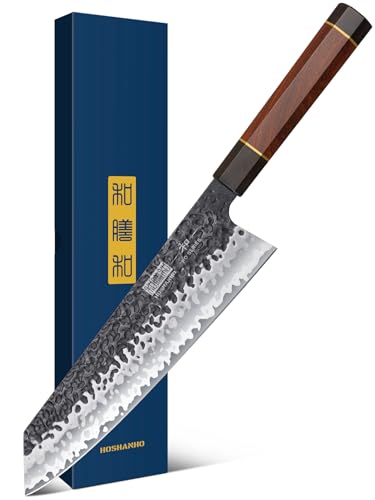
A 9" kiritsuke profile at 0.52 lb and 2.5 mm thick, for cooks who want reach without weight.
Best for: long slicing strokes and a tip-forward grip Skip it if: your board is under 14 inches wide
This is the only knife here that isn't 8 inches, and the only kiritsuke. A kiritsuke has a flatter profile and an angled reverse-tanto tip, built for long push cuts rather than the rocking motion a Western chef's knife invites. If you already own an 8" blade and want a second knife that does something different, this is that knife.
The numbers are the real story. 0.52 lb across a 9" blade is the best length-to-weight ratio in the set, and HOSHANHO states a 2.5 mm blade thickness with 8 layers of composite steel over a 10Cr15CoMoV core. Vacuum heat treatment and nitrogen cryogenic processing are named. The edge is claimed at 12 to 15 degrees per side, hand-sanded. The octagonal rosewood handle is described as stable in wet conditions and resistant to cracking.
The catch is the format. A 9" flat-profile blade needs board space and a different cutting technique, and a kiritsuke tip is easy to damage if you use it as a lever. No hardness rating is published either, and only one seller stocks it.
Pros:
- 9" reach at just 0.52 lb
- Stated 2.5 mm blade thickness
- Named 10Cr15CoMoV core, 8 composite layers
- Octagonal rosewood handle, stable when wet
- Hammered finish to reduce food sticking
Cons:
- Needs a wide board and a push-cut technique
- No published hardness figure
- Kiritsuke tip is vulnerable to chipping
- Only one seller lists it, at a premium price position
7. imarku 3 Pieces Knife set — Best premium
Three knives instead of one, at the highest price position here and the lowest stated hardness.
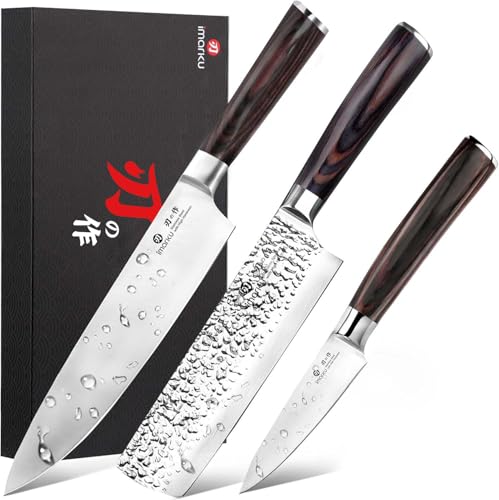
Best for: outfitting an empty kitchen in one purchase Skip it if: you already own a paring knife you like
Six picks here are one knife. This is three, and that's the entire argument for it. imarku builds the set around an 8" chef knife for chopping and slicing, plus two supporting blades, all with matching red-brown pakkawood handles. If you're starting from an empty drawer, one order covers the jobs that a single chef's knife handles awkwardly.
The blade specifications are the most conservative in the group. imarku states 57 ± 1 HRC after vacuum heat treatment and tempering, which is the softest steel here by a clear margin against the 62 HRC claims. Softer steel takes an edge more easily and chips less, but it dulls sooner. The edge is hand-polished to a 15-degree double bevel, which puts it in the same angle band as the Emojoy.
The honest problem is value density. This is the most expensive pick in the set, and it publishes the least per-blade data: no weights, no dimensions, no length figures beyond the 8" chef knife. You're buying coverage, not the sharpest single blade available here.
Pros:
- Three blades in one purchase
- Stated 15° double bevel, hand-polished
- Matching ergonomic pakkawood handles
- Vacuum heat treated and tempered, per imarku
Cons:
- Lowest published hardness at 57 ± 1 HRC
- Most expensive pick in the set
- No published weights or dimensions
- Redundant if you already own a paring knife
What separates the two HOSHANHO blades?
Both HOSHANHO knives use a 10Cr15CoMoV core and both publish an edge angle, which is unusual in this field. Choosing between them comes down to profile and weight.
The 8" is the conventional pick. It rocks, it chops, it fits a standard board, and at 0.77 lb it has enough mass to push through dense root vegetables without effort from you. The 9" Kiritsuke weighs 0.52 lb, which is a third less across an extra inch of blade. It slices in long forward strokes and its angled tip works well for fine detail, but the flat profile fights a rocking motion.
- Standard prep, one knife for everything: the 8"
- Long slicing strokes, second knife in the drawer: the 9" Kiritsuke
- Small board, limited space: the 8"
- You want a hammered finish that food releases from: the 9" Kiritsuke
The cutoff is board width. Under 14 inches and the 9" blade becomes awkward. Above that, its reach is a genuine advantage.
What a Japanese blade asks of you in return
Nobody selling a knife wants to lead with maintenance, so here it is. Thin, hard steel cuts better and forgives less, and that applies to every knife on this page.
Hand wash and dry immediately. A dishwasher's heat and detergent will dull an edge and can loosen a wood handle, and five of these seven have wood or wood-composite handles. Never leave a blade sitting in water. Even at 18% chromium, thin steel stains.
Use a wood or plastic board only. Glass, stone and ceramic boards destroy a 13-degree edge in a handful of cuts. Store the knife in a block, on a magnetic strip, or in the box it came in, not loose in a drawer where the edge meets other metal.
Strop or hone regularly, sharpen occasionally. At the 12 to 15 degree angles claimed across these listings, you want a whetstone rather than a pull-through sharpener, since pull-throughs are usually cut for 20-degree Western edges and will regrind your bevel wider.
And keep the blade away from bone and frozen food. The 62 HRC steels claimed by SHAN ZU and Atumuryou hold an edge longest and chip most readily. That's the bargain hard steel offers.
The verdict
Sort this field by price position and the picture is clean.
At the entry tier, the Emojoy 8-Inch Damascus Chef Knife is the cheapest here and publishes more blade chemistry than anything else, including 18% chromium and a stated lifetime warranty. It's the safest low-commitment entry into Damascus steel. The imarku Japanese Chef Knife-Sharp Kitchen Knife 8 Inch sits alongside it at 6.56 oz, and it's the one to pick if wrist fatigue is the problem you're solving. The SHAN ZU rounds out that tier with a claimed 62 HRC and a G10 handle built for a wet, shared kitchen.
In the middle sits the winner. The HOSHANHO Kitchen Knife in Japanese High Carbon Steel is the best japanese chef knife for electric stoves because it publishes a 13-degree-per-side grind on a named 10Cr15CoMoV core, and it's the one buyers here choose most often. Nothing else in this set combines those two things on a standard 8" blade.
At the premium end, the HOSHANHO 9 Inch Kiritsuke buys you a different blade shape rather than a better version of the same one, and the imarku 3 Pieces Knife set buys you coverage at the lowest published hardness here. The runner-up's exact advantage is weight: 6.56 oz against 0.77 lb, and nothing else.
FAQ
Is a Japanese chef knife worth it over a cheaper Western blade?
A Japanese chef knife is worth it if you prep enough to notice edge angle. The published grinds here run 12 to 15 degrees per side against roughly 20 degrees on a typical Western knife. That thinner bevel means noticeably less resistance through skins and soft produce. If you cook twice a week and rarely dice, the difference is smaller than the price gap.
Does the best japanese chef knife for electric stoves differ from one for gas?
The best japanese chef knife for electric stoves is the same knife you'd buy for gas or induction. None of these seven listings mentions a cooktop, because a blade never touches one. What changes is workflow: electric elements hold heat, so you prep everything before the pan warms up. That favours a knife that stays keen through a full board, which points to edge angle and hardness.
What does 62 HRC actually mean for a kitchen knife?
62 HRC actually means the steel measures 62 on the Rockwell C hardness scale, as claimed by SHAN ZU and Atumuryou. Harder steel holds a sharp edge longer. It's also more brittle, so it chips more readily against bone or a frozen edge. The imarku set states 57 ± 1 HRC, which dulls sooner but tolerates rough handling better.
HOSHANHO 8" or imarku 8": which should I buy?
Between the HOSHANHO 8" and the imarku 8", weight decides it. HOSHANHO publishes a 13-degree-per-side grind on a named 10Cr15CoMoV core at 0.77 lb. imarku weighs 6.56 oz with no stated angle or hardness. Pick HOSHANHO for cutting performance and published data. Pick imarku if long prep sessions leave your wrist aching.
What mistake do first-time buyers make with these knives?
The mistake first-time buyers make is putting a Japanese blade in the dishwasher or pulling it through a cheap sharpener. Both undo the edge. Pull-through sharpeners are typically cut for 20-degree Western bevels and will regrind a 13-degree edge wider, erasing the reason you bought the knife. Hand wash, dry immediately, use a wood board, and hone on a whetstone.
Start with the edge angle, because it's the one number on these listings that predicts how the knife feels the first time you use it. The HOSHANHO 8" publishes the thinnest grind on a standard blade and names its steel core, which makes it the sensible default when you only want to buy once. Check the weight figure too, and be honest about your hands. If 0.77 lb sounds like more knife than you want to hold for an hour, the imarku at 6.56 oz costs less and asks less of your wrist. Either way, buy a whetstone at the same time.