Best Carbon Steel Knife Sharpener by Grit and Rod Length
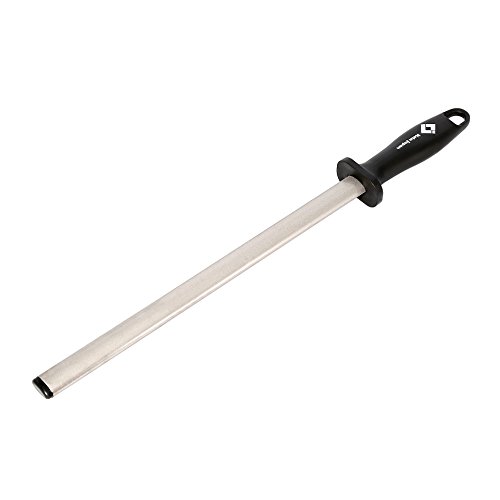
Seven carbon steel honing rods compared on length, weight and grit for working chefs. Kota Japan's 12-inch diamond rod leads, with a Utopia Kitchen 10-inch as the everyday alternative.

By Elin RoweUpdated 18 min read
On this page
- Best carbon steel knife sharpener for professional chefs at a glance
- How I screened seven honing rods on paper
- Honing versus sharpening: which does a rod actually do?
- 1. Kota Japan 12 in. Diamond Carbon Steel Professional Knife — Best overall
- 2. Utopia Kitchen Knife Sharpener Rod 10 Inch — Best for pros
- 3. Cutluxe Honing Rod — Best upgrade
- 4. HOSHANHO Honing Rod — Best premium
- 5. ALLWIN-HOUSEWARE W 12-Inch Knife Sharpening Rod — Most versatile
- 6. Azhou 12" Professional Knife Sharpener Fine Honing Rod — Best minimal setup
- 7. FANERFUN Knife Sharpener Rod — Best budget pick
- Rod length: does 12 inches beat 10 for a working chef?
- What the listings do not tell you about grit
- If your knife is German, Japanese or serrated
- What more money buys in a honing rod
- The verdict
- FAQ
The best carbon steel knife sharpener for professional chefs is the Kota Japan 12 in. Diamond Carbon Steel Professional Knife Sharpener Rod, an 18-inch overall tool with a diamond-electroplated oval rod that Kota says needs a lighter touch than plain steel. If your knife is shorter than 10 inches and you hone daily on the line, the Utopia Kitchen 10 Inch Honing Rod is the better buy at 0.71 lb with a nickel-chrome plated carbon steel surface.
The deciding specification splits this field cleanly, and it is not the one the listings shout about. Grit and coating decide what a rod does to a blade. Length decides which knives it can hone in one clean pass. Handle material decides whether your grip lasts through prep. Everything else is packaging.
Best carbon steel knife sharpener for professional chefs at a glance
| Pick | Rod length | Weight | Price |
|---|---|---|---|
| 12 in rod, 18 in overall | 6.74 oz | Check Price | |
Best for pros Utopia Kitchen Knife Sharpener Rod 10 Inch |
10 in | 0.71 lb | Check Price |
Best upgrade Cutluxe Honing Rod |
10 in | 1 lb | Check Price |
Best premium HOSHANHO Honing Rod |
12 in | 0.88 lb | Check Price |
Most versatile ALLWIN-HOUSEWARE W 12-Inch Knife Sharpening Rod |
12 in | Not listed | Check Price |
Best minimal setup Azhou 12" Professional Knife Sharpener Fine Honing Rod |
12 in, 200-grit claim | 0.9 lb | Check Price |
Best budget pick FANERFUN Knife Sharpener Rod |
13 in | 3.2 oz | Check Price |



How I screened seven honing rods on paper
I started with the listings for carbon steel rods sold in the Knife Sharpeners category on Amazon and pulled everything with a published length, weight and handle description. Then I cut anything that looked like a repackaged import twin, kept one representative from each cluster, and lined up the remaining seven on the specifications that matter for shift work.
The screen ran on four filters, in order:
- Rod material stated as carbon steel or high-carbon steel on the listing.
- Rod length published in inches, not "long" or "professional size".
- Handle material named, not just "ergonomic".
- A stated coating or grit claim, where available.
Two picks cleared every filter with published figures: the Azhou rod and the HOSHANHO rod, both with a stated hardness or grit. Three cleared three filters with a published weight and handle: Utopia Kitchen, Cutluxe and Kota Japan. Two cleared with lighter documentation: FANERFUN and ALLWIN-HOUSEWARE.
That is the honest state of the shelf. Most carbon steel honing rods do not tell you their grit. When a listing gives you a number, that is useful data. When it gives you a paragraph about gift boxes, that is not.
A quick note on the primary keyword. The best carbon steel knife sharpener for professional chefs, as searched, is a working tool, not a display piece, so I weighted the picks toward rods that a chef would actually pick up between orders on the pass.
Honing versus sharpening: which does a rod actually do?
Honing versus sharpening matters here because the two words are used interchangeably on the listings, and they are not the same job.
A honing rod realigns the edge of a blade that has rolled over from use. It does not remove much metal. A sharpening stone or a diamond-coated rod removes metal and cuts a fresh edge. Most of the picks here are honing rods marketed as sharpeners, and that shapes how you should use them.
- Plain or nickel-chrome plated carbon steel: realigns the edge. Use before service, then again mid-shift.
- Fine-grit coated carbon steel (like the Azhou's stated 200 grit): light metal removal, closer to sharpening.
- Diamond-electroplated carbon steel (the Kota Japan): the most aggressive of the seven, cuts a working edge back in without a stone.
That is why the Kota Japan sits at number one for a professional. When a chef knife rolls during service, you want to bring it back fast, and a diamond-coated rod does that with fewer strokes than a plain steel rod. When the knife is already true, a plain rod is safer because it removes less metal over a year.
1. Kota Japan 12 in. Diamond Carbon Steel Professional Knife — Best overall
The most aggressive rod in this set, and the one that brings a rolled edge back fastest.
Best for: a working chef who wants aggressive edge refresh on long blades. Skip it if: you sharpen paring knives more than chef knives.
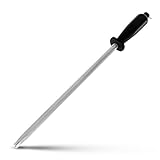
The Kota Japan is the only pick here with diamond electroplating on the rod surface, which is why Kota says it takes a lighter touch than plain steel. The rod is 12 inches with an 18-inch overall length, which clears a full-size chef knife in one pass. At 6.74 oz it is the lightest of the seven, which suits a rod you pick up 40 times a shift. The oval cross-section, which Kota says raises sharpening efficiency, gives you a broader contact patch than a round rod.
Two things to weigh against the win. The listing does not name the handle material, only calls the design elegant, so you cannot judge grip from the page. And a diamond coat removes more metal than a nickel-chrome steel like the Utopia's, so a chef who hones daily on soft German steel will burn through blade life faster than with a plain rod. That is the trade for aggression.
Pros:
- Diamond-electroplated rod, the only one in this set
- Full 12-inch rod, 18-inch overall length
- Lightest rod here at 6.74 oz
- Oval cross-section for a broader contact patch
- Sits mid-range on price for the coating type
Cons:
- Handle material not stated on the listing
- More aggressive than a plain rod, so removes more metal over time
- Only one seller listed
2. Utopia Kitchen Knife Sharpener Rod 10 Inch — Best for pros
The rod a line cook will actually pick up between tickets.
Best for: a line cook who hones several knives every shift. Skip it if: your chef knife is longer than 10 inches.
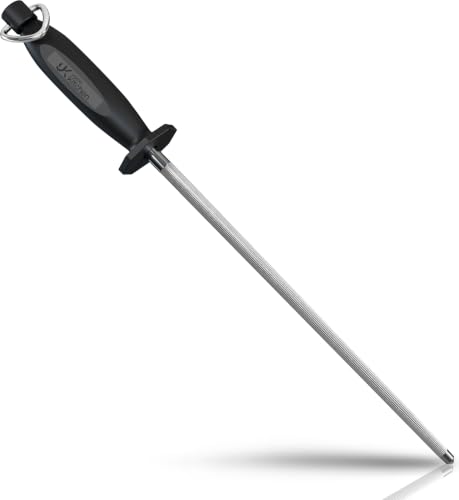
The Utopia Kitchen 10 Inch is the fastest seller of the seven by a wide margin, and the reason is on the spec sheet. At 0.71 lb with a 10 inch rod, it hits the working sweet spot: heavy enough to feel planted, short enough to swing in a tight prep station. Utopia says the rod is carbon steel plated with nickel-chrome, and the plating is why this is a plain-steel-feel rod rather than a metal remover. That is the right profile for a cook who is realigning edges, not resharpening them.
The listing calls out serrated compatibility and an ergonomic non-slip handle sized for either hand. There is a hanging loop for rail storage, which matters in a station with no drawer space. The trade-off against the Kota Japan is aggression: this rod will not rescue a badly rolled edge in three strokes. It will keep a well-honed knife true for a full shift, which is a different and, for most professional kitchens, more useful job.
Pros:
- 10 inch rod at 0.71 lb, balanced for shift use
- Nickel-chrome plating over carbon steel, gentler than diamond
- Ambidextrous non-slip handle per the listing
- Hanging loop for rail or hook storage
- Second-cheapest of the seven
Cons:
- Rod is 10 inches, tight against a 10 inch chef blade
- Nickel-chrome plating is not a coated grit surface
- Marketed for serrated edges, which most pros hone on a stone anyway
3. Cutluxe Honing Rod — Best upgrade
The heaviest 10 inch rod in this set, with a stated PakkaWood handle.

Best for: a chef who wants a PakkaWood handle and a heavier rod. Skip it if: you want a full 12 inches of steel.
The Cutluxe is 10 inches of rod on a PakkaWood handle, weighing a full 1 lb, which is the heaviest of the seven. That mass helps: a heavier rod stays put against your knuckle guard and gives you a more consistent stroke. Cutluxe names the handle explicitly as PakkaWood and says it fits both hands, which is the level of documentation missing from the top pick.
Two honest weaknesses. Rod length is 10 inches, so it matches the Utopia rather than the 12 inch group, and it sits in the most expensive price band. You are paying premium money for a better handle and more mass, not for more sharpening capability. That upgrade is worth it if you hone on a station where the rod gets grabbed with wet or oily hands. It is not worth it if your priorities are aggression or length.
Pros:
- Named PakkaWood handle, ambidextrous
- Heaviest rod here at 1 lb
- Stated 10 inch rod length
- Full 17.7 inch overall length for a 10 inch rod
- Clear handle material on the listing
Cons:
- Sits in the top price band of the seven
- Rod length is 10 inches, not 12
- No grit or coating figure published
4. HOSHANHO Honing Rod — Best premium
The only rod in this set that publishes both a Japanese-steel source and a claimed HRC hardness family.

Best for: someone honing hard Japanese-style blades that need a fine surface. Skip it if: you want the cheapest working option.
The HOSHANHO listing goes further on documentation than any other pick. HOSHANHO says the rod is Japanese high-carbon steel with a vacuum heat treatment, and the sharpening surface uses what the listing calls a fine and uniform fine-sand structure, a high-mesh grinding layer. Translated to spec sheet language, that means a coated rod with a finer grit than the Azhou, on a natural wood handle. The rod is 12 inches long and weighs 0.88 lb, sitting between the Kota Japan's aggression and the plain-steel weight of the ALLWIN.
The catch is the price position. This is the most expensive pick here, and the sales rank is the slowest of the seven, so the value case is thin unless you actually need a fine-grit coated rod for hard Japanese blades. On soft German steel, the Utopia does the same job for less. If you run a Japanese-style edge and a plain steel rod feels too coarse, this is where to look.
Pros:
- Named Japanese high-carbon steel source
- Fine-grit coated rod surface per the listing
- 12 inch rod on a natural wood handle
- Full 12.2 inch overall length matches the rod
- Only pick claiming a heat-treatment process
Cons:
- Most expensive of the seven
- Slowest seller in this set
- Marketing text does the heavy lifting for the grit claim
- Handle described but wood species not named
5. ALLWIN-HOUSEWARE W 12-Inch Knife Sharpening Rod — Most versatile
A 12 inch plain carbon steel rod that covers chef, paring and butcher knives from one hook.
Best for: a home cook who wants one rod for chef, paring and butcher knives. Skip it if: you need a published weight before buying.
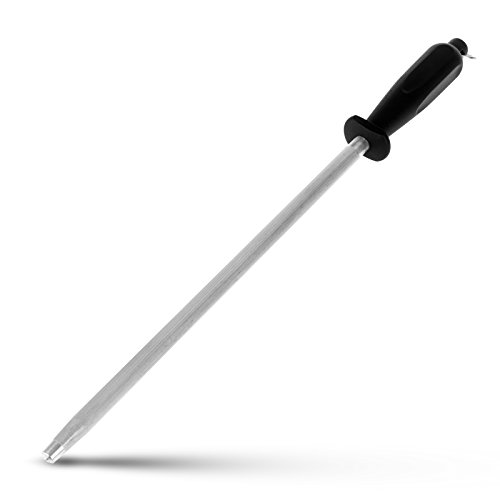
The ALLWIN is a 12 inch plain carbon steel rod on a textured non-slip handle, with what the listing calls an anti-slip metal tip. That tip matters more than it sounds: a metal-capped rod anchors on a cutting board without slipping, which is the safest way to hone if you are not doing the guillotine-drop pass a chef does in the air. The listing calls out chef knives, paring knives and butcher blades as compatible, and at 16.9 inches overall it clears any home kitchen blade.
Two limits. The listing does not publish a weight, which is a real gap when you are choosing between rods on feel. And with two sellers listed, this pick has the widest supply of any rod here, but no grit or coating figure is given. That is the honest picture: a well-specified plain steel rod at an entry price, with less documentation than the Cutluxe for a similar layout.
Pros:
- 12 inch rod on a full 16.9 inch overall length
- Anti-slip metal tip per the listing
- Textured non-slip handle
- Two sellers listed, wider supply than the rest
- Entry price band
Cons:
- Weight not published on the listing
- No grit or coating figure given
- Handle material named only as textured
6. Azhou 12" Professional Knife Sharpener Fine Honing Rod — Best minimal setup
The only rod here with a published grit number and a stated hardness.

Best for: a chef who wants a stated grit and hardness on the listing. Skip it if: you dislike gift-box packaging.
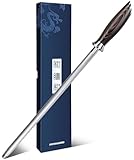
The Azhou is the only pick in this set that puts a grit number on the listing: Azhou says the rod is a 200-grit fine honing surface on hardened high-carbon steel at HRC 63±2. That is coarse enough to remove a hair of metal on each pass, which puts this rod in the light-sharpening camp rather than the pure-honing one, and the hardness figure tells you the rod itself will outlast the knives you use on it. The 12 inch rod weighs 0.9 lb on a Pakka wood handle.
The trade-offs are real. The rod is sold in a gift box, which prices it into the premium band without adding capability at the pass. Sales rank is the second-slowest of the seven, and the model number reads like a first-run product, so you are betting on a less established listing than the top three. On paper, though, this is the most transparently specified rod on the shortlist.
Pros:
- Published 200-grit rod surface
- Stated HRC 63±2 hardness
- 12 inch rod at 0.9 lb
- Pakka wood ergonomic handle
- Full 17.3 inch overall length
Cons:
- Sits in the top price band
- Sales rank is second-slowest of the seven
- Gift-box packaging adds cost, not capability
7. FANERFUN Knife Sharpener Rod — Best budget pick
The longest rod in this set at the lowest price position.

Best for: a cook who wants a 13-inch rod at the lowest price here. Skip it if: you want a metal-tipped, weighted rod.
The FANERFUN is a 13 inch textured carbon steel rod on a polypropylene handle. Two things stand out. It is the longest rod in this comparison, which means it clears a 10 inch chef knife with three inches of run-out to spare. And it is the cheapest of the seven, which makes it the easy pick for a second rod for a knife bag or a prep station where the main rod is a Kota Japan.
The trade-offs are what you would expect at the entry price. Listed weight is 3.2 oz, which is roughly half the Kota Japan and less than a quarter of the Cutluxe, so the rod feels light against a heavy blade. Handle is polypropylene rather than PakkaWood or natural wood, and the listing does not describe a metal tip. Compared with the ALLWIN, you get an extra inch of rod and a lower price for a less anchored feel and a plastic handle.
Pros:
- Longest rod here at 13 inches
- Cheapest of the seven
- Textured carbon steel honing surface
- Hanging end for storage
- Listing names chef, butcher, carving and fillet knives as compatible
Cons:
- Only 3.2 oz, lightest handle-and-rod combined of any pick
- Polypropylene handle rather than wood or PakkaWood
- No metal tip described
- Rod cross-section not specified
Rod length: does 12 inches beat 10 for a working chef?
Rod length is where most guides oversimplify. The rule chefs are taught is that the rod should be at least as long as the blade, and in this set that puts you into 12-inch territory for a 10-inch chef knife.
But length is not free. A longer rod takes more counter space, catches on a full station and adds swing weight during a fast hone. Here is how the seven picks split:
- 13 in: FANERFUN.
- 12 in: Kota Japan, HOSHANHO, ALLWIN-HOUSEWARE, Azhou.
- 10 in: Cutluxe, Utopia Kitchen.
For an 8-inch home chef knife, any of the 10-inch rods clears it. For a full 10-inch chef knife, you want a rod longer than 10 inches so you can run the whole edge in one pass without lifting off the tip. For anything longer, a butcher's cimeter or a slicer, you are into the 12-inch and 13-inch group. That is the real reason the Kota Japan wins the overall pick: a 12-inch rod with an 18-inch overall length is the shortest rod that clears everything a professional chef pulls out of a knife roll.
What the listings do not tell you about grit
Grit is the specification most listings hide behind adjectives. "Fine surface", "high-mesh grinding layer", "textured" and "nickel-chrome plated" are all descriptions of the rod's cutting behaviour, and only one of the seven puts a number on it.
The Azhou publishes 200 grit. The HOSHANHO describes a fine-sand, high-mesh coating without a number. The Kota Japan is diamond-electroplated, which typically runs finer than a plain diamond stone but coarser than a fine ceramic rod. The other four are plain or plated carbon steel with no coated grit.
Practically, that maps to three tiers:
- Plain or plated carbon steel (Utopia, ALLWIN, Cutluxe, FANERFUN): realignment only, gentle on the blade.
- Coated fine grit (Azhou, HOSHANHO): light metal removal on each pass, closer to a sharpening rod.
- Diamond-electroplated (Kota Japan): the most aggressive here, brings a rolled edge back fast.
Match the tier to your actual work. A prep cook realigning edges every morning wants tier one. A chef who hones twice a shift on hard Japanese steel wants tier two. A hunter or butcher whose blades take a beating wants tier three. Buying a diamond rod for realignment work will shorten the life of an expensive knife.
If your knife is German, Japanese or serrated
The steel your knives are made from should change the rod you pick, and the listings do not really talk about this.
- German or European stainless (softer, HRC 56 to 58): any plain steel rod here works, and a diamond rod is overkill and eats metal. Utopia Kitchen or Cutluxe are the safer picks.
- Japanese or high-carbon steel (harder, HRC 60+): a fine-coated rod like the HOSHANHO or Azhou grips the harder steel where a plain rod skates.
- Serrated edges: most rods here are marketed as serrated-compatible, but honing serrations on a smooth rod is a compromise. Utopia calls this out explicitly on the listing. For serious serration work, you want a tapered ceramic rod that fits each scallop, which is not in this comparison.
- Damascus or laminated blades: the diamond coating on the Kota Japan removes more cladding per pass than most makers recommend. Stick to plain or fine-coated for these.
The winner shifts here. For a German-steel kitchen, the Utopia Kitchen becomes the everyday pick and the Kota Japan is the rescue tool. For a Japanese-steel kitchen, the HOSHANHO earns its price band. That is why one rod is not enough for a professional carrying more than one knife family.
What more money buys in a honing rod
The seven picks span three price bands, and the story between them is not what you would guess.
Moving from entry (FANERFUN, Utopia Kitchen, ALLWIN) to mid (Kota Japan) buys you a coating. Diamond electroplating is a materials cost the entry rods do not carry. That is the single biggest capability step in this set.
Moving from mid to premium (Cutluxe, Azhou, HOSHANHO) does not buy you more coating capability. It buys you a better handle, more mass, and better documentation on the listing. The Cutluxe adds a PakkaWood handle and a full pound of weight. The Azhou adds a published grit and a stated hardness. The HOSHANHO adds a named steel source and a described coating process.
None of those upgrades will hone your knives noticeably better than the Kota Japan. What they buy is confidence: you know what steel you are pressing against, you know how hard your rod is, and you know your handle will not slip in a wet grip. For a professional whose knives are the tools of the trade, that confidence is a fair trade for the price step. For a home cook, it usually is not.
The verdict
Two tracks here, and the cutoff is the length of your longest chef knife.
If your longest chef knife is 10 inches or more, the Kota Japan 12 in. Diamond Carbon Steel Professional Knife Sharpener Rod is the best carbon steel knife sharpener for professional chefs in this set. The 12 inch rod, 18 inch overall length, diamond-electroplated surface and 6.74 oz working weight make it the fastest rod to bring a rolled edge back true, and the price sits in the middle of the seven, not the top. That is the working chef's rod.
If your longest chef knife is 8 inches or shorter, the Utopia Kitchen Knife Sharpener Rod 10 Inch is the better buy. The 10 inch rod, 0.71 lb weight, nickel-chrome plated carbon steel surface and ambidextrous non-slip handle add up to the rod a line cook actually reaches for between tickets. It costs less than the Kota Japan and sits in the entry price band. The cutoff is that 10 inch blade length: past it, the rod runs out; before it, the Utopia does everything the Kota Japan does with less metal removal per pass.
The premium picks earn their spots by profile, not by ranking. The HOSHANHO for hard Japanese steel. The Cutluxe for a better handle. The Azhou for the only published grit. None of them beats the top two on core job.
FAQ
What is the best carbon steel knife sharpener for professional chefs?
The best carbon steel knife sharpener for professional chefs in this set is the Kota Japan 12 in. Diamond Carbon Steel Professional Knife Sharpener Rod. Its 12 inch diamond-electroplated rod clears a full-size chef knife in one pass, weighs 6.74 oz for fast handling, and the diamond surface brings a rolled edge back faster than any plain steel rod here.
Is a carbon steel honing rod worth the money over a ceramic one?
A carbon steel honing rod is worth the money for most working kitchens because it realigns edges rather than removing metal. Ceramic rods are finer and more fragile. Carbon steel handles a shift on the line, survives a drop, and works on both German and Japanese blades. For daily edge maintenance, the carbon steel rods here do the job ceramics cannot.
What rod length does a professional chef actually need?
Rod length should match your longest blade with at least an inch of run-out. In this set, that means 12 inches for a 10 inch chef knife, and 10 inches only for an 8 inch blade. The Kota Japan and ALLWIN cover 12 inches. FANERFUN reaches 13 inches. Utopia Kitchen and Cutluxe stop at 10 inches.
Kota Japan versus Utopia Kitchen: which honing rod wins?
Kota Japan versus Utopia Kitchen comes down to aggression versus daily use. The Kota Japan is diamond-electroplated, 12 inches long and rescues rolled edges fast. The Utopia is 10 inches, nickel-chrome plated over carbon steel, and gentler on the blade. For a rescue tool, pick the Kota Japan. For a shift rod you reach for every ticket, pick the Utopia.
What mistake do buyers make with carbon steel knife sharpeners?
Buyers make the mistake of choosing a rod on price and length, then ignoring the coating. A diamond-electroplated rod on soft German steel removes metal you did not need to lose. A plain steel rod on hard Japanese steel skates without honing. Match the coating tier to your knife steel first, and pick length and handle second. That order matters.
Start with the two knives you use most, measure the longest, and pick from the length group above it. If that puts you in the 12 inch tier and you want the fastest edge refresh, the Kota Japan is the default. If you land in the 10 inch tier and hone daily, the Utopia Kitchen is the default. Everything else in this set solves a narrower problem: a specific steel, a specific handle preference, a specific price ceiling. Buy the rod that fits the knife you own, not the one that looks most professional on the pass.