Best Eco Friendly Knife Sharpener for a Home Kitchen
No cords, no motors, no replacement cartridges. Six hand-powered sharpeners lined up by abrasive stage, footprint and published warranty, with the deciding spec named up front.

By Elin RoweUpdated 17 min read
On this page
- Best eco friendly knife sharpener at a glance
- What does eco friendly actually mean here?
- How I cut the field down to six
- Why abrasive stages decide this, not materials
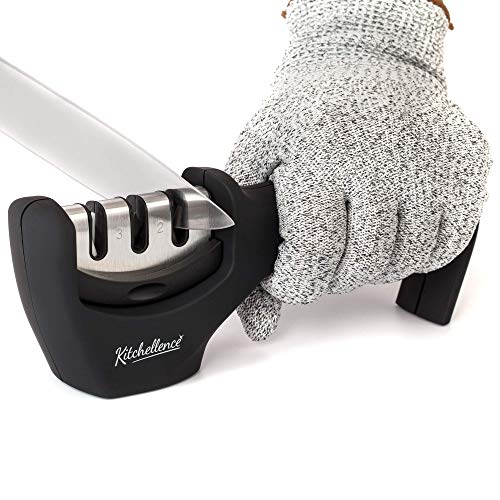
- 1. KITCHELLENCE 4-in-1 Kitchen Knife Accessories — Best overall
- 2. SHARPAL 191H Knife Scissors Sharpener — Best warranty
- 3. AIERLIAN Knife Sharpener Tool — Best premium
- 4. AccuSharp Knife Sharpener — Best upgrade
- 5. Amazon Basics 4-in-1 Kitchen Knife Sharpener — Best budget pick
- 6. Sharp Pebble Orange Ninja Sharpener — Best minimal setup
- Rolling guide or pull-through: which suits your knives?
- What the listings never tell you about wear
- When a different pick wins
- The verdict
- FAQ
The best eco friendly knife sharpener is the KITCHELLENCE 4-in-1, a 6.35 oz hand-powered three-slot unit that repairs, sharpens and polishes without a cord, a motor or a cartridge to replace. If you want a published warranty behind it, the SHARPAL 191H states 3 years and weighs just 3.04 oz. The deciding spec in this field is how many abrasive stages you get and what each one is made of. Two slots means you set an edge and stop. Four means you can finish it.
Best eco friendly knife sharpener at a glance
| Pick | Stages | Weight | Price |
|---|---|---|---|
Best overall KITCHELLENCE 4-in-1 Kitchen Knife Accessories |
3 slots + glove | 6.35 oz | Check Price |
Best warranty SHARPAL 191H Knife Scissors Sharpener |
3 stages, carbide + ceramic claim | 3.04 oz | Check Price |
Best premium AIERLIAN Rolling Knife Sharpener Tool |
#400 diamond + #3000 ceramic claim | 1.26 lb | Check Price |
Best upgrade AccuSharp Knife Sharpener |
1 carbide stage claim | 1.6 oz | Check Price |
Best budget pick Amazon Basics 4-in-1 Knife Sharpener |
3 knife + 1 scissor slot | Not published | Check Price |
Best minimal setup Sharp Pebble Orange Ninja Sharpener |
4 slots incl. serrated | 0.68 lb | Check Price |



What does eco friendly actually mean here?
Amazon's search ignored the qualifier. None of these six listings publishes a recycled-content figure, a certification, a carbon claim or a takeback scheme, so nobody gets to call themselves green on this page. You have to judge that part yourself.
What the data does show is a field of hand-powered tools. Every one of the six runs on your arm. No plug, no battery, no motor, no cartridge subscription. That is a real difference from an electric sharpener, and it's the closest thing to a sustainability angle the listings support.
The materials tell a mixed story. KITCHELLENCE and Sharp Pebble both name ABS plastic bodies. AIERLIAN names high-grade natural wood plus four N42 magnets and a leather strop. AccuSharp publishes a white plastic body at 1.6 oz. Amazon Basics names a silicone non-slip base.
If your definition of a best eco friendly knife sharpener is "the thing I buy once and never replace", the questions worth asking are these:
- Is the abrasive replaceable, or is the whole tool disposable when the carbide dulls?
- Does the body use one material or several bonded together?
- Is there a stated warranty, which tells you what the maker expects to outlast?
- Can it sharpen every knife you own, or will you buy a second tool?
Only SHARPAL answers the third one with a number. AccuSharp lists a manufacturer warranty without a term. The other four publish nothing on warranty at all.
How I cut the field down to six
Three things got listings cut before I compared anything.
Cut one: powered units. Anything with a cord or a battery was out on the first pass. Motors fail, cartridges get replaced, and a broken electric sharpener is a landfill item with a plug attached. Every survivor here is muscle-powered.
Cut two: single-slot tools with nothing published about the abrasive. A sharpener that says "sharpens knives" and stops is not a spec sheet. AccuSharp survived this cut because it names diamond-honed tungsten carbide and says the blade is replaceable, which is exactly the kind of detail that separates a tool from a token.
Cut three: listings with no published dimensions or weight. If I can't tell you whether it fits a drawer, the comparison is decoration. Five of the six publish a weight. Amazon Basics publishes dimensions of 3.5 x 8.9 x 2.17 in but no weight, which is why the table says so plainly.
What survived is six tools that span the full range of approaches in the category. Three pull-through units with multiple grit slots. One suction-mounted compact. One handheld single-stage. One rolling guide system with magnetic angle support.
I then lined the published specifications up side by side: stage count, abrasive material as claimed, footprint, weight, warranty term. Where a maker states something I can't verify from a spec field, I've said who's claiming it.
Why abrasive stages decide this, not materials
Most eco friendly knife sharpener guides compare the body material. Plastic bad, wood good, done. That's the wrong axis.
Here's the thing. A sharpener you have to replace twice is worse than one plastic tool you keep for a decade. And what determines whether you keep it is whether it does the whole job. A single coarse stage sets an edge and leaves it toothy. That edge dulls fast, you go back to the tool more often, and you grind away more steel each time.
Multiple stages fix that. Coarse repairs damage. Medium sharpens. Fine polishes. A polished edge holds longer, so you sharpen less, so you remove less metal from a knife you'd rather keep for twenty years.
Count the stages in this set:
- AccuSharp — one carbide stage, per its listing.
- AIERLIAN — two discs, #400 diamond and #3000 ceramic per the maker.
- KITCHELLENCE — three slots.
- SHARPAL 191H — three stages, with carbide and ceramic named.
- Amazon Basics — three knife slots plus a dedicated scissor slot.
- Sharp Pebble Orange Ninja — four slots, one of them for serrated edges.
That ranking is not the same as my ranking, and that's deliberate. Stage count is the first filter, not the last word. Amazon Basics has four slots and states plainly it is not suitable for serrated knives. Sharp Pebble has four and handles serrated. Same number, different job.
1. KITCHELLENCE 4-in-1 Kitchen Knife Accessories — Best overall
Three abrasive stages, a cut-resistant glove in the box, and 6.35 oz of tool to store, which is the most complete package here without stepping up in price position.
Best for: a mixed knife drawer that needs repair and polish in one tool Skip it if: you sharpen Japanese steel to a fixed angle
What sets this one apart in the set is balance. It's the tool buyers here reach for most often, and the spec sheet explains why. Three slots cover the full sequence from repair to polish. The footprint is 3.4 x 8.3 x 2.2 in, so it lies flat in a utensil drawer. At 6.35 oz it's heavier than the SHARPAL and lighter than the AIERLIAN, which is roughly where you want a pull-through to sit: enough mass to stay put, light enough to hold steady with one hand.
KITCHELLENCE describes a solid ABS plastic body and calls the handle ergonomic for right or left-handed use. It also puts a cut-resistant glove in the box, which two of the six do and four don't. The maker's copy leans hard on the word professional, which is marketing, not measurement.
The trade-off against the AIERLIAN is control. There's no published angle guide here, so the slot sets the angle for you. Against the SHARPAL, you lose a stated warranty term. Against the Sharp Pebble, you lose the fourth slot for serrated bread knives.
Pros:
- Three graded slots cover repair, sharpen and polish
- Cut-resistant glove included in the box
- Flat 3.4 x 8.3 x 2.2 in footprint fits a drawer
- 6.35 oz gives steadiness without bulk
- The pick buyers choose most often in this set
Cons:
- No warranty term published on the listing
- No published slot for serrated edges
- Angle is fixed by the slot, not adjustable
- ABS plastic body mixes materials if you ever recycle it
2. SHARPAL 191H Knife Scissors Sharpener — Best warranty
The only pick here with a warranty term you can actually read: 3 years, stated on the listing, in a 3.04 oz body smaller than a coffee mug.

Best for: someone who wants a stated 3-year cover and a suction base Skip it if: you need to sharpen serrated bread knives
Warranty is the sustainability spec nobody talks about. A maker who commits to 3 years is telling you what it expects the tool to survive. SHARPAL publishes exactly that, covering defects in material and workmanship under normal wear, excluding misuse and commercial use. Four of the six picks publish nothing comparable.
The physical case is strong too. At 2.76 x 2.76 x 2.36 in and 3.04 oz, this is the smallest and second-lightest tool here. SHARPAL claims a suction base with twice the holding force of similar products, activated by a black switch, plus tungsten carbide blades for edge setting, ceramic for honing, and a third carbide blade for scissors. Those are the maker's claims, not verified figures, and the suction claim in particular depends entirely on your counter being smooth and flat.
That's the catch. On a butcher block or a textured laminate, a suction base has nothing to grab. The KITCHELLENCE and Sharp Pebble use handle-and-footprint stability instead, which works anywhere. This one trades universal grip for a smaller footprint.
Pros:
- 3-year warranty term stated on the listing
- Smallest footprint in the set at 2.76 in square
- Lightest multi-stage pick at 3.04 oz
- Dedicated scissor stage alongside knife stages
- Carbide and ceramic abrasives both named
Cons:
- Suction base needs a smooth, flat surface to work
- No serrated knife slot published
- Warranty excludes commercial use entirely
- Sells slower here than the top pick despite the cover
3. AIERLIAN Knife Sharpener Tool — Best premium
A rolling diamond-and-ceramic system with magnetic 15 and 20 degree supports, for the person whose knives are worth more than the sharpener.
Best for: expensive knives you want held at 15 or 20 degrees Skip it if: you want a 30-second job with no setup
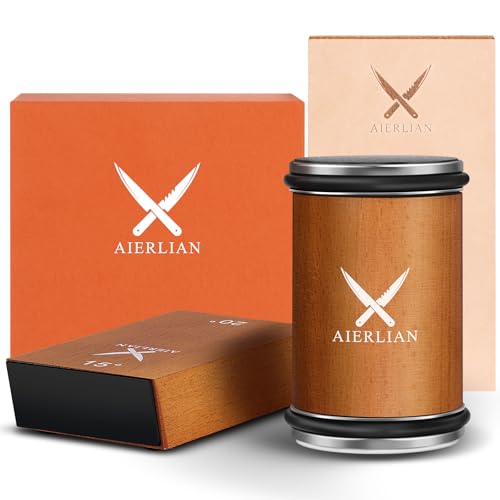
This is the most expensive pick here and the only one that changes how you sharpen rather than just what you sharpen with. Instead of pulling a blade through a slot, you clamp it to a magnetic base and roll an abrasive disc along the edge at a set angle. AIERLIAN names #400 diamond and #3000 ceramic discs, a base with four N42 magnets, high-grade natural wood, and a leather strop for finishing.
Two things follow from that. First, angle consistency is the whole pitch, and a 15 degree option matters if you own Japanese-profile knives that a fixed Western slot would blunt. Second, this is the only pick in the set built primarily from wood rather than plastic, with a leather strop rather than a ceramic rod. If material sourcing is what drove your search for a best eco friendly knife sharpener, this listing gives you the most to work with, though it still publishes no certification.
At 1.26 lb it's the heaviest here by a wide margin, and 2.7 x 5.49 x 4.6 in is a chunkier storage shape than the flat pull-throughs. It's also the slowest of the three most expensive picks to move.
Pros:
- 15 and 20 degree magnetic angle supports
- #400 diamond and #3000 ceramic discs claimed
- Natural wood body and leather strop included
- Four N42 magnets hold the blade to the base
Cons:
- Heaviest pick here at 1.26 lb
- Setup takes longer than a pull-through
- No warranty term published
- Highest price position in the set with no stated cover
4. AccuSharp Knife Sharpener — Best upgrade
At 1.6 oz with a carbide blade AccuSharp says most owners replace every 5 to 10 years, this is the least tool for the most longevity.

Best for: the lightest tool you can throw in a drawer or a pack Skip it if: you want multiple grits and a finishing stage
Weight is the headline: 1.6 oz, the lightest of the six by a factor of nearly two against the SHARPAL. It's also the second-cheapest here. AccuSharp names diamond-honed tungsten carbide blades, says the design is double-bevelled, states the blades are replaceable, and says the whole thing cleans with soap and water or in a dishwasher. It claims most owners go 5 to 10 years between blade changes and around ten seconds per blade.
That replaceable-blade detail is the reason this one earns an upgrade label rather than a budget one. A tool whose only wearing part can be swapped is the closest thing in this set to a buy-once purchase. The listing also says it handles serrated as well as straight edges, which the Amazon Basics explicitly does not.
The cost is refinement. One carbide stage means one grit, so there's no medium and no polish. You get a working edge fast and a coarser one than the three-stage picks leave. The published warranty says "manufacturer warranty" with no term, which tells you nothing next to SHARPAL's 3 years. And the spec fields carry two conflicting size entries, 9"L x 4"W x 1"H and 1.97 in cubed, so plan storage generously.
Pros:
- Lightest pick in the set at 1.6 oz
- Carbide blade stated as replaceable
- Dishwasher-safe per the listing
- Handles serrated and straight edges
- Second-cheapest of the six
Cons:
- Single grit, no honing or polishing stage
- Warranty stated with no term attached
- Two conflicting published size figures
- No angle guide of any kind
5. Amazon Basics 4-in-1 Kitchen Knife Sharpener — Best budget pick
Four slots, a silicone non-slip base and a glove for the lowest price position here, as long as your bread knife isn't the problem.

Best for: a first sharpener for a cheap knife block Skip it if: your bread knife is the one that needs help
This is the cheapest of the six and a 2025 release, which makes it the newest listing in the set. The layout is familiar: three graded knife slots labelled coarse, medium and fine, plus a fourth dedicated to scissors. Amazon Basics names a silicone non-slip base for stability and puts cut-resistant gloves in the box. Cleaning is a rinse or soapy water.
For a drawer of mid-range knives that have never been sharpened, that's a complete starting kit at the lowest cost of entry here. The three-stage sequence is the same idea the KITCHELLENCE uses, and the silicone base is a more surface-agnostic answer to stability than the SHARPAL's suction switch.
Two gaps matter. The listing states outright that it is not suitable for serrated knives, so a bread knife or a tomato knife stays dull. And no weight is published at all, only dimensions of 3.5 x 8.9 x 2.17 in, which makes it the one pick in this set I can't place on the weight axis. It's also the second-slowest seller of the six, and there's no warranty term on the page.
Pros:
- Lowest price position of all six picks
- Three knife grits plus a dedicated scissor slot
- Silicone non-slip base works on most counters
- Cut-resistant gloves included
- Newest listing here, released 2025
Cons:
- Explicitly not suitable for serrated knives
- No published weight figure at all
- No warranty term on the listing
- Slower seller than most of this set
6. Sharp Pebble Orange Ninja Sharpener — Best minimal setup
Four slots including a serrated stage, at 0.68 lb, for the drawer where a bread knife and a chef's knife both need attention.

Best for: a drawer where serrated and straight edges both need work Skip it if: counter space is measured in inches
The Orange Ninja is the widest-coverage pull-through in this set. Sharp Pebble describes a four-slot system: a carbide coarse slot for straightening and repairing damaged blades, medium and fine stages for knives, and coverage for serrated edges alongside them. That's one more capability than the KITCHELLENCE and the direct answer to the Amazon Basics' serrated exclusion.
Setup is the appeal. No suction switch to engage, no magnetic base to align, no angle to choose. You pick a slot and pull. At 0.68 lb it's the second-heaviest pick here, which in a pull-through means it doesn't skate across the counter. The body is high-quality ABS plastic per the maker, and the handle is described as working for either hand.
It's also the most expensive pick after the AIERLIAN, which is a lot to ask for a plastic pull-through when the KITCHELLENCE covers three of the same stages for less. And at 3.3 x 8.18 x 1.96 in it wants roughly the same drawer real estate as the Amazon Basics without a published warranty to justify the step up. It's the slowest seller of the six by a clear margin.
Pros:
- Four slots, including coverage for serrated edges
- 0.68 lb keeps it planted during a pull
- Long ergonomic handle for either hand
- No setup step before sharpening
Cons:
- Second-highest price position in the set
- No warranty term published
- Slowest-selling pick of the six
- 8.18 in length needs real drawer space
Rolling guide or pull-through: which suits your knives?
Five of these six are pull-throughs. One, the AIERLIAN, is a rolling guide. That's the biggest fork in the road here, and it comes down to what your knives cost.
A pull-through sets the angle for you inside the slot. Fast, no thinking, no setup. The catch is that the slot's angle is the slot's angle, and if your knife was ground to a narrower bevel, the first pull reprofiles it.
A rolling guide lets you choose. AIERLIAN publishes 15 and 20 degree magnetic supports, which covers both common profiles. The cost is time and a heavier tool at 1.26 lb.
Use this as the cutoff:
- Knives you'd replace without much thought — pull-through. KITCHELLENCE for three stages, Amazon Basics for the lowest entry cost.
- Knives you chose deliberately, especially at 15 degrees — rolling guide. AIERLIAN is the only pick here with published angle support.
- A mix of both, plus a bread knife — Sharp Pebble, for the serrated slot.
What the listings never tell you about wear
Here's what nobody publishes. Only AccuSharp says its abrasive is replaceable and gives an expected interval of 5 to 10 years between blade changes. The other five say nothing about what happens when the carbide stops biting.
That silence matters if longevity is why you're shopping. A pull-through with worn carbide is not repairable by you, and none of the five listings names a spare part. Practically, the tool becomes the consumable.
The other unpublished detail is metal removal. Carbide stages cut aggressively by design. Every pass takes steel off a blade you'd rather keep, which is why the picks with a medium and fine stage matter more than the stage count alone suggests. Use coarse once when the edge is damaged, then live on the fine slot.
Most shoppers miss this part. Three things worth knowing before you buy:
- A stated warranty term is the only durability signal on these pages. SHARPAL's 3 years is the only one.
- Cleaning method is published for three picks: AccuSharp says dishwasher or soap, Amazon Basics says rinse or soapy water, and metal filings need somewhere to go.
- Stability method varies. Suction needs smooth counters, silicone needs almost none, handle length needs a free hand.
When a different pick wins
The KITCHELLENCE is the default. Four things flip it.
If your bread knife is the dull one. Amazon Basics states it won't do serrated. Go Sharp Pebble for its serrated slot, or AccuSharp, which its listing says handles serrated and straight.
If you sharpen at 15 degrees. No pull-through here publishes an angle. AIERLIAN publishes both 15 and 20, and that's the whole reason to pay its premium.
If a warranty term is non-negotiable. SHARPAL's 3 years is the only stated period in the set, and it's the lightest multi-stage pick at 3.04 oz.
If you want the smallest possible object. AccuSharp at 1.6 oz, with a blade the maker says you can replace.
The verdict
If you cook most nights on knives you bought as a set, the KITCHELLENCE 4-in-1 is the eco friendly knife sharpener to buy. Three graded slots let you repair once and then maintain on the fine stage, which takes less steel off the blade over a decade than a single coarse tool does. It's 6.35 oz, it lies flat at 3.4 x 8.3 x 2.2 in, it brings a cut-resistant glove, and it's the tool buyers here pick most often.
If you own knives you chose one at a time, the AIERLIAN rolling system is the better buy. Its exact advantage is published angle control: 15 and 20 degree magnetic supports, #400 diamond and #3000 ceramic discs, a wood body and a leather strop. No pull-through in this set names an angle at all, and a 15 degree Japanese bevel dragged through a wider slot loses its geometry on the first pass.
The cutoff is whether your knife's bevel matters to you. If you don't know your knife's angle, you don't need to, and a pull-through is the right call. If you do know it, a fixed slot is a downgrade dressed as convenience.
One caveat on the whole category. No listing here publishes a recycled-content figure or a certification, so treat every green claim as your call to make, not mine.
FAQ
Is an eco friendly knife sharpener worth buying over an electric one?
An eco friendly knife sharpener is worth it if you'd rather own one hand-powered tool for a decade than replace a motor. Every pick here runs on arm power, with no cord, battery or cartridge. The trade-off is speed and consistency: AccuSharp claims ten seconds a blade, but you supply the pressure and the stroke count yourself.
Which offers better value, the KITCHELLENCE or the Amazon Basics 4-in-1?
Better value between the KITCHELLENCE and the Amazon Basics depends on your bread knife. Amazon Basics costs less, adds a scissor slot and a silicone base, but states it won't sharpen serrated edges. KITCHELLENCE covers three graded stages, weighs a published 6.35 oz, and moves faster in this set. Pay less for Amazon Basics if your knives are all straight-edged.
What abrasive materials do these sharpeners use?
The abrasive materials named across these listings are tungsten carbide, ceramic and industrial diamond. SHARPAL claims carbide for edge setting and ceramic for honing. AccuSharp names diamond-honed tungsten carbide. AIERLIAN specifies #400 diamond and #3000 ceramic discs. KITCHELLENCE, Amazon Basics and Sharp Pebble describe graded coarse, medium and fine slots without publishing a grit number.
Will a pull-through sharpener ruin an expensive Japanese knife?
A pull-through sharpener can reprofile a Japanese knife, because the slot fixes the angle and none of the five pull-throughs here publishes what that angle is. If your blade was ground near 15 degrees, use the AIERLIAN instead. It publishes 15 and 20 degree magnetic supports and holds the blade at whichever you choose.
How much counter or drawer space do these need?
Counter and drawer space varies more than you'd expect. SHARPAL is smallest at 2.76 x 2.76 x 2.36 in. AIERLIAN is chunkiest at 2.7 x 5.49 x 4.6 in and 1.26 lb. The pull-throughs need length: KITCHELLENCE at 8.3 in, Amazon Basics at 8.9 in, Sharp Pebble at 8.18 in. Measure your drawer before choosing.
Start with your dullest knife, not your favourite one. If it's a straight-edged chef's knife, the KITCHELLENCE handles the repair on its coarse slot and then keeps the edge on fine for years, which is the whole argument for a three-stage hand tool over anything with a plug. If it's a serrated bread knife, jump to the Sharp Pebble. And if it's a knife you saved up for, spend the extra on the AIERLIAN and its 15 degree guide, because the cheapest sharpener is the one that quietly reshapes a blade you paid real money to have ground correctly.