Best Ceramic Knife Sharpener for a First Kitchen
Five ceramic sharpeners and honing rods lined up by published specs, with the one flaw every first-timer should know before choosing a pull-through, a rolling kit, or a 10-inch rod.

By Elin RoweUpdated 14 min read
On this page
- Best ceramic knife sharpener for beginners at a glance
- How I scored these five listings
- Pull-through, rolling kit or rod: which suits a first-timer?
- 1. KITCHELLENCE 4-in-1 Kitchen Knife Accessories — Best overall
- 2. AIERLIAN Knife Sharpener Tool — Best premium
- 3. Work Sharp Kitchen Ceramic Honing Rod — Best upgrade
- 4. Kimura Professional Ceramic Honing Rod — Best minimal setup
- 5. Arkansas Sharpeners Ceramic Sharpening AC46 — Best budget pick
- Does a ceramic knife sharpener actually sharpen?
- What does more money buy in this set?
- Which mistakes ruin a blade fastest?
- The verdict
- FAQ
The best ceramic knife sharpener for beginners is the KITCHELLENCE 4-in-1 kit, because its three fixed slots do the angle-holding for you and the 6.35 oz body stays put on a counter. If you'd rather learn a real sharpening stroke, the AIERLIAN rolling kit uses magnetic 15 and 20 degree guides instead. This category is not for everyone. If you already own a whetstone and enjoy using it, none of these five tools will teach you anything, and you should spend the money on a finer grit instead.
Best ceramic knife sharpener for beginners at a glance
| Pick | Abrasive | Angle help | Price |
|---|---|---|---|
Best overall KITCHELLENCE 4-in-1 3-Stage |
3-slot system (claim) |
Fixed slots | Check Price |
Best premium AIERLIAN Rolling Knife Sharpener Kit |
#400 diamond, #3000 ceramic (claim) | Magnetic 15 & 20 degree | Check Price |
Best upgrade Work Sharp Kitchen Ceramic Honing Rod |
Fine ceramic hone (claim) | Built-in guides | Check Price |
Best minimal setup Kimura Professional Ceramic Honing Rod |
1200 grit ceramic | Freehand, 15 to 20 degree | Check Price |
Best budget pick Arkansas Sharpeners Ceramic AC46 |
Ceramic | None stated | Check Price |


How I scored these five listings
I weighted three things, in this order, and the ranking falls out of that weighting.
- Angle control, at 50%. A beginner's edge fails because the wrist wanders, not because the abrasive is wrong. Any tool that holds the angle for you starts ahead.
- How much can go wrong, at 30%. Fewer decisions, fewer ruined edges. A fixed slot has one right way to use it. A bare rod has dozens of wrong ones.
- What the listing actually publishes, at 20%. Grit, dimensions, weight, materials. A tool I can describe accurately is a tool you can judge before buying.
Why that order? Because every product here is ceramic or part-ceramic, so the abrasive is close to a constant. The variable is the human holding the knife.
That weighting cost two picks their higher spots. The Kimura rod publishes the clearest abrasive figure in the whole set, a 1200 grit finish, and still lands fourth because it gives you no angle assistance at all. The Arkansas AC46 lands last for the same reason plus a thinner listing: two feature lines, one of which is the country of origin.
The KITCHELLENCE kit wins on the first criterion outright. It's also the one buyers choose most often here by a wide margin, which is what you'd expect from a tool with a low barrier to entry.
Pull-through, rolling kit or rod: which suits a first-timer?
The five picks split into three formats, and the format matters more than the brand.
- Pull-through slots. You set the knife in a channel and draw it toward you. The channel sets the angle. The KITCHELLENCE is the only one here.
- Rolling kit. A magnetic base grips the blade, a disc rolls along the edge. The AIERLIAN is the only one here, with #400 diamond and #3000 ceramic discs per the listing.
- Honing rod. A ceramic shaft you stroke the blade along. Three of the five are rods: the Work Sharp, the Kimura, and the Arkansas AC46.
Rods dominate this set numerically, which is worth knowing, because a rod is the format that punishes inconsistency most. The Work Sharp is the only rod of the three with built-in angle guides, which is why it outranks two more expensive-looking picks for a beginner.
Here's the trick with format choice. Ask how many knives you sharpen and how often. One chef's knife touched up weekly suits a rod. Six mixed knives revived twice a year suits a slotted kit or the rolling system.
1. KITCHELLENCE 4-in-1 Kitchen Knife Accessories — Best overall
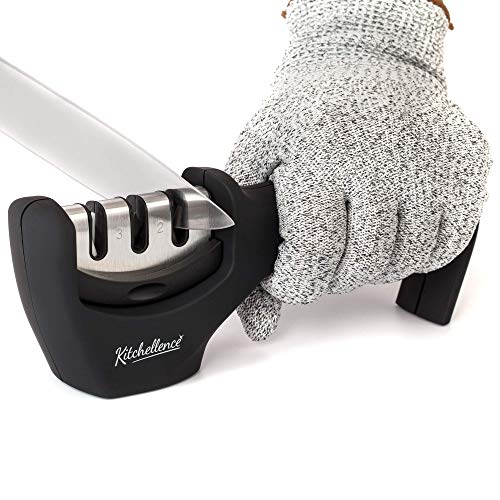
The three fixed slots remove the one variable a beginner can't yet control, and the included glove makes the learning curve safer.
Best for: a first-time sharpener who wants one tool and a safety glove Skip it if: you own thin Japanese blades you plan to keep for decades
At 6.35 oz and 3.4 x 8.3 x 2.2 in, this is the smallest footprint in the set that still holds an angle for you. That combination is what earns it the top spot. The KITCHELLENCE is a three-slot system, and KITCHELLENCE describes the sequence as repairing, restoring and polishing, so the coarse channel does the heavy work and the finer one refines. The brand also says the ergonomic handle works for right or left-handed users, which matters more than it sounds when you're pulling a blade toward your body for the first time.
The cut-resistant glove is the only piece of protective equipment supplied with any pick here. Model KS37 P is listed as ABS plastic construction, in black, one unit per pack.
The trade-off is control in the other direction. A slot decides the angle for you, which means it also decides it for knives that were ground to a different angle. The AIERLIAN lets you pick 15 or 20 degrees. This does not.
Pros:
- Lightest angle-guided pick, 6.35 oz
- Three-stage slot system, from coarse to polish
- Only pick supplying a cut-resistant glove
- Compact 3.4 x 8.3 x 2.2 in drawer footprint
- Works for left or right-handed users, per KITCHELLENCE
Cons:
- Fixed slot angle, no 15 or 20 degree choice
- No published grit figure for any stage
- ABS plastic body, not the wood or steel of pricier picks
- Only one seller lists it
2. AIERLIAN Knife Sharpener Tool — Best premium
The magnetic 15 and 20 degree base is the most genuinely instructive angle system here, if you'll spend ten minutes learning it.
Best for: someone willing to learn a real sharpening motion on good knives Skip it if: you want a 20-second fix before dinner
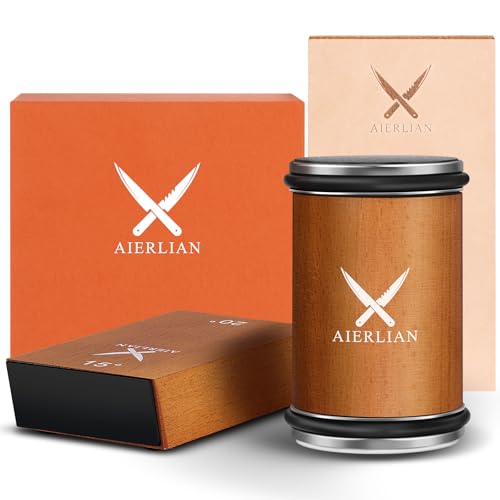
This is the most expensive pick here and the most complete. AIERLIAN specifies #400 diamond and #3000 ceramic discs, the only two-grit figure published in this set, and describes the base as natural wood holding four N42 magnets. A leather strop is included for the final polish, which no other pick offers.
The magnetic angle support is the real argument. AIERLIAN says it maintains a constant grinding angle, and the 15 and 20 degree options mean you can match a Japanese blade or a Western one rather than forcing both through the same channel. That's the difference between sharpening a knife and reshaping it.
At 1.26 lb it's the heaviest pick here, on a 2.7 x 5.49 x 4.6 in base. Heavier is better for a tool that needs to stay still.
The cost is patience. A rolling system has more steps than a pull-through, and the magnetic base has to be seated correctly every time. The KITCHELLENCE asks nothing of you. This asks a little.
Pros:
- Only pick with two published grits, #400 and #3000
- Magnetic 15 and 20 degree angle settings
- Heaviest and most stable base, 1.26 lb
- Leather strop included for finishing
- Natural wood body with four N42 magnets, per AIERLIAN
Cons:
- Highest price position in the set
- More setup steps than any other pick
- No safety glove despite the price
- Only one seller lists it
3. Work Sharp Kitchen Ceramic Honing Rod — Best upgrade
The only honing rod here with angle guides built into the handle, which is exactly what a beginner buying a rod needs.

Best for: a beginner who wants angle guidance while learning the rod Skip it if: your knives are already dull and need metal removed
Three rods sit in this set and only this one solves the rod's core problem. Work Sharp says the built-in angle guides give a consistent, repeatable angle, and that single feature is why it ranks above two pricier picks in a guide about beginners.
The design details back it up. The rubber tip is meant to sit on a cutting board or workbench so the rod stands stable while you stroke downward, which is far easier to control than waving a rod in mid-air. There's a lanyard hole in the handle. Work Sharp describes itself as a fourth-generation company in Ashland, Oregon, with over 40 years of sharpening tools behind it.
At 1 lb and 1.39 x 10.5 x 5.42 in, it's a mid-weight tool with real length. The listing covers chef, santoku, paring and serrated knives.
The honest limit: Work Sharp says the fine ceramic hone removes a small amount of material. That's maintenance, not rescue. A neglected blade needs the coarse work the KITCHELLENCE or AIERLIAN provide first.
Pros:
- Only honing rod here with built-in angle guides
- Rubber tip allows stable board-braced honing
- 10.5 in length covers chef and santoku blades
- Listed as suitable for serrated knives
- Two sellers stock it, unlike most picks
Cons:
- Fine hone only, removes very little material
- Won't revive a genuinely dull edge
- No published grit number
- Heavier than both other rods at 1 lb
4. Kimura Professional Ceramic Honing Rod — Best minimal setup
A 10-inch, 1200 grit rod weighing 2.82 oz: the clearest abrasive spec in the set, with none of the hand-holding.

Best for: long chef's knives and a drawer with no room for a kit Skip it if: you have never held a honing rod before
The 1200 grit finish is the number I'd point to first. Kimura says the rod is pure white ceramic made with a proprietary layering process and smoothed to that grit, and no other pick here publishes a comparable figure for a finishing surface. That makes it the easiest tool in the set to judge on paper.
It's also the lightest by a distance at 2.82 oz, against 1 lb for the Work Sharp. Kimura describes the handle as non-slip polypropylene, ergonomically shaped, with a full tang bolstered into it from a single ceramic piece. The listing gives the technique plainly: slide one side of the blade from base to tip at 15 to 20 degrees. It arrives in a Japanese gift box, which makes it the obvious present here.
So why fourth? Because "15 to 20 degrees" is an instruction, not a mechanism. Nothing on this rod stops your wrist drifting to 30. The Work Sharp costs less and does that job for you, and for a beginner that outweighs a better-documented surface.
Pros:
- Finest published abrasive figure, 1200 grit
- Lightest tool in the set, 2.82 oz
- 10 in length suits large chef's knives
- Single-piece ceramic with full tang, per Kimura
- Gift box packaging included
Cons:
- No angle guide of any kind
- Honing only, will not restore a dull edge
- Premium price position without angle assistance
- Only one seller lists it
5. Arkansas Sharpeners Ceramic Sharpening AC46 — Best budget pick
The cheapest of the five and the simplest, US-made, but the listing tells you almost nothing.
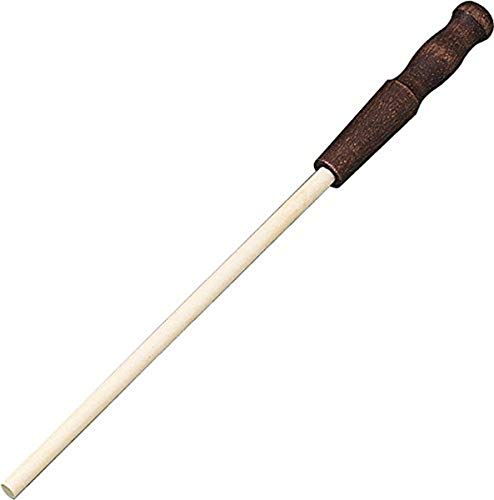
Best for: spending the least on a simple ceramic touch-up tool Skip it if: you need published details before you buy
Model AC46 is the cheapest of the five, and it's honest about what it is. Arkansas Sharpeners publishes two things: that it's a knife sharpener, and that the country of origin is the United States. That US manufacture is a genuine point of difference in this set, and Arkansas Sharpeners is a name with real history in sharpening stones.
The specs are thin but usable. It weighs 1.6 oz, ships in brown, one per pack, with a listed package size of 4 x 3 x 7 in. That 1.6 oz figure is the second-lightest here, just above the Kimura rod's 2.82 oz.
What's missing is everything a beginner wants. No grit. No angle guidance. No stated technique. It's also the slowest seller of the five by a wide margin, which tells you something about how shoppers weigh a sparse listing against a detailed one.
Buy this if you already know how to use a ceramic surface and want the lowest outlay. If you're learning, the KITCHELLENCE gives you a slot, a glove and instructions for very little more.
Pros:
- Cheapest of the five picks
- Made in the United States, per the listing
- Very light at 1.6 oz
- Simplest possible tool, nothing to set up
Cons:
- No grit, angle or technique published
- Only two feature lines in the whole listing
- Slowest seller of the five here
- No safety accessory of any kind
Does a ceramic knife sharpener actually sharpen?
This is where most first-time buyers get caught, so it's worth being precise. Sharpening removes metal to create a new edge. Honing realigns the existing edge without removing much at all.
Ceramic sits mostly on the honing side. Work Sharp states outright that its fine ceramic hone removes a small amount of material. Kimura's 1200 grit is a finishing surface, not a repair one. A rod keeps a decent edge decent. It will not fix a blade you've been sawing tomatoes with for two years.
Two picks here cross into real sharpening. The AIERLIAN pairs a #400 diamond disc with its #3000 ceramic one, and #400 is coarse enough to reshape. The KITCHELLENCE runs a coarse slot ahead of its polishing slot, so the sequence handles both jobs.
That's the practical takeaway for anyone searching for the best ceramic knife sharpener for beginners: check whether your knives need restoring or just maintaining. Restoring needs a coarse stage. Maintaining does not.
What does more money buy in this set?
Spending more here buys documentation and hardware, not necessarily a better result for a novice.
- At the bottom, the Arkansas AC46 buys a ceramic surface and nothing else. No grit figure, no guide.
- Just above it, the KITCHELLENCE adds three slots, a glove and a plastic body under 7 oz.
- In the middle, the Work Sharp adds engineered angle guides, a rubber-tipped stand and a 10.5 in ceramic rod.
- At the top, the Kimura buys a documented 1200 grit surface and a gift box, while the AIERLIAN buys two grits, four N42 magnets, a wood base and a leather strop.
Notice the pattern. Money buys precision for someone who already has technique. The two picks that most reduce the chance of a beginner ruining an edge are the second-cheapest and the mid-priced one.
That's the argument for not overspending on your first tool. Learn the motion on something forgiving, then buy the AIERLIAN when you can feel the difference a 15 degree bevel makes.
Which mistakes ruin a blade fastest?
Three habits do more damage than any tool in this set.
Pulling too hard. Pressure doesn't speed up sharpening, it rolls the edge over. Light, even strokes, every time.
Using a coarse stage every week. The #400 diamond disc on the AIERLIAN and the coarse slot on the KITCHELLENCE are for restoration, a few times a year. Weekly touch-ups belong on a 1200 grit rod like the Kimura.
Guessing the angle. This is the big one, and it's why angle guidance dominated my scoring. A Western chef's knife wants roughly 20 degrees per side, a Japanese blade closer to 15. Kimura's own instruction spans 15 to 20 degrees, and the AIERLIAN gives you both as magnetic settings. If you can't hold an angle by feel, buy a tool that holds it for you.
One more: don't run a serrated knife through a straight slot. The Work Sharp is the only pick here whose listing names serrated knives.
The verdict
Three tiers, three different buyers.
At the entry level, the KITCHELLENCE 4-in-1 is the best ceramic knife sharpener for beginners in this set and my overall winner. Three slots, a 6.35 oz body, and a cut-resistant glove no rival includes. It handles restoration and refinement in one pass, and nothing about it requires technique you don't yet have. The Arkansas AC46 undercuts it, but a listing with two feature lines and no grit figure asks you to guess.
In the middle, the Work Sharp is the pick I'd hand someone who wants to learn a rod properly. Built-in angle guides plus a rubber tip that braces on the board make it the only rod here that corrects your wrist instead of trusting it. Its limit is honest and stated: fine honing, small material removal.
At the top, the AIERLIAN rolling kit is the tool you graduate to. Its exact advantage over my winner is angle choice: magnetic 15 and 20 degree settings mean a thin Japanese blade and a thick Western one each get the bevel they were ground for, instead of both being forced through one fixed channel. Pair that with #400 diamond, #3000 ceramic and a leather strop and it's the most capable pick here.
The cutoff is technique. No technique yet, buy the KITCHELLENCE. Some technique, buy the AIERLIAN.
FAQ
Is the cheapest ceramic knife sharpener worth buying?
The cheapest ceramic knife sharpener here, the Arkansas AC46, is worth buying only if you already know how to hold a sharpening angle. It weighs 1.6 oz, is made in the United States, and publishes no grit figure or technique guidance. A beginner gets far more from the KITCHELLENCE, which adds three slots and a cut-resistant glove for a small step up.
Is a ceramic knife sharpener worth it for a beginner?
A ceramic knife sharpener is worth it for a beginner when the tool controls the angle. Fixed slots, like the KITCHELLENCE three-stage system, or magnetic guides, like the AIERLIAN's 15 and 20 degree settings, remove the main cause of ruined edges. A bare ceramic rod with no guide is worth much less to a newcomer, however fine the surface.
What grit does a beginner ceramic knife sharpener need?
The grit a beginner ceramic knife sharpener needs depends on the blade's condition. For weekly maintenance, a fine surface like the Kimura's 1200 grit finish is right. For a blade that no longer bites, you want a coarse stage first: the AIERLIAN's #400 diamond disc or the coarse slot in the KITCHELLENCE three-stage system does that reshaping work.
Work Sharp or Kimura: which honing rod should a first-timer pick?
Between the Work Sharp and the Kimura, a first-timer should pick the Work Sharp. It's the only rod here with built-in angle guides plus a rubber tip that braces on a cutting board, at 1 lb and 10.5 in. The Kimura publishes a finer 1200 grit surface and weighs just 2.82 oz, but leaves the angle entirely to your wrist.
Can these sharpeners handle serrated and Japanese knives?
These sharpeners handle serrated and Japanese knives unevenly. Only the Work Sharp listing names serrated knives among chef, santoku and paring blades. For Japanese steel, the AIERLIAN's 15 degree magnetic setting matches the thinner bevel, and Kimura states a 15 to 20 degree stroke. A fixed-slot tool applies one angle regardless of how your blade was ground.
Start with the condition of your knives, not the price of the tool. Pull one across a tomato skin: if it slides without biting, you need a coarse stage, and the KITCHELLENCE gives you that plus a polishing slot and a glove in a 3.4 x 8.3 x 2.2 in package. If it still bites but feels tired, a guided rod is enough. What makes the KITCHELLENCE the right default is that it covers both cases at once, which is exactly what you want from a tool you're buying before you know which problem you have.