Best Chef Knife for Everyday Home Cooking Prep

Five chef's knives compared on published steel type, handle material, blade length and weight, with a clear winner and the three conditions that change the answer.

By Elin RoweUpdated 15 min read
On this page
- Best chef knife at a glance
- How I narrowed this best chef knife field to five
- What actually decides a chef's knife: steel, not length
- 1. Victorinox Fibrox Pro 8 Inch Chef's Knife — Best overall
- 2. imarku Japanese Chef Knife 8 Inch — Best for beginners
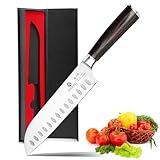
- 3. imarku Santoku Knife 7 Inch — Best budget pick
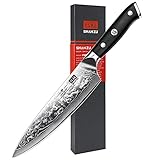
- 4. SHAN ZU Chef Knife 8 Inch Damascus — Best for heavy use
- 5. HOSHANHO Kitchen Knife 8 Inch — Best premium
- Is 8 inches always the right blade length?
- What does more money buy in a best chef knife?
- Which handle material should you pick?
- What the listings will not tell you
- The verdict
- FAQ
The best chef knife here is the Victorinox Fibrox Pro, an 8" stainless blade on a non-slip thermoplastic handle backed by a lifetime warranty against manufacturing defects. If you'd rather have a harder Damascus core that holds an edge through a long prep session, the SHAN ZU 8" is the better buy. The deciding specification is not blade length, because four of these five measure 8". It's the steel and the hardness figure behind it. That single number splits this field into two camps: knives you sharpen often and knives you sharpen rarely.
Best chef knife at a glance
| Pick | Blade & steel | Handle | Price |
|---|---|---|---|
Best overall Victorinox Fibrox Pro 8 Inch Chef's Knife |
8" stainless steel blade 7.9" |
Thermoplastic elastomer | Check Price |
Best for beginners imarku Japanese Chef Knife 8 Inch |
8" high-carbon stainless | Pakkawood composite | Check Price |
Best budget pick imarku Santoku Knife 7 Inch |
7" high-carbon stainless hollow edge |
Pakkawood composite | Check Price |
Best for heavy use SHAN ZU Chef Knife 8 Inch Damascus |
8" Damascus, 67 layers 62 HRC claim |
G10 glass fibre | Check Price |
Best premium HOSHANHO Kitchen Knife 8 Inch |
8" 10Cr15CoMoV 13° per side claim |
Wood | Check Price |



How I narrowed this best chef knife field to five
I set three criteria before I read a single listing, and I weighted them in this order.
- Published steel information, weighted heaviest. A listing that names its alloy, or states a hardness figure, tells you something checkable. A listing that says "premium steel" tells you nothing. Three of these five name a specific steel: 10Cr15CoMoV twice and 10Cr15Mov Damascus once.
- Handle material, weighted second. This is the part of a chef's knife you touch for twenty minutes at a stretch. All five publish a material, and no two are identical in the way that matters: one thermoplastic, two Pakkawood composite, one G10 glass fibre, one wood.
- Stated warranty and support, weighted third. Exactly one knife in this set publishes a warranty. That is a real differentiator, and it is why the ranking landed where it did.
Why those three and not blade geometry or bolster shape? Because geometry claims in this category are unverifiable from a listing, while steel names, handle materials and warranty text are printed commitments. I also cut anything sold as a multi-piece block, since a best chef knife guide should compare single knives against single knives, not a knife against a set that pads its value with a paring blade you may not want.
What actually decides a chef's knife: steel, not length
Most best chef knife roundups open with blade length. Length barely separates this field. Four of the five are 8" and the fifth is 7". What separates them is the alloy and the hardness behind the edge.
SHAN ZU states 62 HRC for its Damascus core. That is the only hardness figure published in this set, and it is the single most useful number here. Higher hardness generally means an edge that stays keen longer and chips more readily under twisting force. Softer stainless dulls faster and forgives abuse. Neither is better in the abstract. The right answer depends on how you actually cook.
Here's the trick with hardness claims: it's the manufacturer's figure, not an independent measurement, and Victorinox publishes no equivalent number at all. So use it as a signal of design intent rather than a verdict. A brand that quotes 62 HRC is building a knife for edge retention. A brand that quotes dishwasher-safe materials and a lifetime warranty is building a knife for a busy kitchen that doesn't baby its tools.
The weight figures reinforce that split. SHAN ZU lists 0.57 lb, HOSHANHO 0.77 lb, imarku's 8" knife 6.56 oz and its 7" santoku 6.88 oz. That's a spread of roughly a quarter pound across the set, which you feel by the fifth onion.
1. Victorinox Fibrox Pro 8 Inch Chef's Knife — Best overall
The only knife here with a published lifetime warranty, dishwasher-safe materials and a grip designed to stay put when wet.
Best for: a cook who wants one workhorse knife and no maintenance rituals Skip it if: you want a heavier blade with visible pattern welding
This is the least glamorous knife in the set and the easiest to recommend. The blade is stainless steel at 7.9 inches on an 8" knife, and the overall listed dimensions are 1.25 x 17 x 4 in. Victorinox states the handle is thermoplastic elastomer for a non-slip grip even when wet, and describes the materials as dishwasher safe. Model 45520, made in Switzerland.
The warranty is the argument. Victorinox publishes a lifetime warranty against original manufacturer's defects, and it's the only pick in this group that publishes any warranty at all. When four other listings say nothing about support, one that commits in writing carries real weight.
It also sells faster than anything else here, and two sellers list it rather than the single seller behind three of these picks. The trade-off is character. There's no Damascus pattern, no wood, no quoted hardness number. You're buying a tool, not an object. If your kitchen shelf is also a display, the SHAN ZU or HOSHANHO look the part and this one doesn't.
Pros:
- Only pick with a published lifetime defect warranty
- Dishwasher-safe materials per the listing
- Non-slip thermoplastic handle for wet hands
- Sells faster than the rest of this set
- Two sellers listed, not one
Cons:
- No published hardness figure to compare
- Plain looks, no pattern-welded finish
- Softer stainless likely needs more frequent honing
- Handle material won't appeal if you want wood
2. imarku Japanese Chef Knife 8 Inch — Best for beginners
The second-cheapest knife here pairs a full 8" high-carbon stainless blade with a Pakkawood handle, which is the friendliest combination for a first serious knife.

Best for: a first real knife with a warm wood-composite handle Skip it if: you need a published warranty in writing
Sitting second-cheapest of the five, this is the entry point that doesn't shrink the blade. You get the full 8", listed at 6.56 oz with dimensions of 1 x 13 x 3 in. It's the lightest 8" knife in this group, which matters if your wrist tires during long prep.
imarku describes it as a gyutou, the Japanese take on a Western chef's knife, and lists it in the Gyutou category. The company says the blade is high-carbon stainless steel and that the handle is Pakkawood, chosen to reduce fatigue and finger numbness during extended use. Pakkawood is resin-impregnated wood laminate, so it behaves more predictably around moisture than solid timber.
Two honest cautions. The listing carries a note that the brand is mid-upgrade, so the logo you receive may differ from the photograph, and products are dispatched at random. And no warranty is published. Against the Victorinox, that's the gap: you save a position on price and give up a written commitment. Against the SHAN ZU, you give up the hardness figure.
Pros:
- Second-cheapest pick with a full 8" blade
- Lightest 8" knife in this set at 6.56 oz
- Pakkawood handle resists moisture better than raw wood
- Listed as a true gyutou profile
Cons:
- No published warranty
- Listing warns the logo may differ from photos
- No hardness figure stated
- Single seller only
3. imarku Santoku Knife 7 Inch — Best budget pick
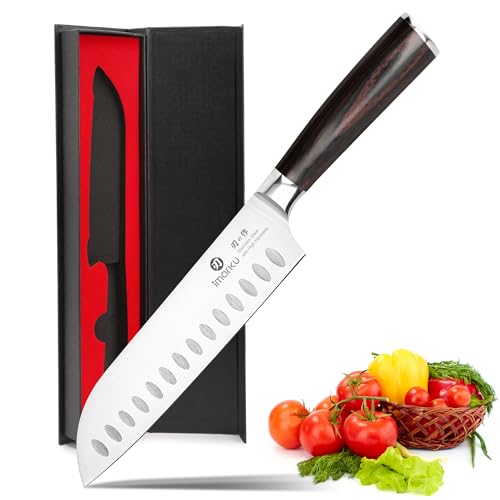
The cheapest of the five, and the only one with a hollow-edge blade, which trades an inch of reach for less sticking.
Best for: short-stroke choppers with limited board space Skip it if: you break down whole chickens or big squash
This is the cheapest knife here and the only santoku, at 7" rather than 8". Listed weight is 6.88 oz, dimensions 1 x 12 x 3 in, model I-KSK0064DB. imarku says the steel is Japanese high-carbon stainless chosen to resist rust, corrosion and discolouration, and describes the scalloped hollow edge as adding a gap between blade and food so slices don't cling.
The santoku shape changes how you work. Less belly curve means less rocking and more straight up-and-down chopping. On a small board or a cramped counter, the shorter blade is genuinely easier to control, and it's the second-fastest seller in this group behind the Victorinox.
The cost is reach. Seven inches won't span a large cabbage or ride cleanly over a chicken carcass, and the flatter profile fights you if rock-chopping is a habit you don't want to unlearn. Like the other imarku, it comes in a black gift box and publishes no warranty. Pick it as a second knife or as a first knife for someone who mostly dices vegetables.
Pros:
- Cheapest pick in this comparison
- Only hollow-edge blade here, reduces food sticking
- Shorter 7" blade easier on a small board
- Second-fastest seller in this set
Cons:
- 7" is short for large produce and poultry
- Flat profile discourages rock-chopping
- No warranty published
- No hardness figure stated
4. SHAN ZU Chef Knife 8 Inch Damascus — Best for heavy use
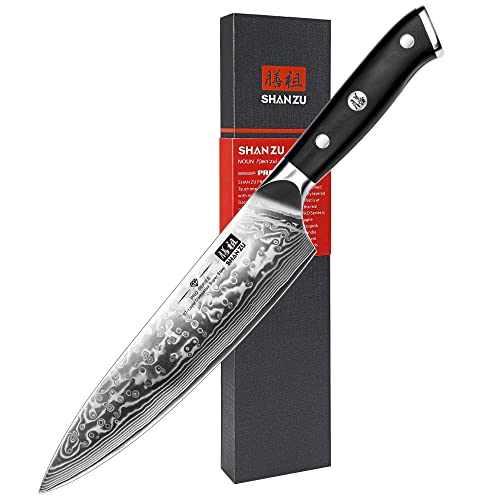
The only knife here with a published hardness figure, and the lightest 8" blade in the set at 0.57 lb.
Best for: long prep sessions where edge retention matters most Skip it if: you want to hand the knife to the dishwasher
If edge retention is what you're buying, this is the listing that puts a number on it. SHAN ZU states a 10Cr15Mov Damascus core at 62 HRC, and says the blade is built from 67 layers of folded and forged steel rather than laser etching. That's the most specific steel claim in this comparison, and the only hardness figure available to compare against.
The handle is the other differentiator. SHAN ZU specifies frosted glass fibre G10, and says it chose G10 over wood for solidity. G10 doesn't swell, absorb odours or crack the way timber can, which makes it the more forgiving choice in a kitchen where knives sit in a sink for an hour.
At 0.57 lb with dimensions of 1 x 13.2 x 1.18 in, it's the lightest 8" pick here. It's also the slowest seller of the five by a wide margin. The real trade-off is care: hard steel at 62 HRC chips more readily under lateral force, and unlike the Victorinox, nothing in this listing says dishwasher safe. Treat it as a hand-wash knife and it should outlast the softer blades between sharpenings.
Pros:
- Only pick with a published hardness figure, 62 HRC claim
- 67-layer forged Damascus, not etched, per the brand
- G10 handle won't swell or absorb odours
- Lightest 8" blade here at 0.57 lb
- Two sellers listed
Cons:
- Slowest seller in this set by a large margin
- Hard steel is more chip-prone under twisting
- No warranty published
- No dishwasher-safe claim in the listing
5. HOSHANHO Kitchen Knife 8 Inch — Best premium
The most expensive pick here, with a named 10Cr15CoMoV steel and a claimed 13-degree edge per side, but the thinnest published specification list.

Best for: someone who wants a hand-finished matte blade and a wood handle Skip it if: you want the most capability per dollar in this set
HOSHANHO takes the top price position here, so the questions get sharper. What it publishes: an 8" blade in Japanese high-carbon 10Cr15CoMoV steel, a listed weight of 0.77 lb, and a matte rather than polished finish. The brand says the edge is hand-sharpened to 13 degrees per side, and that the sloped bolster shape encourages a proper pinch grip. The handle is described as ultra-durable wood.
That 13-degree claim is the most interesting thing on the page. A narrower angle cuts more cleanly through soft produce and dulls sooner than a wider one, so it's a deliberate lean towards slicing over chopping. Worth noting it's the brand's figure, not a measured one.
At 0.77 lb this is the heaviest knife in the group, which some cooks read as authority and others read as fatigue. The problem is what's absent. No hardness figure, no warranty, only one seller, and no dishwasher claim. The SHAN ZU sits one position lower on price and publishes more: layer count, hardness and a specified handle composite. That comparison is the honest case against paying the most here.
Pros:
- Named 10Cr15CoMoV Japanese high-carbon steel
- Claimed 13° per side edge, narrowest angle stated here
- Sloped bolster shaped for a pinch grip
- Matte finish hides fine scratches better than mirror polish
Cons:
- Highest price position with fewer published specs than cheaper picks
- No hardness figure and no warranty stated
- Heaviest knife in the set at 0.77 lb
- Solid wood handle needs more care than G10 or thermoplastic
- Only one seller lists it
Is 8 inches always the right blade length?
No, and the assumption costs people money. Four picks here are 8" and one is 7", so this set gives you a clean choice between the standard and the compact.
Eight inches is the default for a reason. It spans a large onion, rides over a chicken breast and gives your knuckles clearance above the board. Below that, big produce becomes a two-pass job.
Seven inches wins on control. On a small board, in a galley kitchen, or for a cook with smaller hands, the shorter santoku is easier to steer and less intimidating in a crowded sink. It's also the cheapest pick here.
- Mostly dicing vegetables on a compact board: the 7" santoku
- Breaking down poultry, halving squash, big-batch prep: any of the 8" blades
- One knife for absolutely everything: 8", and let the handle decide
What does more money buy in a best chef knife?
Across these five, more money buys published steel detail and finish. It does not reliably buy warranty coverage or a lower weight.
At the entry positions, the two imarku knives give you high-carbon stainless and Pakkawood handles with no hardness figure, no warranty and single-seller listings. That's a lot of function for the least outlay.
In the middle sits the Victorinox, and it's the only knife in this whole comparison that adds a lifetime defect warranty and a dishwasher-safe claim as you step up. That combination is unusual, and it's why the middle position wins overall here rather than the top.
At the two premium positions you get named alloys and finishes: 10Cr15Mov Damascus in 67 layers with a 62 HRC claim, and 10Cr15CoMoV with a matte finish and a 13-degree edge claim. Both drop the warranty. So the pattern is real but not linear. Spend more and you get better-documented steel; spend in the middle and you get better-documented support.
Which handle material should you pick?
This is the specification most shoppers skip and the one they notice every single day. All five listings name a handle material, and there are four different answers.
Thermoplastic elastomer, on the Victorinox. Described as non-slip even when wet, and part of a knife the brand calls dishwasher safe. The lowest-maintenance option here and the least decorative.
Pakkawood composite, on both imarku knives. Resin-bonded wood laminate. It looks like timber and handles moisture better than timber, which is the sensible middle ground.
G10 glass fibre, on the SHAN ZU. The brand says it chose frosted G10 over wood for solidity. It won't swell, stain or hold onions.
Solid wood, on the HOSHANHO. The warmest feel in the group and the most demanding: no soaking, no dishwasher, occasional oiling.
If your knife sometimes waits in the sink, pick thermoplastic or G10. If you always wash and dry immediately, wood and Pakkawood are open to you.
What the listings will not tell you
Three things matter here that no product page in this set states, and you should factor all three before you buy.
None of these five includes a sharpener or a honing rod. Every knife dulls, and the harder-steel picks eventually need a whetstone or a professional service rather than a pull-through. Budget for that separately.
Only one of the five publishes a warranty. Four say nothing about defect coverage. That is not proof there's no support, but it means the only written commitment in this comparison belongs to the Victorinox.
Seller depth varies. Three of these knives show a single seller and two show two sellers. Fewer sellers means fewer routes to a replacement if something arrives wrong.
One more, on the imarku 8": the listing itself warns that branding may differ from the photos during a brand transition. Read that before you order it as a gift.
The verdict
Sort this by tier and the answer gets simple.
At the entry positions, the imarku pair is where the value sits. Take the 8" gyutou if you want one knife that handles everything, and the 7" santoku if your board is small and your prep is mostly vegetables. Both give you Pakkawood handles and high-carbon stainless, and neither gives you a warranty.
In the middle, the Victorinox Fibrox Pro wins the whole comparison. It's the only pick with a published lifetime warranty against manufacturing defects, the only one described as dishwasher safe, and the only one with a handle specified for wet-hand grip. Nothing above it in price matches that combination, which is an unusual thing to be able to write about a mid-priced knife.
At the premium positions, the SHAN ZU is the one to take. Its 62 HRC claim, 67-layer Damascus construction and G10 handle are the most specific set of commitments here, and at 0.57 lb it's the lightest 8" blade in the group. The HOSHANHO's exact advantage is its stated 13-degree edge per side, the narrowest angle claimed by anyone here, which suits a cook who slices more than chops. But it costs more than the SHAN ZU while publishing less.
The cutoff is maintenance tolerance. Hand-wash every time and go premium. Otherwise, buy the Victorinox.
FAQ
Is a best chef knife pick worth spending more on?
Worth spending more on, yes, but only up to a point in this set. Moving up buys named alloys and stated hardness, like the SHAN ZU's 62 HRC claim and 67-layer Damascus. It does not buy warranty coverage, which only the mid-priced Victorinox publishes. The steepest jump in documented capability happens below the top position, not at it.
What size chef's knife should a beginner buy?
The size a beginner should buy is 8 inches, which four of these five picks are. It handles onions, squash and poultry without a second pass. A 7" santoku like the imarku is easier to control on a small board and cheaper, but it runs short on large produce. Start at 8" unless counter space genuinely forces the shorter blade.
Victorinox Fibrox Pro or SHAN ZU Damascus: which should I get?
Victorinox Fibrox Pro or SHAN ZU comes down to how you wash up. The Victorinox is described as dishwasher safe and carries a lifetime defect warranty, making it the low-maintenance default. The SHAN ZU publishes a 62 HRC Damascus core and a G10 handle, so it should hold an edge longer, but it needs hand washing and careful use to avoid chipping.
Can any of these knives go in the dishwasher?
Any of these knives in the dishwasher is a risk except one. Only the Victorinox Fibrox Pro states dishwasher-safe materials in its listing. The other four say nothing about it, and two carry wood or Pakkawood handles that dislike prolonged heat and moisture. Hand wash and dry the rest immediately, whatever the steel claims say.
What's the most common mistake buying a chef's knife?
The most common mistake buying a chef's knife is shopping by blade length and looks while ignoring steel and handle material. Four of these five are 8", so length separates almost nothing. Hardness figures, named alloys and handle composition are what change how the knife performs on day 300. The second mistake is buying no sharpener at all.
Start with the Victorinox Fibrox Pro. It's the one knife in this comparison that asks nothing of you beyond using it: no oiling schedule, no hand-wash rule, no worrying about a chipped hard edge, and a written lifetime commitment behind the steel. That freedom from maintenance is why it belongs in more kitchens than the flashier blades. If you already own a knife you baby and want a second one you can be careless with, that logic points the same way. And if pattern-welded steel is what you actually want on your counter, take the SHAN ZU and buy a whetstone with it.