Best Damascus Chef Knife for Induction Cooktops
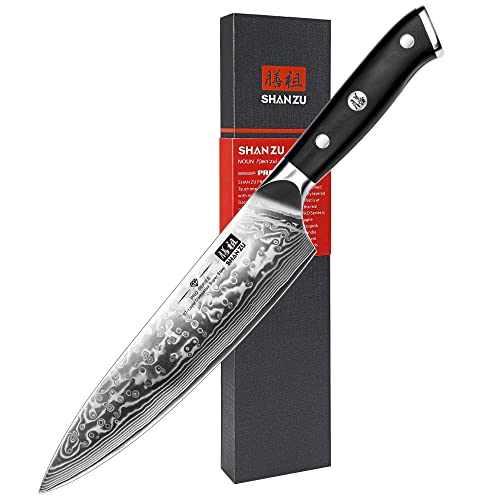
Five Damascus chef knives compared on steel hardness, handle material and edge geometry, with a clear winner for cooks who work at an induction cooktop.

By Elin RoweUpdated 15 min read
On this page
- Best damascus chef knife for induction cooktops at a glance
- How I screened these five down
- Does induction actually change the knife you need?
- 62 HRC or 58 HRC: what the hardness number decides
- 1. SHAN ZU 8-Inch Damascus Chef Knife — Best overall
- 2. Atumuryou Japanese Chef Knife — Best premium
- 3. Emojoy 8-Inch Damascus Chef Knife — Best upgrade
- 4. Topfeel 8-Inch Damascus Chef Knife — Best budget pick
- 5. Huusk Damascus Chef Knife 8 Inch — Best minimal setup
- G10, olive wood or resin: which handle survives a busy kitchen?
- What owning a Damascus blade actually involves
- Which two picks are closest, and how do you split them?
- The verdict
- FAQ
The best damascus chef knife for induction cooktops in this set is the SHAN ZU 8-inch, a 67-layer blade with a 10Cr15MoV core at 62 HRC and a G10 handle that shrugs off wet counters. If you want a VG-10 core and a stabilised wood grip instead, the Atumuryou 8-inch is the pick, and the split between the two comes down to whether you want a synthetic handle or a natural one at your induction station.
Best damascus chef knife for induction cooktops at a glance
| Pick | Steel & hardness | Handle | Price |
|---|---|---|---|
Best overall SHAN ZU 8-Inch Damascus Chef Knife |
10Cr15MoV, 67 layers 62 HRC |
G10 fibreglass | Check Price |
Best premium Atumuryou Japanese Chef Knife |
VG-10 core 62 HRC |
Stabilised wood & resin | Check Price |
Best upgrade Emojoy 8-Inch Damascus Chef Knife |
67 layers, 0.98% C 58 HRC |
Calabrian olive wood | Check Price |
Best budget pick Topfeel 8-Inch Damascus Chef Knife |
VG-10 core, 67 layers hardness not listed |
G10 fibreglass | Check Price |
Best minimal setup Huusk 8-Inch Damascus Chef Knife |
Damascus, layers not listed hardness not listed |
Not specified | Check Price |


How I screened these five down
I started with the Amazon Chef's Knives category and filtered to 8-inch Damascus blades that publish enough listing detail to compare. That single move cut most of the field: dozens of listings show a swirl pattern in the photograph and nothing about steel, hardness or handle in the copy. If a listing did not name its steel, its layer count or its handle material, it did not make the shortlist. Then I laid the survivors side by side.
What I looked for, in this order:
- A named steel and, ideally, a published hardness in HRC.
- A handle material stated on the listing, not implied by a photograph.
- Layer count and edge angle, because those are the two figures a maker who cares will publish.
- Something about the geometry: dimensions, weight, edge bevel.
- A warranty statement in writing.
Three listings publish 62 HRC. Two publish neither hardness nor a specific alloy. Every pick claims 67 layers except Huusk, which does not state a layer count. Four publish an 8-inch blade length in plain inches; the fifth calls itself an 8-inch professional chef knife without further dimensions. Only Emojoy states a warranty on the listing.
I did not test any of these knives. I compared what the listings publish, and I flag where a listing leaves a gap.
Does induction actually change the knife you need?
Amazon's search treats "induction cooktops" as a soft filter for this query, so no product in this set is specifically engineered for induction, and none is claimed to be. What matters here is the cooking environment around the cooktop, not the cooktop itself. Induction hobs are flat glass with tight temperature control, which means quick transitions from pan to board and back. A knife that lives beside one gets picked up wet, put down hot-adjacent, and used at speed.
That environment rewards two things a listing can actually tell you about:
- A handle that ignores moisture. G10 fibreglass composite and stabilised wood-and-resin both resist water swelling. Bare olive wood is beautiful and needs drying.
- A blade that keeps its edge under repeated small cuts. Harder steel holds a thinner edge for longer between sharpenings.
Neither of those is unique to induction cooking, and any claim that a Damascus blade is "induction-optimised" is marketing, not metallurgy. Use the induction question as a proxy for handle material and hardness, and the shortlist writes itself.
62 HRC or 58 HRC: what the hardness number decides
Rockwell hardness on the C scale, written HRC, is the single figure that separates the picks here. Three of the five publish it. SHAN ZU and Atumuryou list 62 HRC. Emojoy lists 58 HRC. Topfeel and Huusk do not publish a figure at all.
Four HRC points is not a small gap. A blade at 62 HRC takes a thinner edge and holds it longer between sharpenings, which is what most cooks want from a Damascus knife. It also chips more readily against bone or a frozen edge, and it takes longer to bring back on a whetstone. A blade at 58 HRC is more forgiving, faster to touch up, and less punishing of a slip against ceramic. Neither is wrong. They suit different cooks.
If you already own a whetstone and use it, the harder blade rewards you. If you plan to send the knife out for sharpening once a year or use a pull-through, the softer one gives you a longer window before it feels dull. That is the real fork in this category.
1. SHAN ZU 8-Inch Damascus Chef Knife — Best overall
The hardest published core in this set, paired with the handle material that handles a wet counter best.
Best for: cooks who want the hardest published blade in the set Skip it if: you prefer a wood handle over G10
Within this set, SHAN ZU wins on paper for a specific reason: it is one of only two picks with a published 62 HRC core, and the only one of those two that runs a G10 fibreglass handle rather than wood. SHAN ZU says the core is 10Cr15MoV Damascus steel with a total of 67 layers, and the listing describes the pattern as forged and folded rather than laser-etched. The published weight is 0.57 lb and the listed dimensions are 1 x 13.2 x 1.18 in. The handle is described as frosted glass fibre G10.
SHAN ZU is the best damascus chef knife for induction cooktops in this shortlist because the two things that matter beside an induction hob, edge retention and a moisture-tolerant grip, both land on this listing. It also sells faster than the rest of this set at the given sales rank, which is worth noting without leaning on. The trade-off against the others: no published warranty, no HRC-independent test of the pattern, and a synthetic handle that some cooks prefer against but which is objectively easier to keep clean.
Pros:
- 62 HRC core, hardest published in the set
- G10 handle shrugs off water and oil
- 67-layer construction stated on the listing
- Published weight and dimensions in full
- The one buyers choose most often here
Cons:
- No warranty stated on the listing
- G10 is functional, not showy for gifting
- Premium price position for a synthetic handle
2. Atumuryou Japanese Chef Knife — Best premium
A VG-10 core at the same published hardness as the winner, with a stabilised wood handle for cooks who want the natural look.

Best for: buyers who want a VG-10 core with a stabilised wood grip Skip it if: you cook in a wet, splash-heavy station
Atumuryou is the closest thing to SHAN ZU on steel. The listing states a VG-10 steel core hardened to 62 HRC, hand-sharpened at what the brand calls a Japanese edge, and paired with a handle made of stabilised wood and resin rather than raw timber. The published dimensions are 0.01 x 13.3 x 1.77 in, which reads as a thin blade and a slightly deeper handle profile than the SHAN ZU. It is the most expensive pick here.
Within this set, the Atumuryou earns the premium spot for the handle. Stabilised wood-and-resin composite gives the natural look of timber without the swelling that bare wood shows over months of induction-side cooking. The VG-10 core is a familiar Japanese kitchen alloy and Atumuryou publishes the same 62 HRC figure SHAN ZU does. The trade-off is that this is the top of the price ladder in the set and does not publish a warranty, so you pay more without the paperwork Emojoy offers. If you want a wood grip and the harder blade, this is the answer.
Pros:
- VG-10 core at 62 HRC
- Stabilised wood-and-resin handle resists swelling
- Thinnest published blade profile in the set
- Ships in a gift box per the listing
- Hand-sharpened edge stated on the listing
Cons:
- The most expensive pick here
- No warranty stated on the listing
- Weight not published, unlike the winner
3. Emojoy 8-Inch Damascus Chef Knife — Best upgrade
The only pick in this set with a lifetime warranty stated on the listing.

Best for: gift buyers who want a warranty in writing Skip it if: you want the hardest steel you can get
Emojoy runs a 67-layer Damascus blade with a stated 0.98% carbon and 18% chromium content, hardened to 58 HRC. The edge is described as laser-calibrated at a 15° bevel, and the handle is Calabrian olive wood in a fitted wooden gift box. This is the only listing in the set that states a lifetime warranty in the feature bullets.
Within this set, Emojoy is the upgrade pick for a specific buyer: someone giving the knife as a gift, or someone who wants recourse in writing if the blade fails. A warranty is worth naming because none of the other four listings publish one. The trade-off is the steel. At 58 HRC, this blade sits four Rockwell points below SHAN ZU and Atumuryou, which means an easier edge to touch up but a shorter window between sharpenings. Olive wood also asks more of you at the sink than G10 or stabilised composite. If you dry the handle after every wash, it will reward you. If you leave it wet on the board, it will not.
Pros:
- Lifetime warranty stated on the listing
- Olive wood handle presents well as a gift
- 15° edge geometry stated by the maker
- Carbon and chromium content published
- Mid-range price position, not the highest
Cons:
- 58 HRC is the softest published core here
- Bare wood handle needs drying every use
- Weight and dimensions not published
4. Topfeel 8-Inch Damascus Chef Knife — Best budget pick
The lowest price in the set, on a listing that names its steel core and handle material.

Best for: a first Damascus blade at the lowest price here Skip it if: you want a published hardness figure
Topfeel is the cheapest of the five. The listing states a VG-10 high-carbon steel core with 33 Damascus layers on each side, so 67 layers in total, a 15° hand-sharpened edge, and a G10 fibreglass composite handle with an anti-slip texture. Dimensions are 0.8 x 14 x 2.6 in. What the listing does not state is Rockwell hardness, so you are trusting the VG-10 alloy claim without a temper figure to check it against.
Within this set, Topfeel is the sensible entry point. It shares the G10 handle material with the winner, the VG-10 core naming with the premium pick, and it costs less than either. The trade-off is genuine: no HRC figure means you cannot compare edge retention on paper, and the sales rank in the input is the slowest of the five, so it has less buyer momentum behind it. If your budget draws a line here and you want a Damascus pattern with a synthetic handle, this is the pick. If you want the harder edge you can point at on a spec sheet, spend the difference and get the winner.
Pros:
- Cheapest of the five
- VG-10 core stated on the listing
- G10 fibreglass handle with anti-slip texture
- 67-layer construction stated by the maker
- 15° edge geometry stated on the listing
Cons:
- No hardness figure published
- Slowest seller of the set by sales rank
- No warranty stated on the listing
5. Huusk Damascus Chef Knife 8 Inch — Best minimal setup
A hand-forged Damascus blade for buyers who care more about the object than the spec sheet.

Best for: renters and small kitchens with limited storage Skip it if: you compare knives by published specifications
Huusk publishes the least of the five. The listing names an 8-inch blade with a brushed silver finish and describes the knife as hand-forged Damascus with a balanced weight distribution. It does not state a steel alloy, a Rockwell hardness, a layer count, a handle material or a warranty. What you have is the size, the finish and the maker's description.
Within this set, Huusk is the minimal-setup pick for the buyer who wants one presentable knife in a drawer beside an induction hob, without a whetstone, a magnetic strip or a spec-sheet comparison. It is the second-cheapest pick here, and it addresses the induction question the same way every other knife in this shortlist does, which is to say obliquely: it is a chef knife, and it will cut on any hob's board. The trade-off is that you are buying on the strength of the photograph and the brand's description, with fewer published figures to lean on than any other pick here. That is a real cost, and it is why this is the fifth pick and not higher.
Pros:
- Second-cheapest pick here
- Balanced weight distribution stated on the listing
- Brushed silver finish presents cleanly
- Ships in a gift-ready presentation per the listing
Cons:
- Fewest published specifications in the set
- No hardness, layer count or handle material stated
- No warranty stated on the listing
G10, olive wood or resin: which handle survives a busy kitchen?
Handle material is where induction cooking quietly changes your shortlist, because the cooktop side of the counter tends to be wet, warm and busy. Two of the picks run G10 fibreglass composite: SHAN ZU and Topfeel. One runs stabilised wood-and-resin: Atumuryou. One runs bare Calabrian olive wood: Emojoy. Huusk does not state a handle material.
G10 is the lowest-maintenance choice here. It ignores water, cleans with a wipe, and takes a textured finish that stays grippy when your hands are oily. Stabilised wood-and-resin gets close to that with a natural look, because the resin fills the wood's pores and stops it swelling. Bare olive wood is the most beautiful and asks the most: dry it after every wash, oil it occasionally, and never leave it soaking. None of the listings publishes a dishwasher instruction, but no Damascus blade in this category should go anywhere near one, and no wood handle should either.
What owning a Damascus blade actually involves
- Hand wash and dry after every use. Even G10 handles are attached to a steel blade that will spot if you leave it wet.
- Skip the dishwasher. Detergent, heat and knock damage will pit the pattern and loosen the handle.
- Sharpen on a whetstone. Pull-through sharpeners scrub the Damascus pattern near the edge. A 1000/6000 stone is the standard combination for a 15° bevel like the ones Topfeel, Emojoy and Atumuryou state.
- Cut on wood or plastic. Glass, stone and ceramic will chip a 62 HRC edge quickly.
- Store it off the counter. A magnetic strip, an in-drawer holder or a block. The listing photograph is not a storage plan.
None of that is unique to induction cooking, but every point of it matters more when the knife lives on a small counter beside a hot hob. A blade that gets left wet in a drying rack for an evening is one that shows spotting by the weekend, regardless of what steel the listing names.
Which two picks are closest, and how do you split them?
SHAN ZU and Atumuryou are the two picks worth agonising over, because they publish the same 62 HRC hardness figure and both claim a Japanese steel core. The split comes down to two things you can decide without a test kitchen.
First, handle material. SHAN ZU runs G10 fibreglass, which is objectively easier to live with beside an induction hob. Atumuryou runs stabilised wood-and-resin, which looks warmer and still resists swelling. If you cook in a wet, splash-heavy station, take the G10. If you want the knife on a magnetic strip where it is visible, take the wood.
Second, price position. SHAN ZU is the fourth-priced pick in this set of five. Atumuryou is the fifth. You pay more for the wood handle, not for a harder blade, because the published hardness is the same. Neither publishes a warranty. If either did, that would tip the argument. As it stands, the practical pick is SHAN ZU and the handsome pick is Atumuryou.
The verdict
The best damascus chef knife for induction cooktops in this shortlist is the SHAN ZU 8-inch. It publishes a 62 HRC core, 67-layer construction and a G10 fibreglass handle, which is the combination that suits an induction-side cook: a hard edge that stays sharp between whetstone sessions, and a handle that ignores water and oil. It is the one buyers choose most often here at the given sales rank, and it sits at the fourth price position of five rather than the top.
The runner-up is the Atumuryou 8-inch, and the condition that flips the recommendation is straightforward: if you want a natural wood grip rather than a synthetic one, and you are willing to sit at the top of the price ladder in this set to get it, take the Atumuryou. Its VG-10 core is stated at the same 62 HRC as SHAN ZU, and its stabilised wood-and-resin handle is the closest thing to G10 in a natural material.
If you want a warranty in writing more than you want the harder edge, take the Emojoy at 58 HRC. If your budget draws a line, take the Topfeel. Skip the Huusk unless you specifically want minimal spec information and a presentable object.
FAQ
Is a damascus chef knife safe to use with induction cookware?
Damascus chef knives are used at the board, not on the hob, so induction cookware makes no difference to the blade. What changes beside an induction hob is the environment around the cutting board: it tends to be wet and warm. That rewards a G10 or stabilised-composite handle, and a hard steel core, over bare wood and softer alloys. None of these knives is engineered specifically for induction.
What is the difference between VG-10 and 10Cr15MoV steel?
The difference between VG-10 and 10Cr15MoV comes down to origin and composition. VG-10 is a Japanese stainless steel widely used in kitchen knives and stated by Topfeel and Atumuryou. 10Cr15MoV is a similar high-carbon stainless with a Chinese origin, stated by SHAN ZU. Both take a hard temper. SHAN ZU and Atumuryou both publish 62 HRC, so on paper they land in the same place.
How does the SHAN ZU compare to the Atumuryou head to head?
The SHAN ZU and the Atumuryou compare closely on the numbers that matter and split on the handle. Both publish a 62 HRC core and a 67-layer Damascus blade. SHAN ZU runs a G10 fibreglass handle and sits at the fourth price position here. Atumuryou runs a stabilised wood-and-resin handle and is the most expensive pick in the set. Pick by handle preference and by price.
Is a damascus chef knife worth it over a regular chef's knife?
A damascus chef knife is worth it if you value edge retention and appearance and you are prepared to hand wash, dry and sharpen it on a stone. The 62 HRC cores in this set take a thinner edge and hold it longer than a soft stainless. If you plan to run any knife through a dishwasher or a pull-through sharpener, buy a cheaper stainless blade and spend the money elsewhere.
What should you avoid when buying a damascus chef knife?
Avoid listings that show a Damascus pattern but do not name the steel core, publish a hardness figure or state a handle material. A blade described only as "hand-forged Damascus" with no HRC and no layer count leaves you buying on a photograph. Also avoid laser-etched patterns dressed up as forged construction, and any listing that promises dishwasher safety on a Damascus blade.
You have five 8-inch Damascus blades that publish enough for a real comparison, and one of them stands out on the two figures that matter beside an induction hob: a 62 HRC core and a G10 handle. Start with the SHAN ZU. If a natural wood grip is what makes you use a knife every day rather than leaving it in the block, step up to the Atumuryou. If you want the warranty, take the Emojoy. The rest of the decision is about how you cook, not about the cooktop underneath your pans, and the picks above map cleanly to those choices.