Best High Speed Blender for Beginners: Easy Picks

A first blender should be forgiving, not fussy. Six countertop machines compared on jar size, motor power, controls and cleanup, with a clear winner and three flips that change the answer.

By Elin RoweUpdated 15 min read
On this page
- How I narrowed six blenders down from a crowded field
- Best high speed blender for beginners at a glance
- What actually matters when you have never owned one
- 1. MAGETANG 1800W Blender for Smoothies — Best overall
- 2. Ninja SS151 TWISTi Blender DUO — Runner-up
- 3. OMMO Blender 1800W — Best for beginners
- 4. Subry Chefy Countertop Blender Pro 2000W — Best premium
- 5. Bear Blender 700W Smoothie Countertop Blender — Best budget pick
- 6. Oster Extreme Mix Blender — Best for heavy use
- Wattage, RPM and the numbers that mislead beginners
- How big a jar do you actually need?
- Which of these is genuinely easy to clean?
- The verdict
- FAQ
The best high speed blender for beginners is the MAGETANG 1800W Blender for Smoothies, thanks to a 70 oz BPA-free pitcher, a 1800W motor rated at 28,000 RPM, and a self-cleaning program that removes the biggest first-timer hurdle. If your counter is short on depth, the Ninja SS151 TWISTi is the smarter buy at 13.8 x 6.51 x 8.3 in with a 34 oz pitcher plus two to-go cups.
Most first-time buyers compare wattage numbers on the box. That is not what decides this. What decides it is jar size, control layout, and how the machine cleans, because a blender that intimidates you or clogs the sink is one you stop using after a month.
How I narrowed six blenders down from a crowded field
I started with the countertop blender listings that publish complete specifications: motor rating, jar capacity, exact dimensions, and either a warranty statement or a model number. Anything with blank spec panels or vague size ranges was cut early. A beginner cannot judge fit under a cabinet from a marketing photo.
From there, three filters ran in order.
- Jar capacity must be published in ounces. Four of the six ship a jar between 40 oz and 70 oz, and two exceed 60 oz. That range covers a single smoothie through a family batch.
- The blender must include either preset programs or clearly labelled speeds. Three offer preset auto-programs; one publishes a 25-speed dial; the rest use fixed speeds plus pulse. All are readable without a manual.
- Cleanup must be documented on the listing. Every finalist claims either a self-clean cycle or dishwasher-safe parts. That is the beginner-critical spec most guides ignore.
What was cut: personal blenders without a full pitcher option, immersion blenders (a different tool), and machines whose listings only stated "high power" without a wattage figure. That left six countertop machines from MAGETANG, Ninja, OMMO, Subry Chefy, Bear and Oster.
One caveat on the keyword itself: Amazon's search returns high-speed blenders from this category, but none of them are explicitly marketed at beginners. Ease of use is a judgment I made from control counts, weight, and cleaning claims, not a marketing badge on the box.
Best high speed blender for beginners at a glance
| Pick | Jar capacity | Motor / speeds | Price |
|---|---|---|---|
Best overall MAGETANG 1800W Blender for Smoothies |
70 oz pitcher + 20 oz to-go cup | 1800W, 28,000 RPM claim | Check Price |
Runner-up Ninja SS151 TWISTi Blender DUO |
34 oz pitcher + 2 to-go cups | 1600 peak watts, 5 functions | Check Price |
Best for beginners OMMO Blender 1800W |
60 oz jar | 1800W, variable speed + pulse | Check Price |
Best premium Subry Chefy Countertop Blender Pro 2000W |
68 oz container | 2000W claim, 25 speeds | Check Price |
Best budget pick Bear 700W Smoothie Countertop Blender |
40 oz cup | 700W, 3 speeds + pulse | Check Price |
Best for heavy use Oster Extreme Mix Blender |
64 oz Tritan jar | 1500 peak watts, auto programs | Check Price |




What actually matters when you have never owned one
Three things separate a blender you use every morning from one that migrates to a cupboard.
- Control count. A beginner does not want 25 speed steps on day one. Three to five clear settings, or a couple of preset buttons, cover 90% of drinks.
- Jar cleanup. A pitcher with a narrow base is harder to reach with a sponge than one that opens up. Every finalist claims either a self-clean cycle or dishwasher-safe parts, and that matters more than any RPM claim.
- Counter footprint. The tallest machine here is 19.7 in; the shortest is 12 in. If your upper cabinets sit low, that is a hard filter before any spec matters.
Everything else is negotiable. Blade count, motor construction, colour: real differences, but they will not decide whether the blender gets used.
1. MAGETANG 1800W Blender for Smoothies — Best overall
A 70 oz pitcher, an 1800W motor, and a self-cleaning function make this the most forgiving all-rounder here.
Best for: a first-time buyer feeding a family or making batch smoothies Skip it if: your counter is under 20 inches deep
Within this set, the MAGETANG stands out for capacity paired with power. The 70 oz BPA-free pitcher is the largest here by 2 oz over the Subry Chefy and 6 oz over the Oster, and it ships alongside a 20 oz to-go cup that no other blender in this roundup bundles at this price position. MAGETANG says the motor pulls 1800W and drives six-point stainless steel blades to a claimed 28,000 RPM, which is the highest RPM figure printed on any listing here. Dimensions run 19.7 x 8.11 x 9.2 in, the tallest in this set by a clear margin.
For a beginner, the useful spec is the self-cleaning program: a drop of soap, water, and one button. MAGETANG also states the food-contact parts are BPA-free. What the listing does not publish is a warranty period, which the Ninja, Bear and Oster all state in writing. That is the trade-off for the extra jar volume and the second cup.
Pros:
- Largest published jar at 70 oz plus a 20 oz to-go cup
- Highest claimed RPM in this set at 28,000
- Self-cleaning function documented on the listing
- BPA-free food-contact parts
Cons:
- Tallest machine here at 19.7 in
- No stated warranty on the listing
- Only one seller lists it
2. Ninja SS151 TWISTi Blender DUO — Runner-up
A compact 13.8 in footprint, five preset functions and a written warranty make this the smart pick for smaller kitchens.

Best for: solo users who want portable to-go cups Skip it if: you regularly blend more than four servings
The Ninja is the second-shortest machine here at 13.8 x 6.51 x 8.3 in, second only to the Bear, and it weighs 7.19 lb. That combination makes it the easiest of the six to store in a cabinet between uses. The 34 oz pitcher is smaller than every other full-size jar on this list, but the two to-go cups compensate for a solo or two-person kitchen. Ninja states a 1600 peak-watt motor and includes what it calls smartTORQUE, a claim about maintaining speed under heavy loads. It also carries a 1 Year Limited Warranty in writing, a reassurance MAGETANG and OMMO do not match.
Five preset functions cover smoothies, spreads and more, which is a friendlier layout for a beginner than a bare speed dial. Ninja also sells faster than every other pick in this set. The one clear miss is jar capacity: at 34 oz, batch blending for a family is a two-round job.
Pros:
- Compact 13.8 x 6.51 x 8.3 in footprint
- Two to-go cups included alongside the pitcher
- Published 1 Year Limited Warranty
- Preset functions reduce guesswork
Cons:
- Smallest full pitcher here at 34 oz
- Heavier than the OMMO despite the smaller jar
- Fewer speed options than the Subry Chefy
3. OMMO Blender 1800W — Best for beginners
Variable speed, a pulse button and a 60 oz jar in a 7 lb body: the friendliest spec sheet for someone new to blenders.

Best for: someone who wants simple controls and a lighter machine Skip it if: you need a published warranty in writing
The OMMO is the second-cheapest of the six and lands the beginners' pick because of what it does not do: it does not force you to learn 25 speeds or eight presets. OMMO says the machine ships with variable speed plus a pulse function, six-blade 304 stainless steel, and an 1800W motor. The 60 oz jar is a comfortable middle ground between the Ninja's 34 oz pitcher and the MAGETANG's 70 oz, and OMMO states the lid is designed with a handle plus dishwasher-safe parts.
Weight is 7 lb, second-lightest here, so lifting it on and off a shelf is not a chore. Dimensions of 17.3 x 7.5 x 6.7 in put it between the Ninja and the MAGETANG. The listing is short on paperwork: no stated warranty, no release date. For a beginner who wants a clean panel and enough jar for a family serving, that gap is manageable, but it is a gap.
Pros:
- Simple variable-speed dial plus pulse
- 60 oz BPA-free jar hits a family-friendly middle size
- Only 7 lb, easier to lift than most here
- Dishwasher-safe parts stated by OMMO
Cons:
- No warranty period published
- Lightest documentation of any pick in this set
- Only one seller stocks it
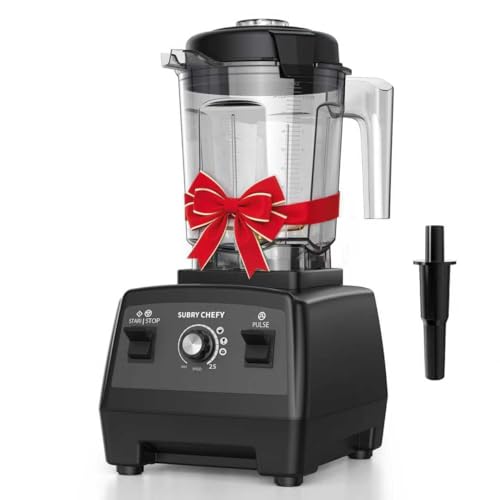
4. Subry Chefy Countertop Blender Pro 2000W — Best premium
A 2000W brushless motor claim, a 68 oz jar and 25 adjustable speeds make this the most spec-heavy option here.
Best for: a beginner willing to pay for the biggest motor here Skip it if: you want the reassurance of a stated warranty
The Subry Chefy is the most expensive pick here, and the specifications reflect that. Subry Chefy says the machine uses a 2000W copper brushless motor rated at up to 28,000 RPM with a plus-or-minus 10% tolerance printed on the listing, which is the only tolerance figure published in this set. The 68 oz BPA-free container is the second-largest here, behind only the MAGETANG. Subry Chefy also states a six-blade titanium head and 25 adjustable speeds. That is more granularity than a beginner needs on day one, but the presence of a self-cleaning program means the speed dial does not have to be the first thing you learn.
Dimensions of 16.5 x 9.06 x 7.06 in are middle of the pack. What is missing is a stated warranty, and the machine is the slowest seller of the six. A beginner buying at this price position is paying for the motor headroom, not for the paper trail.
Pros:
- 2000W brushless motor claim, highest on this list
- 68 oz BPA-free container
- Self-cleaning program documented
- 25 speeds plus titanium six-blade head
Cons:
- The most expensive pick here
- No stated warranty on the listing
- 25 speeds is overkill for a first blender
5. Bear Blender 700W Smoothie Countertop Blender — Best budget pick
Three speeds, a 40 oz cup and 4.23 lb of weight: the simplest, lightest way into the category.

Best for: a single-person kitchen making one drink at a time Skip it if: you plan to blend more than 40 oz in one go
The Bear is the cheapest of the six and, at 4.23 lb, the lightest by nearly 3 lb over the OMMO. It is also the smallest at 12 x 6 x 6 in, which means it fits on a shelf where none of the others do. Bear states a 700W motor, three-speed control plus pulse, and hardened six-blade stainless steel. The 40 oz cup is a solo-user size, not a family-batch size. That is a real limit, not a quibble: two servings and you are running a second batch.
The reassurance here is documentation. Bear publishes a 1-year standard warranty and a safety-lock instruction, which is more paperwork than the MAGETANG, OMMO or Subry Chefy include. For a beginner who wants a low-commitment way to see if daily smoothies stick as a habit, this is the honest entry point. The trade-off, obviously, is power headroom: 700W is less than half the wattage of every other pick here.
Pros:
- Cheapest pick here
- Lightest at 4.23 lb
- 1-year standard warranty published
- Small 12 x 6 x 6 in footprint
Cons:
- 700W motor is the lowest rating here
- 40 oz cup is single-serving
- Only three speeds
6. Oster Extreme Mix Blender — Best for heavy use
A 64 oz Tritan jar, auto programs and an anti-jam blade make this the pick for someone who plans to blend daily from day one.

Best for: daily blending where preset programs remove the guesswork Skip it if: you want the lightest machine to lift on and off the counter
The Oster is the heaviest machine here at 8.63 lb, and Oster states a 1500 peak-watt motor with a 2-horsepower rating. The 64 oz jar is Tritan, which Oster describes as BPA-free, shatterproof and dishwasher-safe. That combination is unique in this set: the other jars are plastic pitchers without a shatterproof claim. Oster also publishes preset iBlend auto-programs for smoothies, milkshakes and salsas, plus an anti-jam reversing blade that the listing says removes the need for tamping or shaking.
For a beginner who expects to blend every day, the presets do the reading of the recipe for you. Dimensions of 16.4 x 8.5 x 6.2 in are compact for the jar size, and the 1 Year Limited Warranty is documented. The trade-offs: heaviest body here, and Oster is the second-most expensive pick. If daily use is the plan, that pays back. If not, a lighter machine wins.
Pros:
- Tritan jar, described as shatterproof and dishwasher-safe
- Auto programs for smoothies, milkshakes and salsas
- Anti-jam reversing blade
- 1 Year Limited Warranty published
Cons:
- Heaviest at 8.63 lb
- Second-most expensive here
- Presets can feel restrictive once you learn the machine
Wattage, RPM and the numbers that mislead beginners
Wattage sells blenders. It also tells you less than most guides claim.
Every full-size machine here except the Bear runs at 1500W or higher, and MAGETANG plus Subry Chefy both claim 28,000 RPM. Past a certain threshold, extra watts do not blend a smoothie any smoother; they extend the runway for ice-crushing, hot soups and thick nut butters. A beginner making banana-and-yogurt drinks will not notice the difference between 1500W and 2000W.
Three numbers matter more:
- Blade count and material. The OMMO, MAGETANG and Bear all state a six-blade stainless steel head. Oster states four titanium-coated blades in a 10-point stack. Subry Chefy states a six-blade titanium head. All are enough for a beginner.
- Jar material. The Oster Tritan jar is the only one described as shatterproof on its listing. Everything else is BPA-free plastic without that specific claim.
- Blade access for cleaning. Every pick claims either self-clean, dishwasher-safe, or both. That matters more than any wattage figure, because a blender you dread cleaning is one that stops getting used.
Read wattage as a ceiling, not a floor.
How big a jar do you actually need?
Jar size is the single most useful spec for matching a blender to your kitchen. Here is the rough split from this set:
- 34 oz to 40 oz (Ninja, Bear): one to two servings per batch. Ideal for solo users, morning smoothies, single shakes.
- 60 oz to 68 oz (OMMO, Oster, Subry Chefy): three to five servings. Handles a family breakfast in one round, plus soups and dips.
- 70 oz (MAGETANG): four to six servings. Party batches, big soup pots, weekend meal prep.
The trap is buying up. A 70 oz pitcher is heavier to lift, harder to wash, and takes more counter space than a 40 oz cup. If you live alone and blend once a day, the largest jars here are overkill. If you cook for a family, the smallest ones are a chore.
Match the jar to your typical batch, not to the biggest you might ever attempt. You can always run a second round in a smaller machine. You cannot shrink a big pitcher on the days you only want one drink.
Which of these is genuinely easy to clean?
Cleanup is where beginners quit blenders. Four of the six here address it explicitly.
- Self-cleaning program stated: MAGETANG and Subry Chefy. Add water and a drop of soap, run the cycle, rinse.
- Dishwasher-safe parts stated: OMMO (the lid handle also gets a mention), Oster (the Tritan jar), and Subry Chefy.
- Pulse-only cleaning: Bear. The listing frames the pulse function as the cleaning method rather than a separate cycle.
- Ninja: the listing does not state self-clean or dishwasher-safe on the specifications I have.
If you know cleanup will be the sticking point, the self-clean claim is the feature to prioritise. It is not a substitute for the occasional deep wash, but it is what gets the machine rinsed on a busy weekday.
The verdict
The MAGETANG 1800W wins for a beginner because it removes the two biggest friction points at once: a 70 oz jar covers almost any batch you will attempt, and the self-cleaning program means you never have to reach around blades with a sponge. The 1800W motor and 28,000 RPM claim are more than any first-time smoothie recipe needs, which is the right kind of overkill: it means the machine will still feel fresh when you graduate from banana drinks to frozen fruit and nut butters six months in.
The Ninja SS151 TWISTi is the sharper buy if your counter cannot spare 19.7 in of depth or you want a written warranty from a known brand. Its 34 oz pitcher is limiting for family use, but the two to-go cups turn it into a portable single-serve setup that no other pick here matches. If money is the constraint, the Bear covers the basics at 4.23 lb and 40 oz.
Two flips change the answer. Blend for one person only? The Bear or the Ninja is enough machine. Plan to blend daily, seven days a week? The Oster's anti-jam blade and preset programs are built for that pace.
FAQ
What size blender jar should a beginner start with?
What size blender jar suits you depends on how many people you feed. A single user or couple is well served by 34 oz to 40 oz, like the Ninja or Bear. Families of three or more want 60 oz or larger, like the OMMO, Oster, Subry Chefy or MAGETANG. Buying oversized adds weight and cleaning time you will not use.
Is a high speed blender worth it over a basic model?
Is a high speed blender worth the step up? Yes if you plan to crush ice, blend frozen fruit, or make nut butters, all of which stall lower-powered machines. Every pick here except the Bear rates 1500W or more, and MAGETANG plus Subry Chefy claim 28,000 RPM. For simple protein shakes only, a basic blender does the job.
How much wattage does a beginner actually need?
How much wattage matters less than most listings suggest. For daily smoothies and softer fruits, 700W is workable, which is what the Bear delivers. For ice, frozen fruit and thicker blends, 1500W or higher is the practical floor. Past 2000W, like the Subry Chefy's claim, extra power gives runway but not noticeably better texture on typical drinks.
MAGETANG versus Ninja: which suits a small kitchen better?
MAGETANG versus Ninja comes down to counter space. The Ninja SS151 is 13.8 x 6.51 x 8.3 in and 7.19 lb, small enough for a cabinet. The MAGETANG is 19.7 x 8.11 x 9.2 in, the tallest here. If your upper cabinets sit low, the Ninja fits where the MAGETANG will not. Choose Ninja for tight kitchens, MAGETANG for batch size.
What mistake do first-time blender buyers usually make?
What mistake first-time blender buyers make most often is chasing wattage instead of jar fit and cleaning. A 2000W machine you dread washing is worse than a 1500W one you clean in 20 seconds. Focus on jar capacity matched to your household, presence of a self-clean cycle, and a footprint that fits your counter before you compare motor numbers.
A first blender should reward daily use, not punish it. That is why the MAGETANG's combination of the 70 oz pitcher, the extra 20 oz to-go cup, and the self-cleaning program does more for a beginner than any single wattage figure could. Start by measuring the depth of your counter under any wall cabinet, then decide how many servings you typically make in one go. Those two numbers will tell you whether to spend up for the MAGETANG's capacity, sidestep to the Ninja's compact body, or start small with the Bear. The right blender is the one still on your counter in six months.