Best Smoothie Blender for Beginners by Watts and Cups

Five picks compared on published specs: motor wattage, cup capacity, weight and warranty. Which one earns counter space, and the exact point where the cheaper pick stops coping.

By Elin RoweUpdated 15 min read
On this page
- Best smoothie blender for beginners at a glance
- How the picks map to four beginner profiles
- Why wattage is the wrong number to shop on
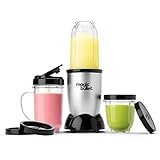
- 1. Magic Bullet Blender — Best overall
- 2. Ninja Nutri-Plus Personal Blender — Best premium
- 3. Consciot 11-Piece Blender for Kitchen and Personal Size — Best for beginners
- 4. Ganiza Smoothie Blender — Runner-up
- 5. The Healthy Smoothie Bible — Best budget pick
- How much cup capacity does one smoothie need?
- Does "for beginners" mean anything on a blender listing?
- What cleaning one of these actually involves
- The verdict
- FAQ
The best smoothie blender for beginners is the Magic Bullet Blender, because at 3.25 lb and 11.6 inches tall it lives on the counter instead of in a cupboard, and it carries a 5 Year Warranty listed on the page. If you blend rock-hard frozen fruit most mornings, the 900-peak-watt Ninja Nutri-Plus is the better buy. The number that actually splits this field is not price. It's how much motor sits under the cup, and whether your fruit comes out of a freezer or a fruit bowl.
Best smoothie blender for beginners at a glance
| Pick | Motor | Cups | Price |
|---|---|---|---|
Best overall Magic Bullet Blender |
250W claim | 11-piece set | Check Price |
Best premium Ninja Nutri-Plus Personal Blender |
900 peak watts | 3 × 20 oz | Check Price |
Best for beginners Consciot 11-Piece Blender |
900W claim | 11-piece set | Check Price |
Runner-up Ganiza Smoothie Blender |
900W claim | 24 oz + 2 × 17 oz | Check Price |
Best budget pick The Healthy Smoothie Bible |
No motor | Recipe book | Check Price |


How the picks map to four beginner profiles
I didn't screen these by wattage. I sorted them by who's standing at the counter, because that's what changes the answer.
- The cautious first-timer. You've never owned a blender. You want one that's obvious to operate and doesn't dominate the counter. The Magic Bullet is 3.25 lb and 4.01 inches wide, and its listing describes the whole workflow as load the cup, twist on the blade, line up the tabs, place on the base. Four steps, no dial.
- The frozen-fruit person. Your smoothie starts in the freezer. That's a motor question, and the Ninja Nutri-Plus is the only pick here with a standardised 900-peak-watts figure published as a specification rather than a marketing bullet.
- The hands-off blender. You want to lock the cup down and walk two steps away. Consciot's listing claims safety micro-switches and hands-free auto blending, plus overheat protection and a cooling fan.
- The batch prepper. You make one big drink, or three across the week. Ganiza lists one 24 oz cup and two 17 oz cups, which is the widest capacity spread in this group.
The fifth pick isn't a blender at all. It's a recipe book, and it solves the problem nobody warns beginners about: you'll repeat banana-and-spinach four times and quit.
Why wattage is the wrong number to shop on
Three of these listings claim 900 watts. Two of the three also claim 25,000 RPM, in nearly identical language. That similarity should tell you something: the number is easy to print and hard to compare, because "peak" watts is a momentary figure, not a sustained one.
Here's what I'd look at instead when picking the best smoothie blender for beginners.
- Blade geometry, as described. Consciot claims an asymmetric stainless steel blade that blends at four angles to pull ice toward the centre. Ninja claims a Pro Extractor blade assembly. Both are shaped claims about how ice gets into the blades, which matters more than the number on the base.
- Whether the cup is the container you drink from. Ninja and Ganiza both include to-go lids. That removes a dish.
- Physical height. The Ninja stands 13.8 inches. The Magic Bullet stands 11.6 inches. Consciot's longest listed dimension is 10.8 inches. Under a low cabinet, that spread decides which one you can leave assembled.
- Warranty length. Magic Bullet's page lists a 5 Year Warranty as a specification. The other three appliances list one year.
That last point is the quiet one. A beginner blender gets used carelessly: overfilled, run too long, left with pulp under the blade. Four extra years of stated cover is worth more than 650 claimed watts you'll use twice a week.
1. Magic Bullet Blender — Best overall
The smallest, lightest, longest-covered pick here, and the one buyers choose most often in this group.
Best for: a first blender in a small kitchen, blending soft and thawed fruit Skip it if: you blend rock-hard frozen fruit or whole ice daily
This is the pick I'd hand someone who has never owned a blender. It weighs 3.25 lb. The base measures 11.6 x 4.01 x 4.48 in, which is narrower than a mug and a phone side by side. Magic Bullet describes the motor as a high-torque 250-watt unit, and that's the lowest claimed figure in this roundup by a wide margin.
Low wattage is a real limitation, and I'll come back to it. But the specification that separates this pick is the 5 Year Warranty listed on the page. Every other appliance here lists one year. For a first blender, that gap matters more than raw claimed power, because year two is when a beginner's blender starts making unhappy noises.
The set is 11 pieces, and the listing describes cleaning as twisting off the blade, rinsing it, and putting the cups on the dishwasher's top rack. It's also the model with the longest presence in the category, sold under the MBR-1101 code.
The trade-off against the Ninja is straightforward. You're giving up sustained power on frozen ingredients in exchange for a smaller footprint and a longer stated warranty.
Pros:
- Lightest pick here at 3.25 lb
- 5 Year Warranty listed, four years longer than the rest
- Narrowest base at 4.01 in wide
- Four-step operation described on the listing
- The one buyers choose most often in this set
Cons:
- 250-watt claim is the lowest of the four blenders
- Small cups mean batching for two people
- Listing quotes a 1 year Limited Warranty in one bullet, conflicting with the 5 Year spec
- No to-go lid mentioned in the specifications
2. Ninja Nutri-Plus Personal Blender — Best premium
The only pick with 900-peak-watts published as a specification rather than a marketing bullet, and three matching 20 oz cups.

Best for: frozen fruit, ice and multiple people packing cups the night before Skip it if: your cabinet clearance is under 14 inches
If your smoothie routine starts at the freezer door, this is the pick. Ninja lists 900-Peak-Watts as a size specification, which is a different thing from a wattage claim buried in a feature bullet. The company describes a Pro Extractor blade assembly that crushes ice and breaks down whole fruits and vegetables, and a push-to-blend base you pulse manually.
Three 20 oz Ninja To-Go Cups come in the box, all the same size. That uniformity is the practical advantage over Ganiza's mixed set: you can fill all three on Sunday, twist on Storage Lids, and swap to Spout Lids each morning without deciding which cup gets which recipe.
It's also the heaviest and tallest of the blenders at 5.34 lb and 13.8 x 4.7 x 4.7 in. Measure your cabinet gap before ordering. The model code is BN301 and the listing dates it to 2021, making it the newest-listed appliance here.
Cups, lids and the blade assembly are described as top-rack dishwasher safe. The trade-off is price position and bulk: it's the most expensive pick in this roundup, and it takes the most vertical space for a one-year stated warranty.
Pros:
- 900-peak-watts published as a specification
- Three identical 20 oz cups for batch prep
- Spout and Storage lids both included
- Manual pulse control for frozen ingredients
Cons:
- Most expensive pick here
- Tallest at 13.8 in, tight under low cabinets
- Heaviest blender at 5.34 lb
- One year limited warranty against Magic Bullet's five
3. Consciot 11-Piece Blender for Kitchen and Personal Size — Best for beginners
The cheapest blender of the four, with the shortest listed body and a hands-free locking design.

Best for: someone who wants hands-free blending and the shortest counter footprint Skip it if: you need a published weight before you buy
Consciot is the cheapest blender in this group, and the specification that earns it a place is size: 8.35 x 10.8 x 4.81 in, the shortest of the four on its longest axis. Under a standard 18-inch cabinet gap you can leave this fully assembled.
The listing claims a full copper motor at a maximum 900W and up to 25,000 RPM, plus an asymmetric stainless steel blade that blends at four angles to pull ice toward the centre. Those are the manufacturer's words. What I find more useful for a beginner is the operating design: Consciot says the cup locks into the base with safety micro-switches for auto blending, so you're not holding a cup down for 40 seconds. The listing also claims overheat protection, a leak hole in the base, non-slip suction feet and a cooling fan.
Cleaning is described as a drop of dish soap and water for a self-clean cycle, with detachable blade parts for deeper cleaning and dishwasher-safe cups and lids.
The gap against Magic Bullet: no weight is published, no released date, and the warranty is one year. You're buying a newer listing with less specification detail behind it.
Pros:
- Cheapest blender of the four picks
- Shortest listed dimension at 10.8 in
- Hands-free locking operation claimed
- Overheat protection and cooling fan claimed
- 11-piece set, matching Magic Bullet's count
Cons:
- No weight published in the specifications
- One year manufacturer warranty
- Cup capacities not stated in ounces
- Sells slower here than Magic Bullet or Ninja
4. Ganiza Smoothie Blender — Runner-up
The only pick with a 24 oz cup, and the widest capacity spread in this roundup.

Best for: one big 24 oz smoothie plus two smaller cups for the week Skip it if: you want a brand with a long track record behind it
Ganiza ships a 14-piece set, the largest piece count here. The capacities are what stand out: one 24 oz cup and two 17 oz cups, with two to-go lids. That's the only 24 oz vessel in this group, and it's the right shape for a single large breakfast drink rather than three matched portions.
The company claims peak power of 900W from an all-copper turbo motor at 25,000 RPM, with food-grade 304 stainless steel blades. It also claims the blender only runs when the cup is pressed down properly, plus a cooling fan on the bottom and back and four non-slip silicone pads.
One detail earns a real mention for a new smoothie maker: the listing says a recipe book is included, and it advises adding more than half a cup of liquid for an even mix. That liquid ratio is the single most common beginner mistake, and it's printed on the page.
At 3.89 lb and 8.6 x 12 x 4.8 in, it sits between the Magic Bullet and the Ninja on both counts. The honest drawback is momentum: it's the slowest seller of the four blenders here and it sits in the more expensive half of the set, with a one-year guarantee.
Pros:
- Only 24 oz cup in this roundup
- 14 pieces, the largest set count here
- Recipe book included per the listing
- Two to-go lids for portable use
Cons:
- Sits in the more expensive half of the set
- Slowest-selling blender of the four
- One Year Guarantee only
- Mixed cup sizes complicate batch prep
5. The Healthy Smoothie Bible — Best budget pick
The cheapest pick here, and the only one that fixes the day-four problem instead of the blending problem.
Best for: a new blender owner who runs out of recipe ideas by day four Skip it if: you don't own a blender yet
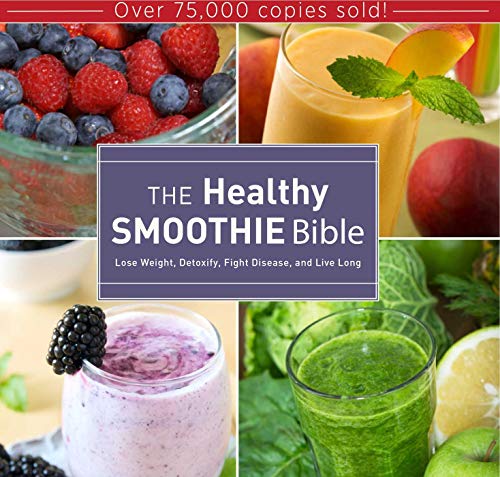
Let me be direct: this is a book, not a machine. It won't blend anything. I've included it because it's the cheapest item in this set and it addresses the failure mode that kills most new smoothie habits, which isn't power. It's repetition.
The specifications are what you'd expect: 1.66 lb, 7.5 x 7.5 x 1 in, released in 2014, published by Skyhorse. The subtitle covers weight loss, detoxifying, disease and longevity, and I'll leave those claims where they sit, on the publisher's cover.
What a reference like this does for a beginner is give you a rotation. Once you've got a working blender and a freezer bag of fruit, the limiting factor is ideas. Two of the blenders above ship a recipe booklet, but a booklet is a handful of pages. A bound reference at 7.5 inches square is the thing that stays on the shelf next to the blender.
Pair it with any of the four appliances above. On its own, it's the pick that makes least sense, and it's the slowest-selling item in this roundup by a wide margin.
Pros:
- Cheapest pick in this roundup
- Solves recipe fatigue, not a hardware problem
- Compact at 7.5 x 7.5 x 1 in
- Pairs with any of the four blenders
Cons:
- Not a blender, so it blends nothing
- No warranty, no model number, no accessories
- 2014 release date, the oldest item here
- Cover health claims are the publisher's, unverified
How much cup capacity does one smoothie need?
Capacity is where the best smoothie blender for beginners decision gets practical, because a cup you can't fill is a cup you're washing for nothing.
Here's how the published numbers line up:
- 17 oz — Ganiza's two smaller cups. One modest drink, no ice headroom.
- 20 oz — all three Ninja cups. Enough for frozen fruit plus liquid without the lid fighting you.
- 24 oz — Ganiza's large cup, the biggest single vessel here.
- Not stated — Magic Bullet and Consciot both describe 11-piece sets without publishing ounce figures per cup.
The rule I'd give a beginner: fill to about two-thirds and stop. Frozen fruit needs room to move, and Ganiza's own listing advises more than half a cup of liquid for an even mix. If you're making one drink for yourself, 17 to 20 oz is plenty. If you're making one for someone else too, three matched 20 oz cups beat one 24 oz cup, because you're not deciding who gets the small one.
Does "for beginners" mean anything on a blender listing?
Honestly, no. Not one of these five listings publishes a beginner-focused specification. There's no skill-level field, no guided-programme count, no "starter" designation in the data. So when you search for a smoothie blender for beginners, what comes back is just blenders, and you have to do the beginner judgement yourself.
What I'd use as proxies, all of them checkable on the page:
- Fewer controls. Magic Bullet's listing describes no buttons at all: you twist and press. Consciot claims micro-switch auto blending. Both reduce the number of decisions.
- Included recipes. Ganiza and the Skyhorse book both provide them. Ninja and Magic Bullet's specifications don't list any.
- A long stated warranty. Beginners break things. Magic Bullet's 5 Year Warranty is the only one over 12 months here.
- Dishwasher-safe parts. Ninja and Consciot both state top-rack safe cups, lids and blade assemblies.
Treat "for beginners" as your own filter, not a promise the listing made. Nothing in this data lets me claim any of these was built for a first-time user.
What cleaning one of these actually involves
Nobody quits smoothies because the blender was underpowered. They quit because the blade assembly sat in the sink for two days.
All four blenders describe similar cleaning: separate the blade, rinse it, dishwasher the cup. Magic Bullet says twist off the blade, rinse with soap and water, top rack for the cups. Ninja states cups, lids and blade assembly are top-rack dishwasher safe. Consciot claims a self-clean with one drop of soap and water, plus detachable blade parts for deep cleaning.
The part that never goes in the dishwasher is the motor base, on any of them. That's a damp-cloth job on all four.
Two design details are worth knowing about. Consciot claims a leak hole in the base to resist fluid getting into the motor, which is a real failure point when a cup is overfilled. Ganiza claims a cooling fan on the bottom and back. Neither is verified here, but both address something a beginner will eventually do by accident.
Rinse the blade the moment you pour. Sixty seconds then beats ten minutes later.
The verdict
If you blend soft or thawed fruit and your counter is short on space, the Magic Bullet Blender is the best smoothie blender for beginners. It's 3.25 lb, 4.01 inches wide, and its page lists a 5 Year Warranty that nothing else here matches. If your fruit comes out of a freezer solid, the Ninja Nutri-Plus is the buy instead: 900-peak-watts published as a specification, a Pro Extractor blade assembly, and three 20 oz cups.
The cutoff is the freezer. Fruit you thawed or bought fresh, or a banana off the counter, is well inside what a 250-watt claim handles. Whole ice cubes and fruit straight from a solid frozen bag every single morning is where the Ninja's motor earns the higher price and the extra 2.09 lb.
Two side cases. If cabinet clearance is your constraint, Consciot's 10.8-inch longest dimension is the shortest here and it's the cheapest blender of the four. If you want one large 24 oz drink rather than three matched portions, Ganiza is the only pick that offers it.
Whichever machine you pick, add the recipe book. It's the cheapest item in this roundup and it's the one that keeps the blender on the counter past week two.
FAQ
Is a beginner smoothie blender worth buying over a full-size one?
A beginner smoothie blender is worth it if you're making one or two drinks at a time, because you blend and drink from the same cup and skip a wash. The Magic Bullet base is 4.01 inches wide against a full-size jug's footprint. The limit is batch size: none of these cups exceeds 24 oz, so family-sized blending needs a pitcher blender instead.
How do I get value from the cheapest pick here?
Value from the cheapest pick here means pairing The Healthy Smoothie Bible with a blender rather than buying it alone. It's 1.66 lb, 7.5 x 7.5 x 1 in, and published in 2014. On its own it blends nothing. Alongside the Magic Bullet or Consciot, it removes the reason most new smoothie habits stall, which is running out of recipes by the second week.
Do these blenders handle frozen fruit and ice?
Handling frozen fruit and ice depends on the motor. Ninja publishes 900-peak-watts as a specification and describes a Pro Extractor blade assembly for crushing ice. Consciot and Ganiza both claim 900W and 25,000 RPM in their feature bullets. Magic Bullet claims a high-torque 250-watt motor, which suits softer or thawed fruit better. Thaw frozen fruit for five minutes if you buy the Magic Bullet.
Magic Bullet or Ninja Nutri-Plus for a first blender?
Magic Bullet or Ninja Nutri-Plus comes down to two figures. Magic Bullet is 3.25 lb, 11.6 inches tall, and lists a 5 Year Warranty. Ninja is 5.34 lb, 13.8 inches tall, publishes 900-peak-watts, and lists a one year limited warranty with three 20 oz cups. Small kitchen and soft fruit, take the Magic Bullet. Freezer-first smoothies, take the Ninja.
What mistake do new smoothie blender owners make most?
The mistake new smoothie blender owners make most is too little liquid. Ganiza's own listing advises adding more than half a cup of liquid for an even mix, and that ratio applies across all four blenders here. Too little liquid leaves a pocket of air under the blade, the motor spins against nothing, and you blame the wattage. Liquid first, then fruit, then ice.
Order the blender that matches your freezer habits, then set it up the same day it arrives: cups washed, one bag of fruit portioned, book open on the counter. The Magic Bullet is the right default for most first-time buyers because the two things that make a beginner give up are counter clutter and a machine that dies in month fourteen, and a 3.25 lb body with a 5 Year Warranty listed on the page answers both. Power you can add later, once you know whether you actually blend every morning or twice a week.