Best Japanese Chef Knife: HOSHANHO Takes the Lead

Five Japanese-steel blades compared on the numbers that matter in a small kitchen: blade length, weight, handle material and how much gear comes in the box. The winner is an 8-inch single knife, not a set.

By Elin RoweUpdated 15 min read
On this page
- Best japanese chef knife for students at a glance
- Why three of these listings were nearly cut
- Single knife or a whole set for a student kitchen?
- What actually decides a Japanese chef knife for students
- 1. HOSHANHO Kitchen Knife in Japanese High Carbon Steel — Best overall
- 2. SHAN ZU Chef Knife 8 Inch Japanese Steel Damascus Kitchen — Best budget pick
- 3. Atumuryou Japanese Chef Knife — Best upgrade
- 4. Diversity DS, Japanese Kitchen Knife Set with Bag — Most versatile
- 5. imarku 3 Pieces Knife set — Best premium
- Handle material: wood, pakkawood or G10?
- What a dorm or shared kitchen does to a knife
- The verdict
- FAQ
The best Japanese chef knife for students is the HOSHANHO 8-inch high carbon steel chef's knife, a single 0.77 lb blade hand-sharpened to 13 degrees per side that handles nearly every prep task a small kitchen throws at it. If you want the lowest price in this group, the SHAN ZU 8-inch Damascus knife weighs less at 0.57 lb and costs the least of the five. Getting this wrong is expensive in an ugly way. A dull, badly balanced blade slips off an onion skin, and the thing it hits next is your knuckle.
Best japanese chef knife for students at a glance
| Pick | Blade length | Weight | Price |
|---|---|---|---|
| 8" | 0.77 lb | Check Price | |
Best budget pick SHAN ZU Chef Knife 8 Inch Japanese Steel Damascus Kitchen |
8" | 0.57 lb | Check Price |
Best upgrade Atumuryou Japanese Chef Knife |
8" | Not published | Check Price |
Most versatile Diversity DS, Japanese Kitchen Knife Set with Bag |
13.2 in overall | 5.6 lb (20 pieces) | Check Price |
Best premium imarku 3 Pieces Knife set |
8" chef blade | Not published | Check Price |



Why three of these listings were nearly cut
I started by throwing things out, and the reasons were the same three every time.
The first cut was overall length. Three of these knives measure between 13 and 13.5 inches from tip to butt, which is longer than the drawer in a lot of shared apartments. That matters more than blade steel if the knife has nowhere to live. The Diversity DS set clears that hurdle differently: it ships with its own bag and sheaths, so the drawer stops being the problem.
The second cut was published weight. Two of the five listings publish no weight figure at all. A knife's weight is the single most predictive number for whether a beginner enjoys using it, so a blank there pushed both the Atumuryou and the imarku set down the order despite strong steel claims.
The third cut was piece count creep. A 20-piece set sounds generous until you count how many of those pieces are sheaths and a finger guard. I kept it because the bag genuinely solves a storage problem, not because 20 is better than one.
What survived: three single 8-inch chef's knives, one three-knife set and one all-in-one kit. Every one of them names Japanese steel in the listing. The picks below are ranked on what a small, busy kitchen actually needs first.
Single knife or a whole set for a student kitchen?
This is the real fork in the road, and it has almost nothing to do with steel.
A single 8-inch chef's knife does about 90% of home prep. Onions, peppers, chicken thighs, garlic, a squash if you're patient. Three of the five picks here are exactly that: one blade, one box.
A set answers a different question. If your kitchen is empty, the Diversity DS 20-piece kit arrives with a cutting board, a sharpener, a knife bag, sheaths and a finger guard. That is a furnished kitchen in one delivery. It also weighs 5.6 lb, and it needs somewhere to sit.
Here's the trick most shoppers miss. A cheap set spreads its budget across pieces you rarely touch, while a single knife concentrates it in the one you use nightly. The imarku three-piece set is the middle road: chef, utility and paring, with nothing decorative added.
- One knife: cheapest per blade you'll actually use, easiest to store, fastest to learn on.
- Three knives: covers the small jobs an 8-inch blade is clumsy at, like coring a tomato.
- Twenty pieces: solves storage, sharpening and board all at once, at the cost of bulk.
What actually decides a Japanese chef knife for students
Most guides for this category compare hardness numbers. Steel hardness is not what decides it.
Here's why. Every knife here claims a hard Japanese steel: SHAN ZU says 62 HRC, Atumuryou says 62 HRC from a VG-10 core, imarku says 57±1 HRC. Those are the manufacturers' figures, and they cluster tightly enough that no beginner will feel the gap in the first year. What you will feel, every single time you pick the thing up, is weight and grip.
The best japanese chef knife for students is the one you keep reaching for on a Tuesday when you're tired. That comes down to three checkable things.
- Weight. The two picks that publish it sit at 0.57 lb and 0.77 lb, a 0.2 lb spread. Lighter feels nimble and tires your wrist less. Heavier drops through a carrot with less effort from you.
- Edge angle. HOSHANHO says 13 degrees per side; imarku says a 15 degree double bevel. Narrower is sharper and chips more easily on bone or a glass board.
- Handle shape. HOSHANHO's listing specifically mentions a sloped bolster that encourages a pinch grip. That grip is the one every knife-skills class teaches, and a handle that fights it teaches you a bad habit.
One more thing on the "for students" part. None of these listings is designed or specified for student use, so treat that framing as your own judgment call: what you're really screening for is compact size, low weight and easy upkeep.
1. HOSHANHO Kitchen Knife in Japanese High Carbon Steel — Best overall
A single 8-inch blade at 0.77 lb with a 13-degree edge per side, and the only listing here that talks about teaching you a proper grip.
Best for: someone cooking most nights in a small shared kitchen Skip it if: you need a paring knife and a bread knife too
Two things put this one first. It publishes its weight, 0.77 lb, and it publishes its edge angle, 13 degrees per side. Between them you know roughly how the knife will behave before it arrives, which is more than three of the other listings offer.
HOSHANHO says the blade is 10Cr15CoMoV Japanese high carbon steel and that it's hand-sharpened. That's the manufacturer's claim, not a measured result. The detail I'd actually weigh is the handle: the listing describes a distinctive sloped bolster shape meant to encourage a proper pinch grip. A handle that nudges you toward correct technique is worth more to a new cook than a few points of hardness, because grip is the habit you'll carry into every kitchen after this one.
At 0.77 lb it's the heaviest single knife here by 0.2 lb, and the matte finish is described as fashion-led rather than functional. It also sells faster than any other pick in this group.
The trade-off is scope. This is one blade, so a tomato or a shallot means the same 8-inch knife doing delicate work it isn't shaped for.
Pros:
- Publishes both weight and edge angle, unlike most rivals
- 13 degrees per side, the narrowest stated angle here
- Handle shaped to encourage a pinch grip
- Buyers choose it more often than anything else in this set
- Second-cheapest of the five picks
Cons:
- Heaviest single knife here at 0.77 lb
- No paring or utility blade for small jobs
- Only one seller lists it
- No published warranty
2. SHAN ZU Chef Knife 8 Inch Japanese Steel Damascus Kitchen — Best budget pick
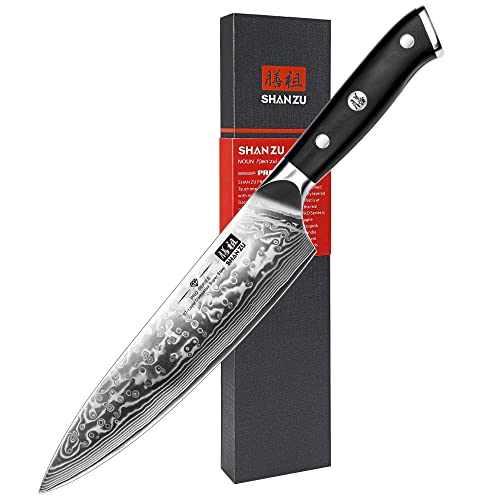
The cheapest pick of the five and the lightest at 0.57 lb, with a synthetic G10 handle that shrugs off a wet sink.
Best for: spending the least and still getting Damascus steel Skip it if: you dislike a synthetic handle
This is the value case, and it's a strong one. The SHAN ZU is the cheapest of the five and still arrives with a Damascus blade, which the listing states is 67 layers of folded steel around a 10Cr15Mov core at 62 HRC. SHAN ZU is explicit that the pattern is forged rather than laser-etched. Take that as the manufacturer's account of its own process.
The number I keep coming back to is 0.57 lb. That's the lightest published weight in this group, 0.2 lb under the HOSHANHO, and light knives are forgiving when your technique is still forming. Your wrist lasts longer through a big batch of prep.
The G10 handle is the other separator. Frosted glass fibre doesn't swell, crack or stain the way wood can when a knife sits in a dish rack overnight, which is exactly the abuse a shared kitchen sink delivers. SHAN ZU claims it's more solid than a wood handle.
At 1.18 in thick and 13.2 in overall, it's a chunky thing in a shallow drawer. And a 62 HRC edge is hard, which means it's also more prone to chipping if you hit a bone or a plate.
Pros:
- Cheapest pick in this comparison
- Lightest published weight here at 0.57 lb
- G10 handle resists water damage better than wood
- 67-layer Damascus construction claimed, forged not etched
Cons:
- Synthetic handle looks less premium than pakkawood or stabilized wood
- 13.2 in overall length crowds a shallow drawer
- Hard 62 HRC edge is chip-prone on bone or hard boards
- No published warranty
3. Atumuryou Japanese Chef Knife — Best upgrade
A VG-10 core Damascus blade in a stabilized wood and resin handle, priced in the middle of this set and shipped in a gift box.

Best for: keeping one knife for years after graduation Skip it if: the knife shares a sink with roommates' dishes
VG-10 is the name that separates this pick. Atumuryou states a VG-10 steel core at 62 HRC and claims stain resistance alongside the hardness. That combination is the reason VG-10 shows up in a lot of well-regarded Japanese kitchen knives, and it's the one specification here that hints at a knife you keep well past a graduation.
The handle is stabilized wood mixed with resin, which Atumuryou describes as slip-resistant. Resin-impregnated wood sits between raw wood and full synthetic on water resistance: better than plain wood, not as indifferent to a wet rack as G10. If your knife lives in a shared sink, that matters.
It's the only pick that mentions a gift box, which is a small thing until you're buying this for someone moving into their first apartment.
Where it falls short is disclosure. The listing publishes dimensions of 0.01 x 13.3 x 1.77 in and an 8-inch blade, but no weight and no edge angle. That leaves you guessing at the two things that most affect how it feels in the hand. It sits mid-priced here, above both single-knife picks ranked ahead of it, and its published specification list is shorter than either.
Pros:
- VG-10 core, the most respected steel named in this set
- Stated stain resistance alongside 62 HRC hardness
- Stabilized wood and resin handle resists moisture better than plain wood
- Gift box included
Cons:
- No published weight or edge angle
- Costs more than both single knives ranked above it
- Shortest published specification list among the single knives
- No stated warranty
4. Diversity DS, Japanese Kitchen Knife Set with Bag — Most versatile
Twenty pieces including a knife bag, cutting board, sharpener and sheaths, which makes it the only pick that solves storage as well as cutting.

Best for: furnishing an empty kitchen in one purchase Skip it if: you have one drawer and no counter space
Everything else here is a knife. This is a kitchen. The 20-piece count covers knives plus a cutting board, a sharpener, a finger guard, a knife cleaner, blade sheaths and a bag to carry the lot, according to the listing. If you're arriving somewhere with nothing, that's a genuinely different proposition.
The bag deserves specific credit. Loose blades in a shared drawer are how people get cut reaching for a fork, and sheaths plus a zipped case remove that risk entirely. It also makes the set portable, which matters if you move every twelve months.
The sharpener is the other quiet win. None of the single knives here includes one, and a Japanese edge that never gets touched up gets dull fast.
Now the honest part. It weighs 5.6 lb and the longest piece measures 13.2 in, so it needs real space. Diversity DS names the steel only as high-carbon stainless, with no hardness figure, no edge angle and no steel designation, which is less detail than any single knife here provides. It's the slowest seller of the five by a wide margin, only one seller lists it, and it costs more than three of the four alternatives while spreading that money across pieces you may rarely reach for.
Pros:
- Includes bag, board, sharpener, sheaths and finger guard
- Only pick that solves knife storage out of the box
- Sheaths make a shared drawer safer
- Portable, which suits annual moves
Cons:
- 5.6 lb and 20 pieces need real storage space
- No steel designation, hardness or edge angle published
- Slowest seller in this group
- Only one seller lists it
- Costs more than three of the four alternatives
5. imarku 3 Pieces Knife set — Best premium
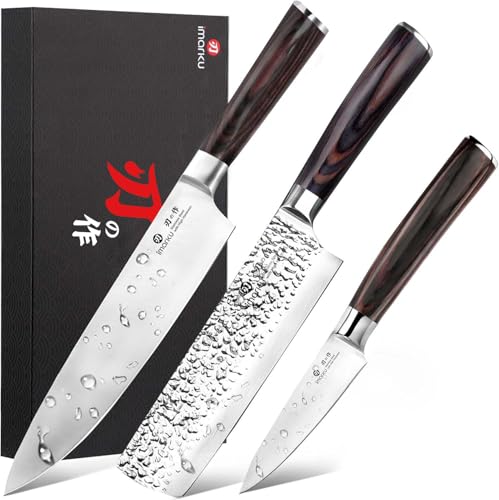
Chef, utility and paring blades with matching pakkawood handles and a stated 15-degree double bevel, at the highest price of the five.
Best for: wanting chef, utility and paring blades that match Skip it if: you want published weight and length figures first
Three knives, no filler. imarku's set is an 8-inch chef knife plus a utility and a paring blade, which is the shortlist most cooks actually settle on after a year in a kitchen. Nothing here is decorative.
The specification I like most is the edge angle: imarku states 15 degrees per side on a double bevel, and says each knife is hand-polished. A 15-degree edge is slightly less delicate than the 13 degrees HOSHANHO claims, which is the safer bet if the knife occasionally meets a bone or a hard board. imarku puts hardness at 57±1 HRC after vacuum heat treatment, softer than the two Damascus picks here. Softer steel dulls a bit sooner and chips a lot less.
The pakkawood handles in red-brown are described as ergonomic and balanced, and they're the most refined-looking option in this group. It's listed under gyutou knives, the Japanese term for a Western-style chef's blade.
The catch is what's missing. No weight, no dimensions, no overall length for any of the three blades. It's also the most expensive pick here, and a set of three at that price buys you fewer published figures than the cheapest single knife on this page.
Pros:
- Three genuinely useful blade shapes, no filler pieces
- 15 degrees per side, more chip-resistant than a 13-degree edge
- Pakkawood handles match across all three knives
- 57±1 HRC stated after vacuum heat treatment
Cons:
- Most expensive pick in this comparison
- No published weight or dimensions for any blade
- Softer stated hardness than either Damascus pick
- No stated warranty
Handle material: wood, pakkawood or G10?
Handles split this field cleanly, and the deciding factor is your sink, not your taste.
- Wood (HOSHANHO): warm in the hand and the only listing here that describes a bolster shape built around a pinch grip. Wood needs to be dried, not left soaking.
- Stabilized wood and resin (Atumuryou): the compromise. Resin fills the grain, so it tolerates moisture better than plain wood while keeping the look.
- Pakkawood (imarku): layered wood and resin, engineered for stability. It's the most polished-looking finish of the five.
- G10 (SHAN ZU): frosted glass fibre. It doesn't care what happens to it. If the knife will end up in a dish rack overnight, this is the one that survives.
- Not specified (Diversity DS): the listing says non-slip and ergonomic without naming a material.
In practice, I'd start with how the knife gets washed. Hand-washed and dried immediately, take the wood. Washed whenever someone gets around to it, take G10.
What a dorm or shared kitchen does to a knife
Nobody warns you about the cutting board.
Glass and ceramic boards are common in furnished rentals, and they wreck hard Japanese edges. Both Damascus picks here claim 62 HRC, and hard steel chips rather than rolls. The Diversity DS set is the only one that ships with a board, which quietly removes the problem.
Then there's the drawer. Three picks measure over 13 inches overall, so measure yours before ordering. Loose blades sliding around a drawer dull each other and cut fingers, which is the argument for the sheaths in the Diversity DS kit.
Sharpening is the last one. A Japanese edge at 13 or 15 degrees per side is thin, and thin edges need touching up more often than a thick German blade. Only one pick here includes a sharpener. Budget for one separately if you're picking a single knife, and treat the blade as something you maintain rather than something you own.
The verdict
If you're cooking for yourself most nights in a kitchen that already has a board and a drawer, buy the HOSHANHO. It's the best japanese chef knife for students in this group because it publishes the two numbers that predict how it will feel, 0.77 lb and 13 degrees per side, and because its handle is shaped to teach you the grip you'll use for the next twenty years. It's also the pick buyers here choose most often.
If you're moving into an empty kitchen with nothing but a pan, buy the Diversity DS 20-piece set. Its bag, board, sheaths and sharpener replace four separate purchases, and no single knife on this page can do that.
The cutoff is your storage. Under one drawer of free space, take a single knife every time, because 5.6 lb of kit and a 13.2 in bag has to live somewhere. With a cupboard shelf free, the set earns its bulk.
The SHAN ZU's exact advantage over the winner is weight and price together: 0.57 lb, the lightest published figure here, at the lowest cost of the five. If your wrist tires or your budget is fixed, that combination beats the HOSHANHO's edge angle.
FAQ
Is a Japanese chef knife worth it for a student cook?
A Japanese chef knife is worth it for a student cook if you prep food more than twice a week. The narrow edges here, 13 to 15 degrees per side, cut with less force than a blunt supermarket blade, which lowers the chance of the knife skidding. Cook rarely and any sharp knife will do.
What size Japanese chef knife should a student buy?
The size a student should buy is 8 inches, and four of these five picks use exactly that blade length. It's long enough for a cabbage and short enough to control on a small board. Check overall length too. Three picks here run 13 to 13.5 in tip to butt, which is longer than some rental drawers.
Which is better value, the HOSHANHO or the SHAN ZU?
Better value between the HOSHANHO and the SHAN ZU depends on one thing. The SHAN ZU is cheapest of the five and lighter at 0.57 lb, with a water-proof G10 handle. The HOSHANHO costs slightly more, weighs 0.77 lb and publishes a 13-degree edge plus a grip-training bolster. Pick SHAN ZU for cost, HOSHANHO for technique.
Does a harder steel mean a better Japanese chef knife for students?
Harder steel does not mean a better Japanese chef knife for students. The two Damascus picks claim 62 HRC and the imarku set claims 57±1 HRC. Harder steel holds an edge longer and chips more readily on bone, plates or glass boards. In a shared kitchen where the board is unpredictable, the softer edge is often the safer choice.
What's the biggest mistake buying a Japanese chef knife?
The biggest mistake buying a Japanese chef knife is skipping the sharpener. A 13-degree edge dulls faster than a thick Western blade, and a dull thin knife is the most dangerous tool in the drawer. Only the Diversity DS set includes one. If you're buying a single knife, order a whetstone or pull-through in the same basket.
Measure your drawer, look at your cutting board, then order. If both check out, the HOSHANHO is the default because it's the only pick that tells you both how heavy it is and how thin its edge is, and those two figures are what you'll notice on night one. Buy a sharpener alongside it and the knife stays useful for years, not months. The people who regret this purchase are almost never the ones who bought the wrong steel. They're the ones who never touched up the edge.