Best Stainless Steel Chef Knife for Pro Kitchens

Five stainless steel chef knives compared on steel type, blade length, weight and handle. PAUDIN's 8-inch N1 wins overall, with a Japanese-steel runner-up for finer edge work.

By Elin RoweUpdated 16 min read
On this page
- Stainless steel chef knife for professional chefs at a glance
- How I screened this shortlist down to five
- What actually decides a chef knife for pro use?
- 1. PAUDIN N1 8-inch Chef Knife — Best overall
- 2. HOSHANHO 8-inch Japanese Steel Chef's Knife — Best premium
- 3. imarku 7-inch Santoku Knife — Best for pros
- 4. Amazon Basics Classic 8-inch Chef's Knife — Best minimal setup
- 5. Cuisinart Graphix 8-inch Chef's Knife — Best budget pick
- Does the 'professional chef' label on a listing mean anything?
- 8-inch chef versus 7-inch santoku: which shape wins?
- Handle, tang and balance: reading a listing properly
- Care, sharpening and the real cost of owning one
- The verdict
- FAQ
The best stainless steel chef knife for professional chefs in this set is the PAUDIN N1, an 8-inch high carbon stainless blade weighing 6.88 oz with a 24-month warranty and an ergonomic wood handle. If you want a harder Japanese-steel edge for finer prep, the HOSHANHO 8-inch in 10Cr15CoMoV is the alternate, at 0.77 lb with a hand-sharpened 13-degree bevel per side.
Stainless steel chef knife for professional chefs at a glance
| Pick | Blade & steel | Weight | Price |
|---|---|---|---|
Best overall PAUDIN N1 8-inch Chef Knife |
8" high carbon stainless | 6.88 oz | Check Price |
Best premium HOSHANHO 8-inch Japanese Steel Chef's Knife |
8" Japanese 10Cr15CoMoV (claim) | 0.77 lb | Check Price |
Best for pros imarku 7-inch Santoku Knife |
7" Japanese high carbon stainless | 6.88 oz | Check Price |
Best minimal setup Amazon Basics Classic 8-inch Chef's Knife |
8" full tang high carbon stainless | 0.51 lb | Check Price |
Best budget pick Cuisinart Graphix 8-inch Chef's Knife |
8" stainless steel | 0.62 lb | Check Price |



How I screened this shortlist down to five
I started with the stainless steel chef knife listings that a working cook would actually see when searching, then cut anything without a stated blade length, a stated weight, or a clear steel description on the listing. That knocked out most of the field. What was left, I lined up by the four figures that matter on paper: blade length, weight, handle material as described, and any published warranty.
The five that survived split into three tiers by price position in this set:
- Two entry picks, both 8-inch stainless blades under 0.65 lb.
- One mid-range 8-inch with a 24-month warranty on the listing.
- Two premium picks, both citing Japanese high carbon stainless steel.
A note on the modifier. The search says "for professional chefs", but Amazon's results here are consumer listings that a pro might buy, not restaurant supply. Four of the five listings use the word "professional" in their marketing copy, and that word alone is not evidence of anything. I judged each pick on the specifications and the shape, not the label. If you cook for a living, treat "professional chef" on a listing as decoration and read the steel line instead.
What actually decides a chef knife for pro use?
Most guides compare blade length. Length is easy to see and it barely decides anything at this level, because four of the five picks here are 8 inches. The three variables that actually split this field are steel, weight, and handle construction.
Steel first. Two picks name Japanese high carbon stainless (HOSHANHO cites 10Cr15CoMoV; imarku says Japanese high carbon stainless). Two others say "high carbon stainless" without naming an alloy (PAUDIN, Amazon Basics). Cuisinart says "stainless steel" and stops. Harder steels hold an edge longer between sharpenings, which matters when you're doing four hours of prep before service. Softer steels are easier to bring back on a stone at home.
Weight next. The spread is real: from 0.51 lb on the Amazon Basics up to 0.77 lb on the HOSHANHO. A lighter blade is faster through a case of onions. A heavier blade rocks through winter squash without you leaning on it. Pick the weight for the food you cut most.
Handle is the third split. Two picks call out wood scales (PAUDIN, HOSHANHO's ultra-durable wood, imarku's Pakkawood). The two entry blades run synthetic composites. Wood scales feel warmer in a long shift; synthetics survive the dishwasher, which you should not be putting a good knife in anyway.
1. PAUDIN N1 8-inch Chef Knife — Best overall
The N1 is the one 8-inch stainless chef in this set that pairs a working weight with a published 24-month warranty, which is why it wins.
Best for: a working cook who wants one solid 8-inch stainless blade with a warranty Skip it if: you already own a Japanese-steel gyuto and want a finer edge
The N1 is 8 inches, 6.88 oz, and sits mid-range in this set for price. Nothing about the numbers is exotic. What differentiates it here is a specific pairing: the mid-weight of the imarku santoku (6.88 oz too) applied to a full-length 8-inch chef profile, plus the only stated warranty in the shortlist. PAUDIN says on the listing, "with 24 moths warranty as standard", which I read as 24 months.
The listing describes it as high carbon stainless steel with an ergonomic wood handle integrated with the blade. Those are manufacturer claims, not lab measurements, and the alloy is not named the way HOSHANHO names theirs, so treat the steel as a working stainless rather than a Japanese premium. PAUDIN says the blade handles bread, vegetables, fillets and meats, which describes what every 8-inch chef is supposed to do. What matters is the balance between the 6.88 oz weight and the 8-inch length: enough mass to rock through denser vegetables without wearing out your wrist on softer prep.
The trade-off: the N1 is not the sharpest out of the box in this set, going by the way HOSHANHO and imarku describe their edges, and PAUDIN does not publish a bevel angle.
Pros:
- 8-inch blade at a working 6.88 oz
- Only pick here with a stated warranty (24 months)
- Wood handle described as integrated with the blade
- Mid-range price position, not entry-tier
- Sells faster than three of the other four picks
Cons:
- Steel alloy not named on the listing
- No published bevel angle
- Warranty wording on the listing has a typo, which is not confidence-inspiring
2. HOSHANHO 8-inch Japanese Steel Chef's Knife — Best premium
The HOSHANHO is the only pick that names its steel alloy and its bevel angle, which is what you pay the premium for.

Best for: prep-heavy cooks who want a harder Japanese-steel edge Skip it if: you would rather spend less on a workhorse blade
This is the most expensive pick in the set. What you get for it, on the listing, is specificity: HOSHANHO says the blade is Japanese high carbon steel 10Cr15CoMoV, hand-sharpened to 13 degrees on each side, with a matte finish and a wood handle shaped for a pinch grip. That is a lot more information than any other listing here publishes, and specificity in a listing usually correlates with a manufacturer that knows what it made.
At 0.77 lb the HOSHANHO is the heaviest pick in this shortlist. On an 8-inch blade that mass sits forward and helps the knife do the work through denser cuts like celeriac or a butternut neck. Cooks who spend a shift on herbs and shallots may find it slower than the 6.88 oz PAUDIN. HOSHANHO says the sloped bolster shape encourages a pinch grip, which is the grip most pros default to, and the wood scales should suit a full shift.
The trade-off: it is the highest price position in the set, and the sales rank is slower than PAUDIN's, so fewer buyers here are choosing it as the default.
Pros:
- Names its steel: 10Cr15CoMoV Japanese high carbon
- Publishes bevel angle: 13 degrees per side (claim)
- Heaviest blade in the set at 0.77 lb, good for dense prep
- Wood handle with sloped bolster for pinch grip
- Matte finish resists smudging
Cons:
- Highest price position of the five
- No stated warranty on the listing
- Heavier weight is a drawback for long herb prep
3. imarku 7-inch Santoku Knife — Best for pros
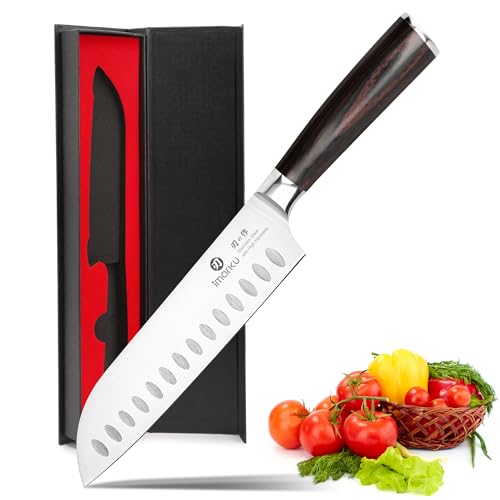
A 7-inch santoku with a hollow edge is the pick for a cook who spends most of a shift on vegetables and does not need the rocker of an 8-inch chef.
Best for: line cooks doing high-volume vegetable prep on a santoku profile Skip it if: you need the extra inch and rocker of an 8-inch chef
The imarku is the only non-8-inch pick here, and the only santoku. That matters because a santoku is a different tool. Shorter blade (7"), flatter profile, and imarku's version has a scalloped hollow edge that the listing says keeps slices from sticking to the blade. If your prep list is onions, carrots, mushrooms, potatoes and squash in that order, a santoku is faster than a chef knife. If you break down proteins on the same board, you will miss the length.
The blade is described as Japanese high carbon stainless, weighs 6.88 oz on a 7-inch length (so it sits denser per inch than the PAUDIN), and the Pakkawood handle is imarku's standard. This is the fastest seller in this set by category rank, which is the santoku market rather than chef knives directly.
The trade-off against the two 8-inch premium options: you're giving up an inch of blade and the rocking cut that goes with it, and you're gaining a flatter profile that suits push cuts. That is a real preference, not a compromise, but it is not the default 8-inch chef shape a professional kit assumes.
Pros:
- Denser mass per inch than the 8-inch picks (6.88 oz on 7")
- Hollow edge helps release wet food
- Pakkawood handle stated as ergonomic
- Japanese high carbon stainless on the listing
- Sells faster than the rest of this set
Cons:
- 7-inch length is short for protein breakdown
- No published bevel angle
- Santoku shape does not rock; some cooks dislike push-cut motion
4. Amazon Basics Classic 8-inch Chef's Knife — Best minimal setup
Full-tang, three-rivet 8-inch stainless at the second-cheapest price in the set, which is the honest starter answer.

Best for: a stager or new cook building a first kit on a tight budget Skip it if: you want a published warranty or a wood-scale handle
At 0.51 lb this is the lightest pick in the shortlist by a clear margin, and it is the second-cheapest. The listing describes forged high carbon stainless steel construction with a full tang, three rivets and a semi-bolster. Amazon Basics says the satin finish is stain, rust and pit resistant. Those are the specifications a first knife should have. The semi-bolster claim matters because it lets you sharpen the full length of the blade, which many bolstered chef knives block.
Amazon Basics does not name the alloy, and there is no warranty on the listing. What you're buying is a competent, light, full-tang 8-inch chef with the features a working knife needs and nothing more. For a cook who wants a backup, or someone assembling a first kit before deciding what steel and weight suits them, that's the right specification list at this price position.
The trade-off against the PAUDIN one tier up: no warranty, a lighter blade that some cooks will find twitchy on denser prep, and a synthetic handle rather than wood.
Pros:
- Full tang with three rivets, stated on the listing
- Semi-bolster allows full-edge sharpening
- Lightest pick in the set at 0.51 lb
- Second-cheapest here
Cons:
- No stated warranty
- Steel alloy not named
- Synthetic handle instead of wood scales
5. Cuisinart Graphix 8-inch Chef's Knife — Best budget pick
The cheapest of the five, an 8-inch stainless blade with a blade guard included and not much else on the listing.

Best for: a backup blade or a knife you can leave at a rental kitchen Skip it if: this will be your only knife for six shifts a week
Cuisinart's Graphix chef knife is the cheapest of the five and the sparsest on published specifications. The listing states an 8-inch stainless steel blade, a 0.62 lb weight, and a bonus blade cover. That is the whole specification sheet. Cuisinart does not describe the steel beyond "stainless", does not state a tang construction, does not name a handle material, and does not publish a warranty. It sells slowest of the five in this set.
For a working cook, this is a knife with a specific job: something you can throw in a knife roll for a stage, leave at an Airbnb kitchen on holiday, or hand to a prep cook who forgot theirs. The included blade guard makes it safer to transport than the naked blades above it. As a daily driver on your own line, it does not publish enough about itself for me to recommend it in that role.
The trade-off against the Amazon Basics one tier up: you save a little more, and you give up the stated full-tang, three-rivet construction and the semi-bolster that make the Basics a more serious knife.
Pros:
- Cheapest pick in the set
- 8-inch stainless blade
- Includes a blade guard for transport
- 0.62 lb, in the working weight range
Cons:
- Steel not described beyond "stainless"
- No tang or handle detail on the listing
- No stated warranty
- Slowest seller of the five
Does the 'professional chef' label on a listing mean anything?
Four of these five listings use the word professional in their headline or bullets. That word is not a specification, and it is not audited. Any manufacturer can put it on a listing.
What actually distinguishes a knife that suits professional work is a shorter list:
- A named steel alloy, ideally with a hardness figure.
- Full-tang construction, stated plainly.
- A comfortable handle for a long shift, in a material you can maintain.
- A blade profile that matches your prep pattern.
- Balance you can feel in a pinch grip.
Only one listing here (HOSHANHO) publishes a specific alloy code and a bevel angle. Only one (Amazon Basics) states full tang, three rivets and a semi-bolster in plain language. The other three describe their knives in adjectives. That doesn't mean those three are bad knives. It means the listing is not the place their case is made, and you are buying the brand's reputation rather than the specifications.
For a working cook shopping online, read the specifications section, not the bullets. If a listing sells you the word "professional" but won't tell you the steel, treat that gap as the answer.
8-inch chef versus 7-inch santoku: which shape wins?
Four of these picks are 8-inch chef knives. One (imarku) is a 7-inch santoku. That is the deepest split in this shortlist and it deserves its own answer.
An 8-inch chef knife is the default for a reason. The curved belly lets you rock through onions, shallots and herbs; the tip is fine enough for a shallot dice; and 8 inches is long enough to portion a chicken breast in one pass. A working line cook is expected to own one.
A 7-inch santoku is a specialist. The flatter profile is faster on push cuts, the shorter length is nimble in tight prep, and imarku's hollow edge helps release wet foods. A cook who spends most of a shift on vegetables often prefers it.
The cutoff is your prep pattern. If proteins and rocking cuts are more than a third of what you do, the 8-inch chef wins and the PAUDIN or HOSHANHO is the pick. If your board is 80% vegetables and you push more than you rock, the imarku santoku wins. There is no shape that is better in the abstract.
Handle, tang and balance: reading a listing properly
Handle and tang decide how a knife feels in the fourth hour of prep, and both are cheap for a manufacturer to fudge on a listing.
- Full tang means the steel of the blade runs the length of the handle. It's what you want. Amazon Basics states it explicitly ("Forged stainless steel construction with a full tang"). PAUDIN describes the handle as integrated with the blade, which reads like a full tang but doesn't use the word. HOSHANHO and imarku describe wood-scale handles without stating the tang. Cuisinart says nothing.
- Rivets hold the scales to the tang. Three is standard for an 8-inch chef. Amazon Basics states three rivets.
- Handle material decides comfort and maintenance. Wood and Pakkawood are warm in the hand and need occasional oiling. Composites survive abuse but feel colder.
- Bolster is the thick metal band between blade and handle. A semi-bolster (Amazon Basics) lets you sharpen the full edge. A full bolster blocks the heel.
None of this is exotic knowledge. It is the information the listing is required to give you, and when a listing skips it, that is the answer to your question about the knife.
Care, sharpening and the real cost of owning one
A stainless chef knife is not a fixed cost. It is the blade plus the honing rod plus the stones or the pull-through, plus the time it takes you to keep the edge.
The rough breakdown for any of these picks:
- Hone before or after each shift on a ceramic or steel rod.
- Sharpen every few weeks on a whetstone, or every couple of months on a pull-through if you'd rather.
- Hand-wash and dry immediately. No dishwasher, not once.
- Oil a wood handle occasionally with mineral oil.
Harder Japanese steels (HOSHANHO, imarku) hold an edge longer between sharpenings but need a finer stone to bring back once dulled. Softer stainless steels (PAUDIN, Amazon Basics, Cuisinart) come back faster on a basic stone but need more frequent attention. Neither is better; they suit different maintenance habits.
Most shoppers miss this and buy the sharpest edge they can find, then let it dull because they don't own a stone. A working knife needs a working sharpening habit behind it. Buy the stone first if you don't already own one.
The verdict
For a working cook who wants one stainless chef knife off this shortlist, the PAUDIN N1 is the pick. It is the only 8-inch blade here that pairs a mid-weight of 6.88 oz with a stated 24-month warranty, at a mid-range price. It is not the sharpest listing in the set and it does not name its steel alloy, but for a general-purpose kitchen knife that will do everything an 8-inch chef is supposed to do, that specification balance is the right answer.
If your prep is heavy and dense and you want a harder edge that stays sharp longer, the HOSHANHO is the alternate. It names its steel (10Cr15CoMoV), publishes a 13-degree bevel per side (as a claim), and at 0.77 lb it has the mass to push through winter vegetables. It is the most expensive pick here and the sales rank is slower than PAUDIN's, so treat it as the answer for a specific need rather than the default. The cutoff between them is simple: if you sharpen your own knives on a stone and want a finer edge, HOSHANHO; if you want one knife that does everything and comes with a warranty, PAUDIN.
FAQ
Is a stainless steel chef knife good enough for professional kitchens?
A stainless steel chef knife is good enough for professional kitchens, and the alloy matters more than the label. A named Japanese high carbon stainless like the 10Cr15CoMoV HOSHANHO cites holds an edge longer than an unnamed stainless. Every pick in this shortlist is high carbon stainless of some form. The steel line on the listing is where you separate a working blade from a decoration.
What size chef knife do professional chefs use?
The size chef knife professional chefs use most often is 8 inches, which is why four of the five picks here are that length. An 8-inch blade rocks through onions and portions a chicken breast in one pass. A 7-inch santoku like the imarku is faster on vegetable-heavy prep but shorter for proteins. Length is a preference, not a rule, and both belong in a serious kit.
Is the HOSHANHO worth the premium over the PAUDIN?
Whether the HOSHANHO is worth the premium depends on how you sharpen. The HOSHANHO names its steel (10Cr15CoMoV Japanese high carbon) and its bevel angle (13 degrees per side, claim), which suggests a harder edge that stays sharper longer. The PAUDIN does not publish either figure but carries a 24-month warranty and a lighter 6.88 oz weight. If you own a whetstone, the HOSHANHO earns the premium. If you don't, the PAUDIN is smarter.
PAUDIN N1 versus Amazon Basics: which is the better daily driver?
PAUDIN N1 versus Amazon Basics comes down to warranty and handle. Both are 8-inch high carbon stainless chef knives; the Basics is lighter (0.51 lb versus 6.88 oz on the PAUDIN) and states full tang with three rivets and a semi-bolster. The PAUDIN has a wood handle and a 24-month warranty. For a starter blade, the Basics is honest. For a daily driver you want to keep for years, PAUDIN.
What is the biggest mistake buying a chef knife online?
The biggest mistake buying a chef knife online is trusting the word "professional" in the listing headline instead of reading the specifications. Four of these five listings use it. Only one names its steel alloy. Only one states a full tang in plain language. Only one publishes a warranty. Ignore the adjectives and read the specifications block. If the listing won't tell you the steel and the tang, that is the answer.
If you're outfitting a working kitchen, start with the PAUDIN N1 as your default 8-inch chef and add the imarku santoku later if your prep leans hard on vegetables. That two-knife pair covers the shapes a line uses most, at a total spend well below a single premium gyuto. The reason PAUDIN wins here isn't that it's the fanciest blade in the set; it's that it's the only one that publishes both a working weight and a warranty on the same listing. When you're choosing a stainless steel chef knife for a job you cook every day, published information beats marketing every time.