Best Knife Sharpeners by Grit, Stages and Warranty

A comparative buying guide to six knife sharpeners, ranked by stages, grit, warranty and footprint, with a named winner and the conditions that flip the pick.

By Elin RoweUpdated 16 min read
On this page
- Best knife sharpener for home cooks at a glance
- How I narrowed six sharpeners from a crowded shelf
- What actually decides a knife sharpener, and what doesn't
- 1. Stonetiger 4-in-1 Electric Knife Sharpener — Best overall
- 2. SHARPAL 191H Knife Scissors Sharpener — Best warranty
- 3. Narcissus Knife Sharpener — Best for families
- 4. Sharp Pebble Whetstone Knife Sharpener — Most versatile
- 5. Astercook Knife Set for Kitchen with Block and Sharpener — Best upgrade
- 6. KITCHELLENCE 3-Stage Sharpener — Best budget pick
- Electric, pull-through or whetstone: which suits you?
- How often should a home cook actually sharpen?
- What the listings quietly leave out
- The verdict
- FAQ
The best knife sharpener for home cooks is the Stonetiger 4-in-1 Electric Knife Sharpener, a 3.4 x 9.6 x 3.6 in countertop unit built around a claimed 6500 RPM motor and a three-stage crude, fine, polish sequence that the listing puts at 20 seconds per blade. If you'd rather have a small manual tool with a stated three-year warranty, the SHARPAL 191H is the safer buy at 3.04 oz and a 2.76 in footprint. Most sharpeners here promise speed. The one that wins is the one that also stays out of your way.
Best knife sharpener for home cooks at a glance
| Pick | Type & stages | Key spec | Price |
|---|---|---|---|
Best overall Stonetiger 4-in-1 Electric Knife Sharpener |
Electric, 3-stage | 20s sharpen claim 6500 RPM claim |
Check Price |
Best warranty SHARPAL 191H Knife Scissors Sharpener |
Manual, 3-stage | 3-year warranty 3.04 oz |
Check Price |
Best for families Narcissus Knife Sharpener |
Electric, 2-stage | 30W motor claim Scissors slot |
Check Price |
Most versatile Sharp Pebble Whetstone |
Whetstone | 1000/6000 grit 2.1 lb |
Check Price |
Best upgrade Astercook 15-Piece Knife Set |
Built-in block sharpener | 15 pieces 7.28 lb |
Check Price |
Best budget pick KITCHELLENCE 3-Stage Sharpener |
Manual, 3-stage | 6.35 oz Cut-resistant glove |
Check Price |


How I narrowed six sharpeners from a crowded shelf
I started with a wider pool inside the knife sharpener category, then cut on three grounds. First, anything with no useful published spec: no dimensions, no weight, no stated stages or grit. If a listing won't tell you what's in the box, it can't be compared on paper. Second, anything that duplicated a survivor without adding something distinct. Two near-identical pull-throughs is one pull-through. Third, anything whose category was wrong for the job.
That left three electric units, one whetstone, one manual pull-through, and one hybrid where the sharpener lives in a knife block. Six picks, three formats, three price positions in the set: entry, mid, premium. That spread matters, because the right knife sharpener for home cooks is not the same tool for every kitchen. Someone who cooks four nights a week needs a different answer to someone who bakes on Sundays and orders in the rest of the time.
A few notes on what did not survive:
- Listings that named a grit but not a size.
- Sharpeners aimed squarely at outdoor and hunting blades.
- Units whose only sharpening claim came from a single feature bullet with no supporting specification.
- Anything above a premium price position that didn't publish more spec than the mid tier.
Two things I could not check on paper: how the tool actually feels in the hand, and how the edge holds up after a week of dinners. Those are honest gaps. Everything below reasons from what the listings publish.
What actually decides a knife sharpener, and what doesn't
Most guides to the best knife sharpener for home cooks lead with speed. Speed is the wrong answer. A pull-through in a drawer will always beat an electric on the counter for time-to-first-cut, because setup is the tax you actually pay. What decides it is honestly this: how much control you want over the angle, and how varied your knives are.
Three practical thresholds:
- If every knife you own has a Western bevel around 20 degrees, an electric or pull-through with a fixed guide is fine. That covers most home kitchens.
- If you own one Japanese-style knife you care about, a whetstone is the safer choice. Fixed-angle sharpeners set for Western knives will regrind a shallower bevel every time you use them.
- If you sharpen more than knives, look for a scissors slot. Two of the picks below have one; the others don't.
What doesn't decide it: motor wattage on its own, the number of stages on the label, or a claim of "professional results". A three-stage manual and a three-stage electric are not the same tool doing the same job. The stages describe what the abrasives try to do; the format describes how much of the work you do yourself.
1. Stonetiger 4-in-1 Electric Knife Sharpener — Best overall
The Stonetiger wins on published sharpening spec and a footprint that still fits behind a kettle.
Best for: a home cook who wants a fast, hands-off sharpen on a mixed drawer of knives Skip it if: you own single-bevel Japanese knives or want a fixed sharpening angle you control
Within this set, the Stonetiger is the only pick that publishes both a stage count and a target time: three stages for crude, fine and polish, and a 20-second sharpen claim from the manufacturer. Its 3.4 x 9.6 x 3.6 in body sits longer than the SHARPAL and shorter than the Narcissus, so it takes a strip of counter rather than a whole corner. Stonetiger says the motor spins at 6500 RPM and that a spring-loaded guide sets the angle for you, which matters because angle drift is what turns a decent sharpen into a bad one on a manual. There is a magnetic dust box built into the housing to catch filings, which the listing calls out as a safety detail.
Two honest trade-offs. It sits in the most expensive position of the six picks here, and it moves the slowest of the survivors on published sales rank in the category, so it's a newer face than the older manuals. If those don't put you off, it is the one I'd start with for a busy home kitchen.
Pros:
- Three-stage crude, fine and polish sequence
- 20-second sharpen claim from the manufacturer
- Spring-loaded angle guide, per the listing
- Magnetic dust box for metal filings
- Compact 3.4 x 9.6 in footprint on the counter
Cons:
- The most expensive pick in this set
- Fixed guide angle unsuited to single-bevel Japanese knives
- Sells more slowly than the older manuals here
2. SHARPAL 191H Knife Scissors Sharpener — Best warranty
The only pick in the set with a stated warranty, and a body small enough to leave on the counter without noticing.

Best for: a cautious buyer who wants three years of cover on a small countertop tool Skip it if: you sharpen a lot of knives in one session and want an electric motor doing the work
Of the six picks, the SHARPAL 191H is the only one that publishes a warranty: three years for non-commercial use, per the listing, from date of purchase. That is worth putting first, because five of the six sharpeners here say nothing at all about cover. It's also the lightest and smallest thing on the list at 3.04 oz and 2.76 x 2.76 x 2.36 in, which is smaller than a stack of coffee coasters. SHARPAL calls the abrasive setup a three-stage tool with tungsten carbide for edge setting, ceramic for honing, and a dedicated carbide slot for scissors.
The trick with a manual this small is stability, so the listing leans on a suction base and describes the hold as twice as strong as similar tools. That's a manufacturer claim, not a measurement, but it is at least a specific one. The trade-off is that everything else on offer here has more mass to it: this is a lightweight tool for occasional touch-ups, not a workhorse for a full block once a month. If you want the electric option in a small kitchen, look at the Stonetiger instead.
Pros:
- Stated three-year non-commercial warranty
- Smallest and lightest pick in the set at 3.04 oz
- Three-stage carbide, ceramic and scissors slots
- Suction base described as twice as strong
- Sells briskly in its category
Cons:
- Manual effort, so slower for a full drawer
- Compact body means less stability than a heavier unit
- Not suited to Japanese-style single-bevel knives
3. Narcissus Knife Sharpener — Best for families
A two-stage electric with a scissors slot, sized for a household drawer with more than just chef's knives in it.
Best for: a household that shares kitchen shears and a mixed set of chef and paring knives Skip it if: your knives are Japanese-style with a shallower bevel than a Western chef's knife
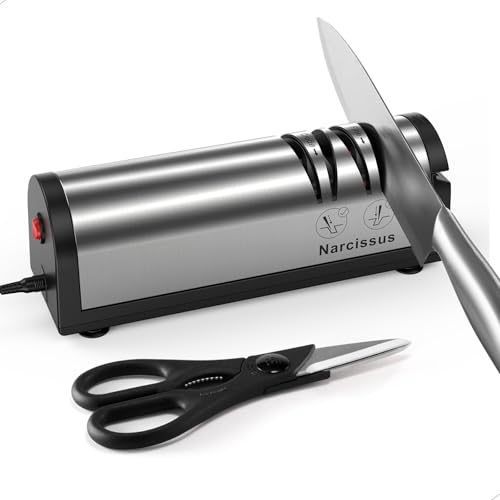
The Narcissus sits at mid range for this set and weighs 1.63 lb across a 7.1 x 8.6 x 2.6 in body, which puts it heavier than the Stonetiger and much heavier than either manual. That mass is the point of an electric on a counter: it doesn't skate. Narcissus calls the design two-stage rather than three, aimed at crude and fine, and adds a scissors slot on the side surface. For a family kitchen where the same drawer holds shears for herbs, poultry scissors, and a couple of paring knives, that second slot earns its space.
The listing describes a 30-watt DC motor and says it can run continuously for over an hour, which is more spec than any of the other electrics here publish. In practice, no home cook needs an hour of sharpening in one sitting, but the number tells you the motor isn't sized for a 20-second burst and then a rest. What you give up is the polish stage that the Stonetiger includes: two stages will restore a working edge but won't put a mirror on it. If polish matters, use the whetstone below for finishing.
Pros:
- Two-stage design for crude and fine sharpening
- Dedicated scissors slot on the side
- 30W motor claim with continuous running spec
- 1.63 lb body sits stable on a counter
- Mid range price position in this set
Cons:
- No polish stage, unlike the Stonetiger
- Larger footprint than the manuals here
- Fixed angle guide unsuited to Japanese blades
4. Sharp Pebble Whetstone Knife Sharpener — Most versatile
A dual-grit stone that hands you full angle control, and the only pick here that will work on any bevel you throw at it.

Best for: a patient cook willing to learn a whetstone in return for full angle control Skip it if: you want to be done in under a minute with no setup or cleanup
The Sharp Pebble is the versatile pick because it is not locked to a Western bevel. Every other sharpener in this set has a fixed angle guide, and every one of those guides is set for a Western chef's knife. A whetstone doesn't care: you set the angle. That is why a single stone can maintain a mixed drawer of European and Japanese blades where no pull-through can. The dual-grit setup runs 1000 for repair and 6000 for polish, and the kit ships with a bamboo base, an angle guide and an instruction manual per the listing.
The stone is 1 x 7.25 x 2.25 in and weighs 2.1 lb, so it sits flat and stays put once wetted. The listing calls it water-based, which is the low-mess option: no honing oil. Two honest downsides. The learning curve is real; the first few sharpens will not match what an electric does in 20 seconds, and the first stroke of a knife across an uneven angle can round an edge you were trying to save. And the format asks for a sink, a towel and a few minutes each time. If those aren't obstacles, this is the most useful tool on the list a decade from now.
Pros:
- Dual 1000 and 6000 grit for repair and polish
- Full user control over sharpening angle
- Kit includes bamboo base and angle guide
- Water-based, no honing oil required
- Handles Western and Japanese bevels alike
Cons:
- Steep learning curve compared to a pull-through
- Requires water, a towel and workspace each use
- Slower per knife than any electric in this set
5. Astercook Knife Set for Kitchen with Block and Sharpener — Best upgrade
A 15-piece set where the sharpener lives in the block, aimed at a cook starting a kitchen from scratch.

Best for: a cook starting from scratch who wants knives, block and sharpener in one buy Skip it if: you already own knives you like and only need a sharpener
The Astercook is the outlier in this comparison, and it earns a place because a real home-cook question is "should I just replace the whole set?" It's a 15-piece kit with a chef, slicer, santoku, bread, utility and paring knife, six 4.5 in steak knives, a block, kitchen shears and a built-in sharpener in the block. The listing describes 1.4116 high-carbon German stainless steel with a black non-stick coating, and the block is 8.5 x 7 x 4.5 in on the counter. At 7.28 lb, it is the heaviest pick here by some way, which is the price of a full block.
The built-in sharpener is the reason it belongs in this guide. Astercook describes it as one-handed operation as the knife draws through a slot in the block. That's convenient in exactly the way a dedicated tool isn't: it lives with the knives, so it gets used. The trade-off is that a block sharpener is fixed to the geometry the knives shipped with; it will maintain these blades, not necessarily a knife from another brand with a different edge angle. This is the upgrade pick, not the sharpener pick. Buy it if you're rebuilding a drawer.
Pros:
- Full 15-piece kit including six steak knives
- Built-in one-handed sharpener in the block
- German 1.4116 stainless steel per the listing
- Sells fast in the block-set category
- Sole pick with more than one seller
Cons:
- Only right if you actually want new knives
- Heaviest and bulkiest pick in this set at 7.28 lb
- Built-in sharpener is tuned to these blades
6. KITCHELLENCE 3-Stage Sharpener — Best budget pick
The cheapest pick here, a three-slot manual that ships with a cut-resistant glove.
Best for: a first apartment kitchen where a manual pull-through is all the drawer needs Skip it if: you sharpen weekly and want a tool that will stay sharp for years of heavy use
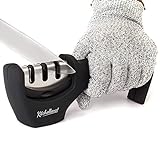
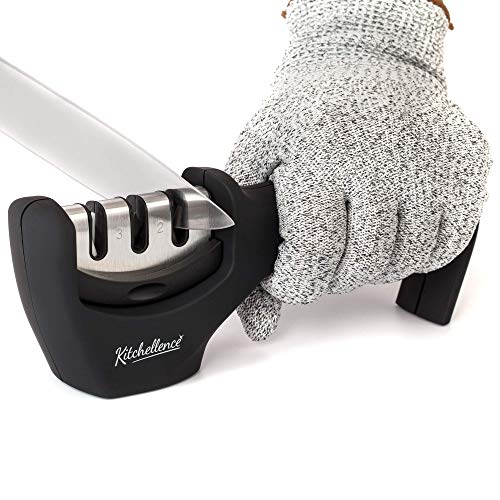
The KITCHELLENCE is the cheapest of the six and the one buyers choose most often in this set. It is a manual pull-through with a three-slot system aimed at repair, restore and polish, and it weighs 6.35 oz across a 3.4 x 8.3 x 2.2 in body, so it will sit in a drawer between uses without complaint. The listing calls out an ergonomic handle for right or left-handed use and includes a cut-resistant glove, which is a genuinely useful addition for a first-time sharpener. Kitchellence describes the body as solid ABS plastic.
Where this pick belongs is a small kitchen where sharpening is a monthly job, not a weekly one. It doesn't publish a warranty like the SHARPAL, and it doesn't have the mass or motor of the electrics. What it does have is the shortest step from drawer to counter to sharp knife, at the lowest price position in the set. The honest weakness is durability: a manual pull-through's tungsten carbide inserts wear over time, and there is no stated warranty here to fall back on if they wear early. Treat it as a good starter tool rather than a lifetime buy.
Pros:
- Lowest price position in this set
- Three-slot repair, restore and polish design
- Cut-resistant glove included
- Ambidextrous handle per the listing
- Sells briskly in the category
Cons:
- No stated warranty, unlike the SHARPAL
- Plastic body less durable than metal-housed picks
- Fixed angle unsuited to Japanese blades
Electric, pull-through or whetstone: which suits you?
The three formats in this set do different jobs, and picking the right format matters more than picking the right brand. A short breakdown:
- Electric, three of the picks: fastest per knife, largest footprint, most expensive positions in the set. Best when you own five or more knives and sharpen the whole drawer in one sitting. The Stonetiger and the Narcissus sit here.
- Manual pull-through, two of the picks: cheapest, smallest, slowest per knife. Best when you own two or three knives and touch them up as needed. The KITCHELLENCE and the SHARPAL sit here.
- Whetstone, one pick: most control, longest learning curve, most versatile across bevel angles. Best when you own a knife you care about, especially a Japanese one. The Sharp Pebble sits here.
The block-with-sharpener from Astercook is a different question again: a whole-drawer replacement rather than a sharpener buy. Only right if you were going to buy knives anyway.
A rule of thumb from the specs. If your sharpener needs to weigh under a pound and hide in a drawer, it's a manual. If it weighs over a pound and lives on the counter, it's an electric. If it needs water, it's a whetstone.
How often should a home cook actually sharpen?
How often you sharpen depends on how much you cook, what you cut, and what surface you cut on. A working home kitchen that sees four dinners a week wants a real sharpen every one to three months, with quick honing in between. A kitchen that plates two dinners a week can stretch to twice a year. A knife that hits a glass cutting board once loses more edge than a month of tomatoes.
Two signs a knife needs sharpening now, not later:
- It slides off the skin of a ripe tomato instead of biting in.
- It crushes rather than slices soft herbs, leaving a dark bruise line.
The 20-second claim on the Stonetiger and the "quick and simple" language on the Narcissus are both about the sharpening step, not the whole job. Add a minute either side for setup and wipedown and you have the real cost. A manual is faster start-to-finish for one knife, an electric is faster for four or more.
What the listings quietly leave out
Five of the six picks here publish no warranty. That is worth stating clearly, because "3 years" on the SHARPAL listing is not a small detail: it's the only pick you can go back on if something fails inside the cover window. Every other product here trusts the return policy of the retailer instead.
A few other gaps to plan around:
- None of the electric picks publish a decibel figure, so you can't compare motor noise on paper.
- None of the manuals publish an angle in degrees, only a "guide" claim.
- Feature bullets like "professional results" and "razor-sharp" are marketing lines, not measurements. Weight them accordingly.
- The keyword "home cooks" is aimed at everyday kitchens, but only two of these listings explicitly speak to that use case in their titles. Read the product description for how it will actually sit in your kitchen.
The best knife sharpener for home cooks is the one you'll actually reach for on a Wednesday. A tool that publishes its spec makes that easier to judge.
The verdict
The Stonetiger 4-in-1 Electric Knife Sharpener is the best knife sharpener for home cooks when you weigh what the listings actually publish: three stages, a 20-second sharpen claim, a 6500 RPM motor claim, and a footprint that fits on a working counter. It is the most complete package in the set on paper, and the format matches how most home kitchens sharpen: a full drawer in one session, once every few weeks.
Two clear conditions flip the pick. If a stated warranty is what you're buying for, the SHARPAL 191H is the one to pick here, because it is the only sharpener in this set with cover published on the listing. If you own even one Japanese-style knife you care about, skip every fixed-angle sharpener here and start with the Sharp Pebble whetstone, whose 1000/6000 grit and free angle work with any bevel.
The Narcissus is the runner-up for the everyday electric slot: its scissors slot and continuous-running motor claim make it the family kitchen pick. Its exact advantage over the Stonetiger is the extra function, not the sharpening; if you sharpen scissors too, buy it instead.
FAQ
Is a knife sharpener for home cooks worth it over sending knives out?
A knife sharpener for home cooks pays back in convenience more than money. Sending knives out means a trip and a wait; a countertop unit means a sharp edge before dinner. The Sharp Pebble listing describes a whetstone kit as maintaining an entire knife collection indefinitely, which frames the trade honestly: a small tool at home replaces a recurring errand.
Which is the best knife sharpener for home cooks who own Japanese knives?
The best knife sharpener for home cooks with Japanese knives is the Sharp Pebble whetstone. Every other pick here has a fixed angle guide set for Western bevels around 20 degrees, and running a shallower Japanese edge through a Western guide will regrind the bevel each time. The 1000/6000 grit combo repairs and polishes, and you set the angle yourself.
How does the Stonetiger compare with the Narcissus for daily use?
The Stonetiger compares favourably with the Narcissus on stages: three stages for crude, fine and polish versus two for crude and fine. The Narcissus adds a scissors slot the Stonetiger doesn't publish. If polish matters, the Stonetiger wins. If you sharpen kitchen shears alongside knives, the Narcissus is the better everyday pick for a family drawer.
Do manual pull-through sharpeners damage knives?
Manual pull-through sharpeners can damage knives if you press too hard or use them on a bevel they weren't built for. Both manuals here, the KITCHELLENCE and the SHARPAL 191H, describe fixed-angle guides aimed at Western kitchen knives. Used on those blades with light pressure, they will restore an edge safely. Used on single-bevel Japanese knives, they will not.
What's the biggest mistake home cooks make when buying a sharpener?
The biggest mistake home cooks make is buying on speed instead of format. A 20-second sharpen claim is only useful if the format matches your knives and your kitchen. A whetstone owner sharpens more slowly and better; an electric owner sharpens faster and more often. Match the tool to the drawer, not the drawer to the tool's advertised speed.
If you want a starting point, the Stonetiger 4-in-1 is the everyday pick, with the SHARPAL 191H as the small-kitchen alternative and the Sharp Pebble whetstone as the answer for anyone with a Japanese knife in the mix. The right buy isn't the flashiest one; it's the one you'll reach for without thinking about it. Match the format to your drawer first, then let the published specs decide between the two or three that fit, and you'll end up with a sharper knife on a Wednesday night for years to come.